
Some of the places I have most enjoyed visiting over the past few months have been the remote little hill towns which can only be reached by taking a minivan through a series of snake-like roads that take you round and round as you slowly ascend up the mountains. I’m not staying I enjoy getting there – that’s the part where I close my eyes, hold on to the front seat, and pray while the bus driver plays chicken with other vehicles, seemingly oblivious to the cliff on the lefthand side – however, once that is over and I am back on solid ground, these destinations are exactly my kind of place.
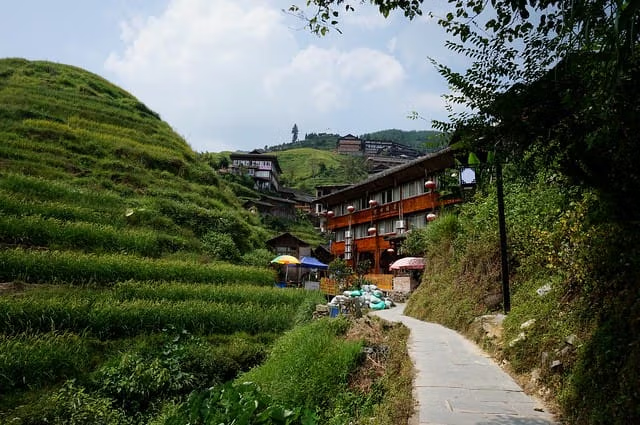
Remote Hillside Town
Like with many of the hillside towns I had previously visited (the Cameron Highlands and Sapa come to mind), getting to Longji wasn’t easy. Overturned trucks could sporadically be spotted on the side of the road and there were a few occasions where we nearly ran a pedestrian or two over. However, in spite of this, our tour guide insisted that we had nothing to worry about, “Your driver is master – 25 years driving experience!” Sure he is…
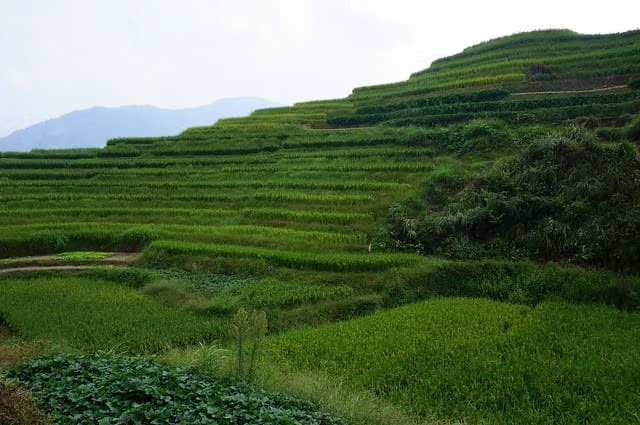
Well, we did make it to Longji in the end albeit I don’t have the photos of sweeping rice terraces to prove it. You see, by the time we finished visiting the Huangluo Yao Village (which is home to the women with the longest hair in the world!) it was high noon and the sun was scorching! Sam and I made it about halfway up the ‘dragon’s back’ (aka Longji) before we admitted defeat and settled for exploring the town which was at the halfway mark.
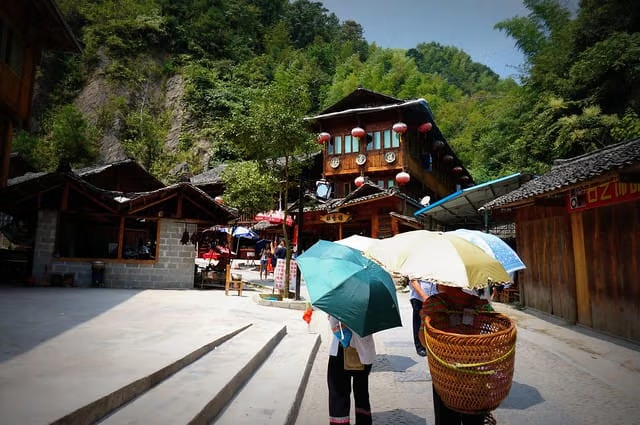
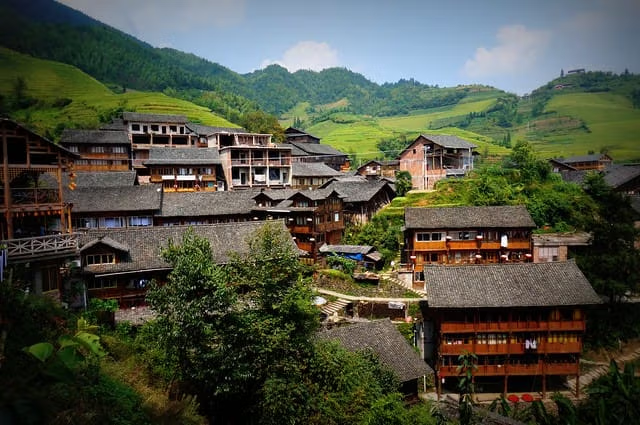
So today instead of rice fields, you get to see the little town of Ping’An.
Practical Guide: When to Go, Where to Hike and What to Know Before You Arrive
If your planning is better than mine — and given the noon-heat admission-of-defeat story above, that’s not a high bar — here’s everything you need to time your visit right, pick a hiking route that suits you, and actually reach those terraces in all their glory.
Six Centuries of Carving a Mountain by Hand
What looks like a single sweeping landscape is really thousands of individual decisions, repeated for six hundred years. Farmers began cutting the first terraces into these slopes during the Yuan Dynasty, working the mountainside upward field by field, and the project wasn’t considered finished until the early Qing Dynasty — a construction timeline that outlasted several imperial houses. There was no blueprint. Each new tier followed whatever contour the hillside offered, which is why the Longji terraces curve and double back on themselves instead of running in straight lines like the rice paddies of the lowlands.
That patchwork of individual labor eventually added up to something recognized well beyond Guangxi. In 2018, the United Nations’ Food and Agriculture Organization named the Longji system a Globally Important Agricultural Heritage site, citing the terraces as a working example of centuries-old land management rather than a museum piece. Four years later, Dazhai — the village on the far side of the ridge from Ping’An — was named one of the World Tourism Organization’s Best Tourism Villages, largely because locals turned their contracted land into a shared tourism company instead of selling out to outside developers. The terraces you’re looking at from your guesthouse balcony are still owned, worked, and maintained by the same families whose ancestors carved them.
When to Go
Longji’s terraces change dramatically with each season, so timing genuinely matters.
| Month | Landscape | Pros | Cons |
|---|---|---|---|
| Late Apr – Mid-May | Silver mirrors — paddies just flooded | Fewer crowds; dramatic reflections at sunrise | Trails muddy; leeches in forest sections |
| Mid-May – June | Neon chartreuse seedlings | Rice-planting festivals, drumming and folk dances | Humid; afternoon thunderstorms |
| July – Aug | Deep-emerald “dragon scales” | Cool nights in the hills (~20°C) | Peak domestic tourism — room rates jump |
| Sep – Oct | Liquid gold harvest | Warm light perfect for photos; farmers drying grains in lanes | Pre-book buses and inns at least a month out around Golden Week |
| Nov | Rust-red sheaves and morning mist | Crisp air; hotpot tastes better | Terrace irrigation drained; some trails closed |
| Dec – Feb | Frosted terraces (occasional snow) | Ethereal and quiet | Limited buses; chilly rooms; few cafés open |
Hiking Routes: Three Options
| Route | Distance / Time | Who It Suits | Highlight |
|---|---|---|---|
| Ping’An → Nine Dragons & Five Tigers → Seven Stars With Moon → Ping’An loop | 7 km / 3 h easy | Photographers hunting sunrise angles | Sweeping S-curves of terraces beneath you |
| Ping’An → Longji Ancient Zhuang Village | 6 km / 2 h downhill, bus back | Culture seekers | 300-year wooden drum towers and bamboo-smoked bacon lunch |
| Dazhai → Jinkeng Great View Terrace → West Hill Music → Tiantouzhai | 16 km / 6 h moderate | Hikers wanting fewer tourists | Cable-car descent over the terraced amphitheatre |
Download an offline map such as Gaia GPS before arrival — cell signal disappears between ridges.
Getting There
- Guilin → Longsheng: Hourly buses (07:00–19:00) from Guilin Qintan Bus Station. Around 35 RMB, 1 hour 45 minutes.
- Longsheng → Ping’An: Minivans park opposite the bus station and wait until 6–7 seats are filled. Around 15 RMB, 50 minutes along the switchback mountain road.
- Gate to trailhead: You’ll be dropped at the scenic-area gate; pay the entrance fee, then take the shuttle another 20 minutes up to the trailhead.
Motion sickness is real on these roads — as the story at the top of this article confirms. Sit front-left, focus on the terrace horizons rather than the road, and peppermint oil or travel tablets help considerably.
If you’d rather skip the bus transfers altogether, several tour operators run the route directly from Guilin. The Longji Rice Terraces and Minority Village Day Tour is a budget-friendly small-group option that pairs Huangluo Yao Village with a guided walk through Ping’An — solid for solo travelers or couples who don’t mind sharing a coach. For more flexibility, the Longji Rice Terraces: Full-Day Private Tour from Guilin puts a private English-speaking guide and driver at your disposal for the whole day, which suits families or anyone who wants to set their own pace between viewpoints. And if steep stone steps aren’t your idea of a holiday, the Longji Rice Terraces with the Dazhai Cable Car Private Day Tour swaps most of the climbing for a cable car ride up to Golden Buddha Peak on the Dazhai side — a good match for older travelers or anyone visiting with limited mobility.
The Terraces’ Real Engineering Secret
Every terrace here sits above sea level by as much as 880 meters, which raises an obvious question: how does water reach paddies that far up a mountain without a single pump? The answer is a system locals call “forest above, fields below.” Dense forest is deliberately preserved on the upper slopes and ridgelines, acting as a natural reservoir that holds rainfall and releases it slowly through underground springs and streams. From there, gravity does the rest — water is channeled through a network of earthen ditches, stone-lined canals and, in places, split bamboo pipes, dropping from the highest paddy to the lowest in a controlled cascade.
It’s a quietly brilliant piece of design: the same channels that irrigate the crop also slow the water down enough to stop it stripping the topsoil off a slope this steep, which is the main reason terraces this old are still farmable at all. Next time you cross one of the narrow stone bridges on the trail, look for the small notch cut into the wall beside it — that’s a spillway, and it’s doing more engineering work than it looks like.
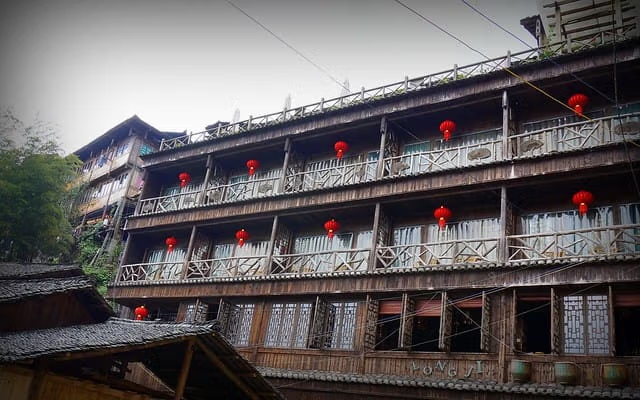
Where to Stay
Accommodation in the scenic area is almost exclusively wooden stilt-house guesthouses, and the options span from backpacker dorms to design-forward lodges depending on which side of the mountain — and which budget — you’re working with.
In Ping’An itself, the standout property is Li-An Lodge — 16 individually designed rooms created by Keren Su, a renowned Chinese photographer and artist who first discovered the area on a photography trip and built the lodge without a single nail, using traditional tongue-and-groove joinery. Each room has a different theme drawn from Chinese folk art and culture; terrace-view rooms look directly over the Seven Stars With Moon viewpoint, and the lodge runs nightly slide shows of Su’s terrace photography. This is the splurge pick for a honeymoon or an anniversary trip. A short walk away, Longji One Art Hotel occupies a similarly panoramic perch but leans more boutique-artistic than heritage-luxury: recently renovated, it pairs terrace-view rooms with an on-site hot spring and spa, and past guests single out the family who runs it for going well beyond typical innkeeping. It suits couples wanting a design-led stay without Li-An Lodge’s price tag. For families, Longji Ping An Hotel is the more practical choice — air-conditioned rooms, free breakfast and a genuinely family-friendly welcome, all still inside walking distance of the main viewpoints.
If you’d rather not tackle the steep walk into the village at all, Longji Holiday Hotel, just outside the Ping’An entrance, is a good staging point: the host arranges transfers from Guilin, gives hiking advice, and helps book onward buses, which makes it a solid pick for first-time visitors or solo travelers who’d appreciate some hand-holding. On the Dazhai side, budget travelers and backpackers are well served by Dazhai Dragon’s Den Hostel in Tiantouzhai, which serves one of the only proper Western breakfasts in the village, runs a small library where guests can volunteer teaching local children, and has direct rice-terrace views from its common areas — a rarity at hostel prices.
For the Dazhai and Tiantouzhai side more broadly, additional budget guesthouses with dorm bunks and private rooms are available throughout both villages — search Booking.com or Trip.com filtering for Longsheng accommodation. If arriving after 18:00, arrange pickup with your host in advance; private cars are restricted in the scenic area at dusk.
What to Eat
- Bamboo-tube rice (竹筒饭 zhútǒngfàn) — sticky rice mixed with cured pork, shiitake and taro, stuffed into a fresh bamboo cylinder and roasted over charcoal. Available at trail kiosks for around 20 RMB.
- Laozao wine soup — sweet fermented-rice porridge topped with a poached egg; an ideal breakfast before a long climb.
- Smoked chilli duck — Ping’An specialty; order before the hike, eat at sunset with a Tsingtao beer.
- Wild mountain-herb tea — granny vendors pour from battered kettles for 3 RMB a cup; it does more to rehydrate you after a climb than bottled water ever will.
For vegetarian options, ask for sù shí (素食) dishes — stir-fried fern heads and pumpkin leaves are both excellent.
Cultural Context Worth Knowing
- Zhuang minority make up the overwhelming majority of Ping’An’s roughly 170 households — many still share the same family surname, Liao, reflecting generations of settlement in one place. Their wooden stilt houses (diaojiaolou) are assembled without nails — the same construction logic as Li-An Lodge, refined over centuries.
- Red Yao women (whose cousins we visited in Huangluo earlier in the day) still wash their famously long hair in fermented rice water here too. If you notice locks drying on balcony rails, it’s polite not to photograph them directly.
- Drum towers and wind-rain bridges you pass en route serve as social hubs and were also built to funnel storms away from the terraced fields.
Knowing these layers turns what could be a “pretty view” walk into something considerably richer.
The One Day a Year Huangluo’s Hair Comes Down
If you visited Huangluo Yao Village earlier in the day, as most Longji trips do, you likely saw women with their hair pinned into elaborate coiled buns rather than loose. There’s a reason for that, and one day a year it changes. On the third day of the third lunar month, Red Yao women from villages across the Longji area converge on Huangluo for what’s known locally as the Long Hair Festival, gathering along the river by Moon Island to sing the traditional Hair Ballad while combing out hair that, for some women, has never been cut.
The centerpiece of the day is a coming-of-age ceremony: a young woman, usually around seventeen, has her hair cut for the very first time in a public ritual that marks her passage into adulthood — after that, by custom, it’s never cut again. The rest of the day unfolds around it, with drumming, glasses of home-brewed rice wine, and a re-enactment of a traditional Red Yao wedding. It’s worth timing a visit around, if your dates allow it, though the daily hair-washing demonstrations in the village give a smaller taste of the same tradition on any afternoon.
What to Pack
| Item | Why |
|---|---|
| Convertible hiking pants | Cool mornings on the trail, scorching afternoons — zip-off legs earn their place. |
| Sturdy shoes or micro-spikes | Stone steps get slippery after irrigation. Flip-flops are a serious mistake. |
| Quick-dry towel | Some guesthouses charge a small towel fee. |
| Cash (small bills) | No ATMs in villages. Snacks and homestays are cash only. |
| UV umbrella | What locals carry; doubles as rain cover. |
| Headlamp | Power cuts are common; essential for 4 am sunrise climbs. |
| Small gift | Pens, nail polish or postcards to thank hosts (not sweets — dental care is limited in remote villages). |
A Two-Day Sample Itinerary
Day 1
- 09:30 — Arrive Ping’An, drop bag at guesthouse
- 10:00 — Bamboo rice brunch, then hike to Nine Dragons viewpoint
- 13:00 — Continue to Seven Stars With Moon, circle back via tea fields
- 17:30 — Golden-hour views from the guesthouse balcony
- 19:00 — Smoked duck and taro hotpot dinner, early bed
Day 2
- 04:45 — Headlamp climb for sunrise timelapse
- 08:00 — Laozao breakfast, pack out
- 09:00 — Minivan to Dazhai; cable car up, 3-hour traverse across the Jinkeng bowl
- 15:00 — Soak feet in the river at Tiantouzhai, then bus back to Guilin — or stay an extra night for star-trails photography
FAQs: Ping’An and the Longji Rice Terraces
When is the best time to visit Longji?
Late April–June brings mirror-like flooded fields and neon seedlings; July–August is lush green with cool nights; September–October is the golden harvest and most photogenic period; November is misty and rustic; December–February brings occasional frost or snow and real quiet. Avoid China’s Golden Week if you dislike crowds.
How do I get to Ping’An from Guilin or Yangshuo?
From Guilin, take a bus to Longsheng then a shared minivan to the Longji Scenic Area gate and on to Ping’An or Dazhai. From Yangshuo, most travellers connect via Guilin or join a direct tour minivan.
Do I need a ticket for the terraces?
Yes. The Longji Rice Terraces Scenic Area requires an entrance ticket; internal shuttles cost extra. Keep your ticket for checks at village shuttles.
Ping’An vs. Dazhai/Tiantouzhai — where should I base?
Ping’An has the classic viewpoints, shorter loops and more eating options. Dazhai and Tiantouzhai offer wider amphitheatre vistas, a cable car, longer hikes and slightly fewer tourists. Both have atmospheric wooden guesthouses.
What are the best viewpoints near Ping’An?
Nine Dragons and Five Tigers (grand S-curves of terraces) and Seven Stars With Moon (terraces clustered like a constellation). Sunrise and late afternoon give the best light and shadow.
Are the hikes difficult?
Trails are stone-stepped and well-signed. Ping’An loops are easy to moderate at 2–4 hours. Cross-village routes such as Dazhai to Tiantouzhai are moderate at 4–6 hours. Steps can be slick after rain — proper shoes matter.
How many days do I need?
One day covers Ping’An’s two classic viewpoints. Two days allows sunrise and sunset and a fuller loop. Three days lets you combine Ping’An and Dazhai at a relaxed pace.
What should I pack for a day on the terraces?
Grippy footwear, sun hat and UV umbrella, rain shell, water and snacks, small bills in cash (no ATMs in villages), headlamp for early starts or power cuts, and layers — mountain weather changes quickly.
What local food should I try?
Bamboo-tube rice (zhútǒngfàn), laozao sweet rice-wine soup, smoked chilli duck, wild mountain-herb stir-fries, and taro hotpot. For vegetarian options, ask for sù shí (素食) — pumpkin leaves and fern tips are excellent.
Any lodging tips?
Book ahead for summer, harvest season and national holidays. If arriving after 18:00, arrange pickup at the shuttle stop — private cars are restricted inside the scenic area at dusk.
Are the roads and shuttles safe?
Drivers know the switchbacks, but motion sickness is common enough that it’s worth planning for — as the story at the top of this article confirms. Sit forward, focus on the horizon, and bring mints or medication. Steps around the paddies can be muddy; watch your footing.
Photography and etiquette advice?
Golden and blue hour are when the terraces really sing; a mini tripod helps. Always ask before photographing locals, especially the hair-care rituals of Red Yao women. Drones may be restricted — check current rules and fly responsibly away from crowds and crops.
Great pictures, Audrey 🙂
Thank you!
As usual you do not disappoint with fabulous photos and your descriptions. Thanks
I can certainly see why! You captured Ping’An beautifully. Thanks for sharing.
Happy travels 🙂
Thanks Lauren. 🙂
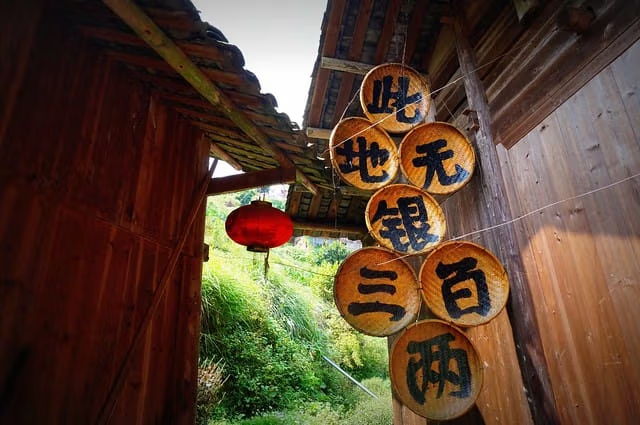
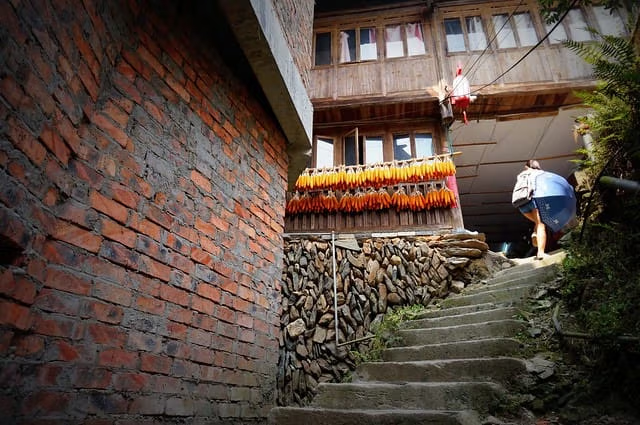
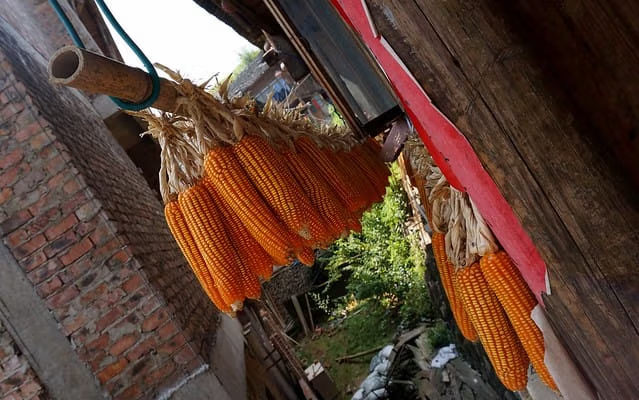
It seems really odd to see corn in China. Not sure why. As for the Chinese characters…I can tell you the one with three horizontal lines is the number 3. That is the extent of my wisdom for today.
Haha, thanks for translating that character for me! You’re practically fluent in my books. 😉
The Chinese: 此地无银三百两
How to read it: Cǐ dì wú yín sān bǎi liǎng
What it means:
I’ll translate character-by-character so y’all can enjoy piecing together the meaning.
此 = this
地 = ground/place
无 = (is) without/doesn’t have
银 = silver
三 = three
百 = hundred
两 = Liang. A traditional unit of weight, equivalent to 50grams or 1.763 ounces.
Beyond the meaning: This is a reference to a tale where a clever individual buries his fortune then, to prevent anyone suspecting treasure may be buried here, erects a sign that reads “此地无银三百两”.
I would love climb the rice terraces, I am sure the view up there is splendid. I heard that the famous Dragon’s backbone rice terraces are found in this town.
It’s a great feeling to see that you guys have been to exactly the same places we had gone in May. The village has not changed at all since we saw it and it’s still so beautiful!
That’s because I read your posts for a bit of China travel inspiration. 😉 “Hmm, where did Agness and Cez go that looks good?” I also wanted to visit Fenghuang until I saw how far it was. I’ll hopefully save that for another time.
This looks like a truly special place. You are so blessed, Audrey!
I do feel blessed. The whole time I was in China I just kept repeating myself, “Look at this! I can’t believe we’re in China!!!” 🙂
These photos are wonderful! Your posts really make me want to travel China more thoroughly and explore the smaller towns.
I wasn’t sure what to expect from China, but I really enjoyed my brief visit to the southwestern part. I definitely want to go back in search of more little towns. 😉
SImply Stunning – I’d be hard pressed to leave such a beautiful area. Wow!
I really wish I’d had more time in China. While I didn’t enjoy the big cities, once I was out in the countryside visiting the smaller villages, it really was an enjoyable trip. 🙂
That looks absolutely stunning. Being back in Asia makes me realized that I miss being around rice fields and this one is definitely amazing!
Nothing like green rice fields to soothe the soul. 🙂
This looks like a charming and quiet place, to be visited without a hurry. The drive to get there sounds scary, though!
Most drives in Asia have been terrifying – especially when you have winding roads and a drop on the one side.
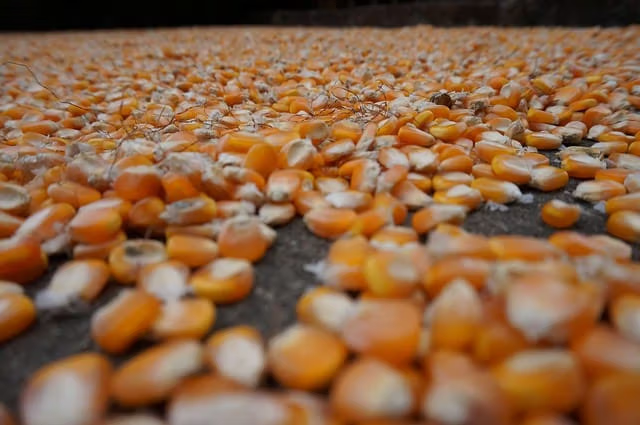
I love little Chinese towns! We saw a lot of corn drying in Yunnan, too, but couldn’t figure out why. Animal feed perhaps? That sign might be a store name and address. Two of the top characters are for ‘earth’ and ‘silver’ while the bottom ones read ‘three hundred two’.
Ooo, thanks for translating! I’m impressed by your skills! 😉
I would have stopped halfway too – that town looks super charming! So much corn!
I didn’t realize there was so much corn until I started going back through my pictures. 😉
There’s rarely a bus ride in Asia where I’m not closing my eyes and griping the seat in front of me. From Hong Kong to Thailand and even in Japan, all the drivers I get seem to think they’re pro and love to play chicken!
Also, it’s so weird to see corn since we don’t have any here in HK!
I love the look of this village. Still looks so traditional. Reminds me of the hilltribe villages in Nepal.
They also reminded me a bit of the hill tribes I met in Sapa, which are quite close to the border with China. 🙂
Absolutely stunning! Your posts makes me feel like i can fly to my dream country China
Thanks Jeff.
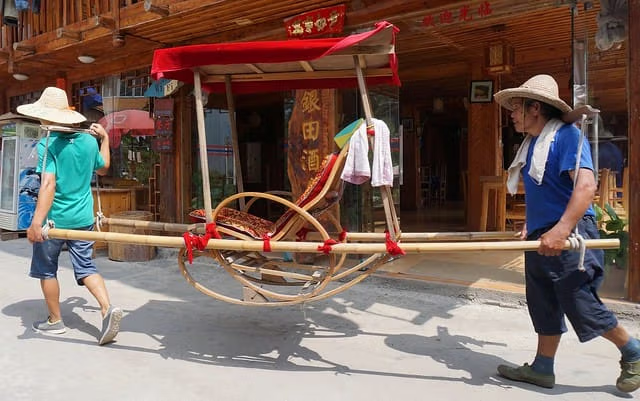
That looks awesome! I love the picture of the guys walking with the chair.
looks awesome! I love all these little towns. Would love to see the village with the longest haired women too
If you ever go back stay in Tian Tou Zhai instead. This place is a beautiful hike up through the rice terraces and was an amazing place to stay. I think you could walk here from Ping’An but we had a storm a day while we were there which stopped us from trying out the path. This was one of my favourites places I visited when I spent a year in China.