
If there’s one quintessential experience every traveller needs to have in Seoul, it’s visiting a jjimjilbang…or so I am told.
This is something that I had somehow managed to avoid the whole time I lived in Korea and I was totally fine with that, but since Sam is a big fan of jjimjilbangs and we happened to be staying right down the street from Siloam Jjimjilbang, it was only a matter of time before I ended up there.
A quick update before we dive in: Siloam has since closed, so this is the story of our day there rather than a place you can still visit. If you’re planning a trip of your own, skip ahead to my guide to visiting a jjimjilbang in Seoul today, with places that are still open, what to expect on the bathhouse floor and how to fit a soak around your flight home.
But before we go any further I should answer the question:
What is a jjimjilbang?
A jjimjilbang is a Korean public bathhouse filled with showers, hot tubs, and saunas, but it is much more than that.
It is also a communal space where you can watch Korean dramas on TV, work out in the exercise rooms, cool down in the ice rooms, sweat it out in the kiln saunas, play computer games, spend coins at the arcades, sing your heart out at a noraebang, catch up on sleep in one of the napping caves, relax in a massage chair, and so much more.
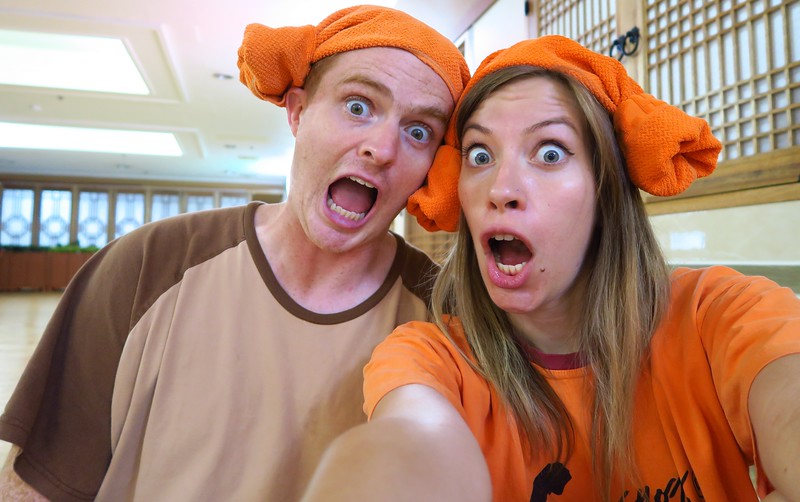
Yes, you can come and have a bath here, or you could skip that awkward part altogether and spend the day wearing a Princess Leia towel bun on your head, but more on that later.
How does going to a jjimjilbang work?
Once you walk in through the main doors you will find a desk where you pay for admission.
There are 4 different rates depending on whether you are going there during the day (5:00 a.m. – 8:00 p.m.) or at night (8:00 p.m. – 5:00 a.m.), and whether you are entering the bathhouse or also wanting to access the other floors of the jjimjilbang.
If you want the full experience, you’ll want to pay for both the bathhouse and the jjimjilbang, and you can save a few dollars by visiting during daytime hours.
Once you’ve paid, you will be given a set of clothes to change into.
At the Siloam Jjimjilbang women are given orange t-shirts with red shorts, and the men are giving beige t-shirts with brown shorts.
You will then bring these clothes with you into the change room. The change rooms are segregated; the women’s change room is to the right and it has a red sign, and the men’s change room is to the left and it has a blue sign.
Once you set foot inside the change room, the first thing you will do is remove your shoes.
Once your shoes are off, you will step up onto the floors, walk over to the shoe lockers, store your shoes, and hand the locker key in at the desk.
The person behind the desk will in turn give you two small towels, as well as another key which gives you access to a bigger locker where you can store the rest of your belongings.
If you’re heading down to the bathhouse and sauna, this is the part where you strip bare and walk your naked self down into the basement where things are also kept segregated.
The towels are the size of small hand towels, so there’s little use in trying to cover yourself up.
And if you’re a bit shy and not quite ready to experience the naked bathhouse, this is the part where you put on the clothes they gave you, and follow the steps up to the ‘fomentation area’ where you can start exploring the jjimjilbang.
Inside a Korean jjimjilbang
What better way to show you than video?! If you’re interested in getting the full tour then you can watch the vlog we filmed on our visit, and if not keep reading for a quick layout of the place floor by floor.
Basement
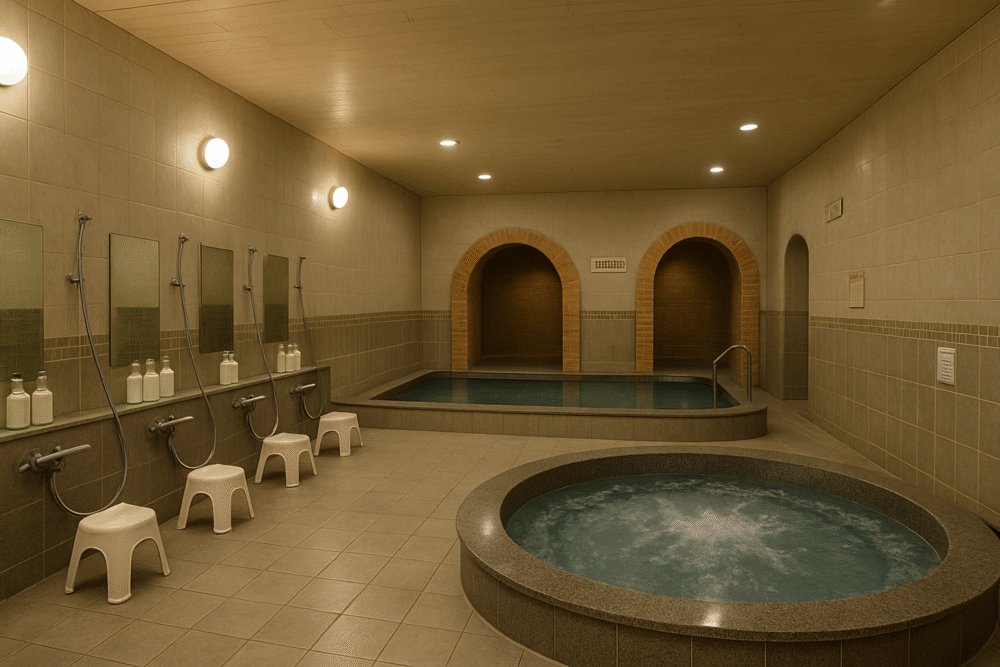
The basement level is where all the soaking, scrubbing, and washing happens.
Here you’ll find all the pools, steam rooms, mud tubs, hot tubs, and showers. You must shower before you even think of setting foot anywhere else – cardinal rule!
You can also pay an additional 15,000 won to have your whole body scrubbed down by a professional.
My husband was brave enough to try this and he tells me they take a lot of skin off. It sounds like a pretty painful experience to me, but you’ll no doubt leave squeaky clean!
Level 1
This is the main floor and it’s where you enter the jjimjilbang.
This is also where the change rooms are located, and as you make your way out the change rooms, you’ll find a hairdresser and a threading lady.
Level 2
The second floor has a restaurant with a pretty complete menu. This was our very first stop inside the jjimjilbang and I can confirm that they make some great Korean food in there.
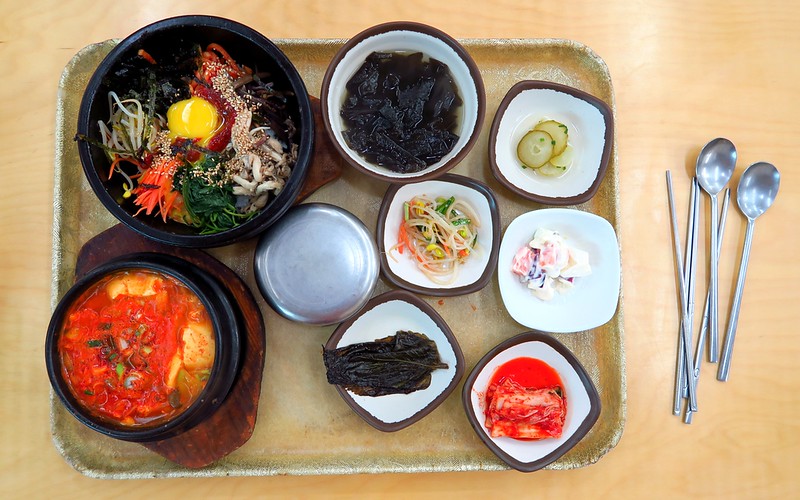
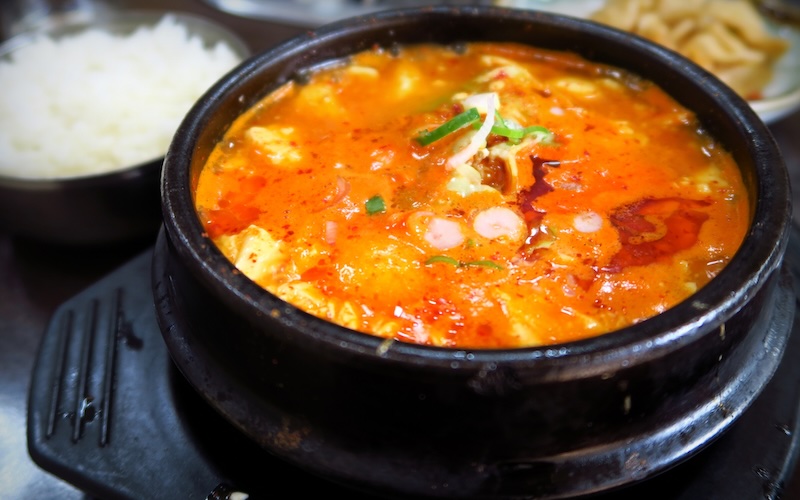
We had dolsot bibimbap (돌솥 비빔밥), which is a mixed vegetable rice cooked in a stone pot, as well as sundubu jiggae (순두부찌개), which is a spicy tofu soup served with rice.
This also came with miyeokguk (미역국), which is a seaweed soup, and an assortment of side dishes known as banchan (반찬).
If you want to have some typical jjimjilbang fare, order the baked eggs (맥반석 계란) which are slow cooked in the hottest sauna, as well as a glass of sikhye (식혜), a sweet rice beverage.
Aside from the restaurant, in this floor you’ll also find a massage centre, a nail salon where you can get a gel manicure, there’s an area where you can tuck your feet into hot jade pebbles, and there’s also a quiet communal space where you can have a nap or enjoy some quiet reading.
Level 3
The third floor is all about entertainment and I would say it’s the most active of all the floors.
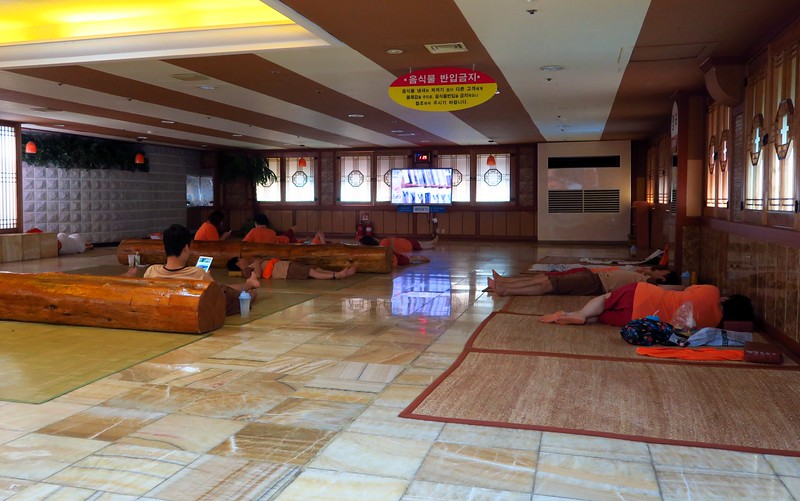
Here you have a main area where they play Korean dramas on TV and people just lounge around on hard mats on the floor.
They have a table tennis room, a reading room, a PC bang (computer game room), a workout room, a group room in case you’re having a special event with friends, and a movie room where they screen films twice a day.
They also have massage chairs, where you can pop in a few coins and get a full body massage.
Level 4
The fourth floor has different rooms that vary in terms of lighting, minerals, and therapeutic effects.
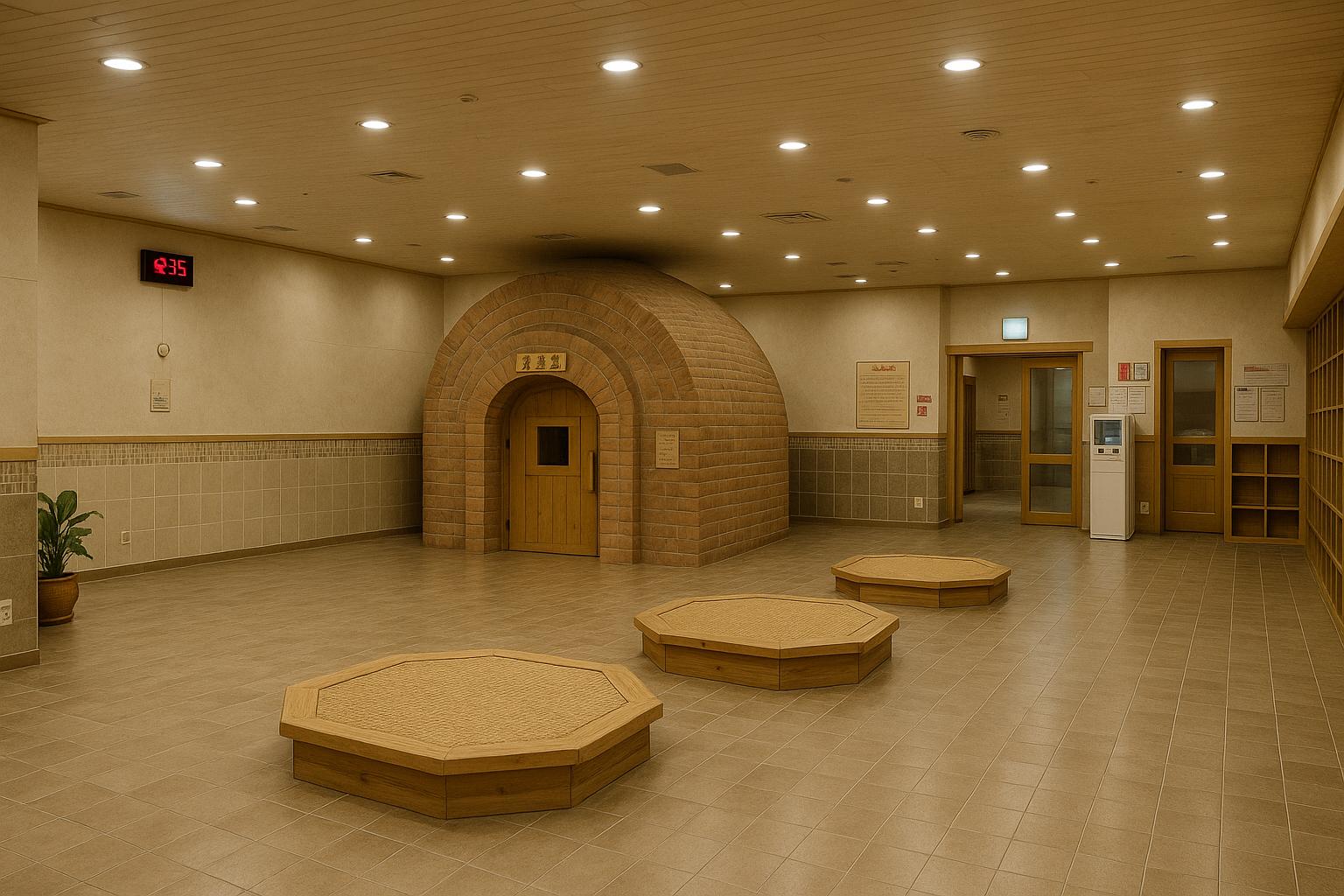
There are rooms where the ceiling is covered in jade or salt, rooms that feel like ovens and others that feel like igloos, rooms with heated floors and rooms where you lay down on salt crystals, and the list goes on and on!
I also found it interesting that all of these rooms kind of looked like little caves and some of the doors are so small you literally have to hunch over to walk in.
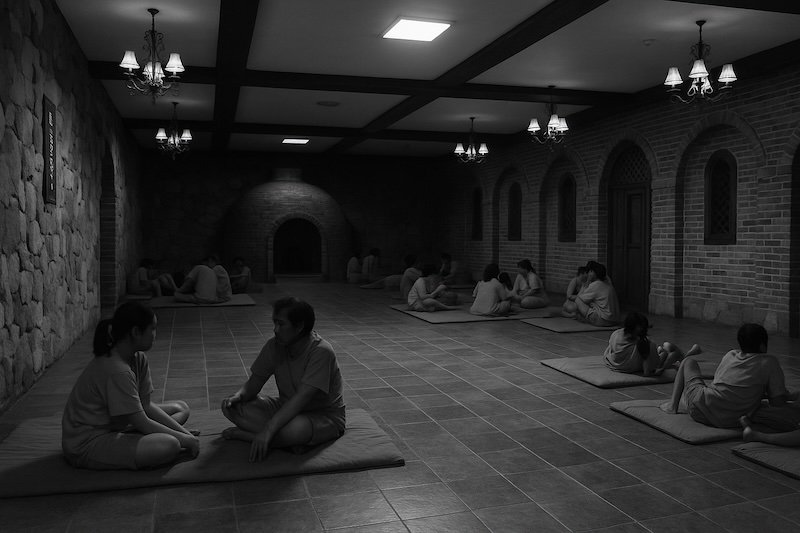
My favourite out of all of these was the charcoal room where the temperature was kept at 22 degrees Celsius.
I couldn’t tell you what sort of effect this charcoal room is meant to have on the body, but I enjoyed the cool temperature and the fact that it was a dark room where you could catch some sleep.
Aside from all this, the fourth floor also has a cafe where you can order light snacks like sandwiches, smoothies, and patbingsu.
Level 5
This fifth floor is known as the sleeping floor, and while you can technically nap on mats in any of the floors, this space is very quiet and dedicated to sleep.
Here you’ll find a communal sleeping area where families are napping on mats with pillows and blankets. There’s another sleeping area that’s strictly divided into men and women only, and you’ll also find bunkbeds and rows of cubby holes that you can crawl into for some quiet and restful sleep (these are a great idea if you’re trying to get away from the snorers!)
What to expect inside the jjimjilbang?
Visiting a jjimjilbang is all about relaxing and you’ll find that a lot of Korean families go to spend the day there as a fun weekend activity.
Once I was inside, it kind of reminded me of being inside a hotel or a spa for the weekend, with lots of different areas and activities to keep you entertained without having to leave the premises.
One of the funnest parts for me was wearing the Princess Leia towel on my head and forcing Sam to do the same.
To achieve this look you have to fold your towel lengthwise into thirds, and then take each end and roll it outwards twice like you would a sleeve.
You’ll then be left with a funny looking towel hat that people wear whether they’re eating lunch or hanging out in one of the hot rooms.
Getting to Siloam Jjimjilbang
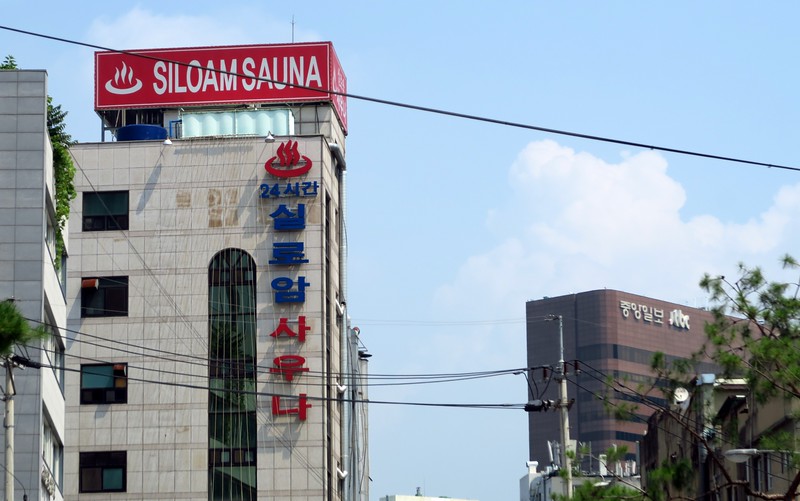
Siloam is one of the best jjimjilbangs in Seoul, so it’s worth seeking out even if you’re staying in a different part of the city.
To get there take Line 1 or 4 to Seoul Station and then take exit 1, go past the overpass and walk across the street at the intersection. Siloam will then be on your right-hand side.
Alternatively, you can take Line 2 or 5 to Chungjeongno Station and take exit 5. From there you’ll have to walk down the hill and you’ll eventually spot Siloam on the left hand side. It looks like a 5-story hotel, so it’s hard to miss!
Keep in mind that most Seoul neighbourhoods have at least one jjimjilbang, so if this one is too far from where you’re staying, you should still be able to visit another near you.
Address: 49 Jungnim-ro, Jung-gu, Seoul
Visiting a Jjimjilbang in Seoul Today
Where to Go Now That Siloam Has Closed
Siloam, the jjimjilbang near Seoul Station where Samuel and I spent our day, has closed for good, and a recruitment company now has its head office in the building. Two other famous names are gone too. Dragon Hill Spa in Yongsan closed during the pandemic and hasn’t reopened, and Itaewon Land shut down and its building was torn down. All three still turn up on older lists of the best jjimjilbangs in Seoul, so check any recommendation against a current map before you cross the city in a pair of flip-flops.
Plenty of good places are still going, and they suit different plans. Some are built for a long, lazy afternoon in matching uniforms, one is all about wood-fired charcoal kilns, one is for women only, and several will happily let you stay the night. These are the strongest options in and around Seoul right now. We haven’t reviewed them ourselves, so I’ve stuck to what each one offers and what it costs.
| Jjimjilbang | Area and subway | Hours | Adult entry (approx.) | Best for |
|---|---|---|---|---|
| Sparex Goodmorning City (스파렉스 굿모닝시티점) | Dongdaemun, across from DDP; Dongdaemun History & Culture Park Station (Lines 2, 4, 5) | 24 hours | ₩14,000 day / ₩16,000 night | First visits, late nights, travellers with luggage |
| Sparex Dongmyo (스파렉스 동묘점) | Dongmyo Station (Lines 1, 6), Exit 6 | 24 hours | About ₩12,000 day / ₩15,000 night | Newer facilities near the Dongmyo flea market |
| Supsok Hanbang Land (숲속한방랜드) | Near Bongwonsa temple, Seodaemun; bus 7024 | Baths 6:30 a.m.–10 p.m.; kilns 8 a.m.–9 p.m. | ₩16,000–17,000 | Wood-fired charcoal kilns, by day |
| Spa Lei (스파레이) | Sinsa area, Seocho | Listed as always open | Ask at the desk | Women only |
| Club K Seoul (클럽케이서울) | Seolleung, Gangnam | 24 hours | ₩17,000 weekdays / ₩19,000 weekends | A long, quiet break south of the river |
| Riverside Spa Land (강변스파랜드) | Gangbyeon Station (Line 2), beside Dong Seoul Bus Terminal | 24 hours | ₩15,000 day / ₩17,000 night | Eastern Seoul, late bus arrivals, families |
| Aquafield (아쿠아필드) | Starfield malls in Goyang and Hanam, outside Seoul | 10 a.m.–10 p.m.; six-hour limit | About ₩26,000 (Hanam) | A polished day out |
Prices tend to creep up, so treat them as a budget rather than a quote.
Sparex Goodmorning City (스파렉스 굿모닝시티점)
For something close to our Siloam day, with a huge space, a food court and the option to stay all night, this is where I’d start. It’s in the basement of the Goodmorning City shopping mall, right across the road from Dongdaemun Design Plaza (DDP). Come out of Exit 14 of Dongdaemun History & Culture Park Station, look for the Sparex sign and take the lift down to B3. The shared rooms are designed to feel like a traditional Korean village, with hanok-style wood throughout, dry and wet saunas, clay rooms and an ice room, and the food court runs through the night.
Entry is around ₩14,000 during the day and ₩16,000 at night. Day rates run from 5 a.m. to 8 p.m. and night rates from 8 p.m. to 5 a.m., and there’s an extra charge once you pass 24 hours. Bring your own shampoo and conditioner or buy single-use ones there. A suitcase can stay with the staff while you’re inside, and a paid luggage option lets you head out and come back. A basic men’s scrub starts at ₩25,000 on site, and scrub-and-entry packages are sold in advance. If you’d rather walk back to a proper bed afterwards, have a look at hotels near Dongdaemun Design Plaza.
Sparex Dongmyo (스파렉스 동묘점)
The second Sparex is on the 13th floor of a building at 19 Jibong-ro, right by Exit 6 of Dongmyo Station (Lines 1 and 6). It’s one of the newer jjimjilbangs in the city, with a Himalayan salt room, a cypress-wood room and an ice room among its themed spaces. A recent listing put entry at about ₩12,000 by day and ₩15,000 at night, and it’s a natural stop after an afternoon digging through the Dongmyo flea market nearby. Teenagers are asked to leave by 9:30 p.m. unless a parent stays with them. When you save it in your map app, double-check the branch name, because the two Sparex locations are easy to mix up.
Supsok Hanbang Land (숲속한방랜드)
This is the most traditional option in the city, tucked into the woods at the foot of Ansan near Bongwonsa temple (75-7 Bongwonsa-gil, Seodaemun-gu). The charcoal kilns are outdoors and fired with real wood, graded from low to high heat. Between sessions you sit out in the forest air and roast sweet potatoes or rice cakes over the brazier, and the restaurant grills pork belly over charcoal from the kilns.
The baths open at 6:30 a.m. and close at 10 p.m., but the kilns only run from 8 a.m. to 9 p.m., so plan a daytime visit. Budget around ₩16,000–17,000 for the kilns. It isn’t close to a subway station: take bus 7024 to the Bongwonsa stop at the end of the line (it runs through Sinchon) or a short taxi from Sinchon. The last stretch up is steep, and it isn’t open overnight.
Spa Lei (스파레이)
Spa Lei is a women-only spa in the Sinsa area, with baths, heated rooms and a sleeping area of its own. The tourism office lists it as always open, but its published prices and time limits don’t agree, so ask at the desk before planning a long stay. Women-only doesn’t mean private. You’ll still be bathing alongside other women, and it won’t work for a mixed couple who want to spend the afternoon together.
Club K Seoul (클럽케이서울)
For Gangnam, Club K Seoul takes up the basement floors of a building at 524 Seolleung-ro, near Seolleung Station. It’s open around the clock, every day of the year. A standard jjimjil ticket costs about ₩17,000 on weekdays and ₩19,000 on weekends and covers 12 hours. A bath-only ticket is about ₩13,000 for five hours, and a 24-hour ticket about ₩30,000. It’s a good place for a long, slow break between plans south of the river.
Riverside Spa Land (강변스파랜드)
Over in eastern Seoul, Riverside Spa Land fills the basement of a building at 45 Guui-gangbyeon-ro, Gwangjin-gu, beside Gangbyeon Station (Line 2) and Dong Seoul Bus Terminal. That location is the real draw if you’re arriving late on an intercity bus. There’s a pine-wood fire kiln, charcoal and salt rooms, an igloo room and a clay kiln for women only, plus a kids’ playroom, table tennis and a big games area. The operator lists jjimjilbang entry at ₩15,000 by day and ₩17,000 at night (8 p.m. to 5 a.m.), and that ticket covers 15 hours before an extra ₩1,000 an hour kicks in. A bath-only ticket, around ₩13,000, covers six hours.
Aquafield (아쿠아필드)
Aquafield is a different kind of place: sleek, modern and built inside Starfield malls outside Seoul, including Goyang and Hanam. Instead of a well-worn neighbourhood feel, you get ten themed heat rooms in a glossy, modern setting. It’s open from 10 a.m. to 10 p.m., visits are capped at six hours with ₩5,000 for every extra hour, and adult jjimjil spa entry at the Hanam branch was recently listed at about ₩26,000. The water park is a separate ticket, so don’t assume you can swim on a spa pass.
Because it’s a trip out of the city anyway, this is the one place on the list where booking ahead makes sense. An Aquafield jjimjil spa entry ticket covers six hours in the spa and works at any of its branches. Everywhere else, just turn up and pay at the desk.
Finding a Jjimjilbang on Your Own
Most Seoul neighbourhoods still have a bathhouse of some kind, and the sign tells you what you’re getting. A 목욕탕 (mogyoktang) is a plain public bathhouse with separate men’s and women’s sections: showers, hot and cold pools and a sauna. A 찜질방 (jjimjilbang) adds the shared floors in uniforms, the heated rooms, a snack bar and somewhere to nap. A sign that just says 사우나 (sauna) could be either, so don’t count on a restaurant or a sleeping room.
Naver Map or Kakao Map is the easiest way to search in Korean. Type 찜질방 in the area where you’re staying and look at recent photos of the entrance and the price board rather than old reviews. Pay attention to the status on each listing: 영업 중 means open, 휴업 means temporarily closed and 폐업 means it has closed for good. If you get stuck, the Korea Travel Hotline (dial 1330 in Korea, or +82-2-1330 from abroad) has English-speaking staff around the clock, and your hotel front desk can usually phone ahead for you.
Korean Phrases for the Front Desk
You can get through a whole visit by pointing and smiling, but a few phrases make the front desk much easier, and you can always just show the staff your screen.
| Korean | Say it | Meaning |
|---|---|---|
| 찜질방 이용할 수 있어요? | jjimjilbang iyonghal su isseoyo? | Can I use the jjimjilbang (the shared floors)? |
| 얼마예요? | eolmayeyo? | How much is it? |
| 몇 시간 이용할 수 있어요? | myeot sigan iyonghal su isseoyo? | How many hours can I stay? |
| 문신이 있어도 입장할 수 있어요? | munsini isseodo ipjanghal su isseoyo? | Can I come in if I have tattoos? |
| 짐을 맡길 수 있어요? | jimeul matgil su isseoyo? | Can I leave my luggage here? |
| 세신 하고 싶어요. | sesin hago sipeoyo. | I’d like a body scrub. |
| 살살 해주세요. | salsal haejuseyo. | Please go gently. |
| 감사합니다. | gamsahamnida. | Thank you. |
What It Costs and What Your Ticket Covers
Back when we filmed our Siloam day, full access cost about ₩10,000. On his solo return a few years later, Samuel paid ₩11,000 for the baths plus the shared floors (the baths alone were ₩9,000), and he couldn’t get over how little that was next to spa prices back home. These days, ordinary adult entry at the big city jjimjilbangs runs roughly ₩14,000–19,000, with premium spas like Aquafield costing more. It’s still one of the best-value afternoons in Seoul.
What the ticket covers varies more than the price. A bath-only ticket gets you the washing and soaking floor, while a jjimjilbang ticket adds the shared floors and your uniform. Most places charge more at night, and many limit how long a ticket lasts before an hourly charge kicks in: Riverside Spa Land allows 15 hours on a jjimjil ticket, Club K 12 and Aquafield six. Towels and uniforms usually come with the ticket, but toiletries don’t always. Food, scrubs, massages and the coin-operated massage chairs are extra. At many places you charge snacks to your locker key or wristband and settle up on the way out. On Samuel’s last visit to Siloam, he paid cash at the restaurant counter and waited for a buzzer to tell him his meal was ready. If you’re buying a scrub package, check whether it already includes entry, so you don’t pay for it twice.
Do You Have to Get Naked?
No, not if you stay on the clothed floors the way I did. Nudity only happens in the gender-separated bath area. Everywhere else, everyone wears the same T-shirt and shorts from the front desk, and families, couples and friends all mix together. My whole afternoon was lunch, a ridiculous towel hat, my Kindle and a nap, and I never felt I’d missed out by skipping the bath.
If you’re visiting with someone of a different sex, agree on where to meet before you split up at the changing rooms. The shared floors are where you’ll find each other again, and the layout can be very different from Siloam’s five storeys, so pick somewhere obvious like the food court or the main hall. If you need step-free access, a larger uniform or a private place to change, contact the jjimjilbang before you go rather than assuming it can help because another spa did.
The Bathhouse Floor, Step by Step
I lived and taught in Korea and still managed to dodge this part, and on our Siloam day I stayed upstairs with my book while Samuel went down. He’s the household expert. During the month we stayed near Seoul Station, he went five or six times a week, and his routine never changed: sweat in the hot rooms for as long as he could stand it, then plunge into the ice-cold pool he calls his “polar plunge.” As I told him on camera, that’s a very Canadian way to relax. A few years later, on a solo trip back to Seoul, he found an ice room hovering around 6°C on a sweltering summer day and enjoyed it more than ever.
On our day together he spent about 45 minutes down there, and on that later trip he said he felt like a million bucks afterwards. His routine is his, though, and you don’t need to copy it to enjoy the baths. For a first visit the process is simple, but the order matters:
- In the gender-separated changing room, undress completely, lock everything away (your phone included) and take only your small towel and toiletries. Swimsuits aren’t worn in the bath area.
- Wash thoroughly at the showers before you go near any pool. Many have low stools, so rinse yours and put it back when you’re done.
- Tie long hair up and keep your towel out of the water. People fold it on their head or leave it at the edge of the pool.
- Check the temperature signs and start with the mildest pool. The pools are for soaking, not for washing.
- Take breaks, drink water and cool down gradually. The cold pool and the hottest rooms are entirely optional.
- Rinse and dry off before you go back to the changing room, then put on your uniform for the shared floors.
Phones and cameras stay out of the changing rooms and bathing areas, which is why there’s no bathhouse footage in our video, and it’s polite not to photograph strangers dozing on the shared floors either. Children aged four and over can’t go into the opposite-sex bath area, so a mother can’t take her five-year-old son into the women’s side. Anyone who has obviously been drinking can be turned away at the door.
Each jjimjilbang sets its own rules on tattoos. If your ink is large or very visible, ask before you pay, and ask about the baths and the shared floors separately.
The Body Scrub (Seshin)
Samuel was the brave one who got scrubbed, and his report afterwards was that they take a lot of skin off. I took his word for it rather than finding out myself.
The scrub is called seshin (세신), and the scrubber is known informally as a ttaemiri (때밀이). It happens inside the bath area, on a washable table, once you’ve soaked long enough for your skin to soften. The scrubber uses a rough, usually green mitt called an “Italy towel.” It was invented in Busan in 1962 and named after the Italian viscose rayon it was first made from, and today it’s in nearly every Korean bathroom. Expect to be turned and scrubbed from head to toe, firmly, while a startling amount of grey skin rolls away. If you’re nervous about the pressure, say 살살 해주세요 (salsal haejuseyo), “please go gently,” and skip it altogether if your skin is sunburned or broken.
At Sparex Goodmorning City, a basic men’s scrub starts at ₩25,000 on site, and add-ons like massages push the price up. A 24-hour jjimjilbang doesn’t mean 24-hour scrubs either, since the bath areas close for cleaning for part of the night, so ask at the desk when the scrubbers are working.
The scrub is the part a lot of first-timers want to try but feel nervous about. If that’s you, a booked spa treatment is a gentler way in. The Myeongdong MUD Korean body scrub and massage has private treatment rooms and English-speaking staff, about five minutes on foot from Exit 6 of Myeongdong Station on Line 4. The scrub and mud treatments there are for women only, while men can book the massage programs, and it isn’t suitable during pregnancy. It’s a spa appointment rather than an afternoon at a public jjimjilbang, so check what your package includes before you book.
What Those Hot and Cold Rooms Are Really About
When I said I couldn’t tell you what the charcoal room was supposed to do, it turns out I was in good company. In 1422, King Sejong ordered his Ministry of Rites to find out whether sweat bathing actually cured illness. Sweating rooms called hanjeungso were already in use for treating the sick, and a few years later two monks who ran them were given rice and cotton cloth to fund care for poor patients, with a physician assigned to work alongside them. Traditionally, bathers wrapped themselves in cloth or straw matting, lay on a bed of pine needles, sweated for just four or five minutes, cooled off and went back in. The surviving kilns are mounds of stone and clay with a hollow in the middle, heated by fire, and the largest, on Gyodong Island off Ganghwa, measures about 4.5 metres across.
The multi-storey jjimjilbang, with its restaurant, PC room and sleeping caves, is much newer and only spread across Korea from the 1990s onward. The heated floors where whole families stretch out on mats come from ondol, Korea’s age-old way of heating a home from beneath the floor, which is why lying on the ground feels so natural there.
The names on the doors tell you what’s inside. A bulgama (불가마) is a fiercely hot fire kiln, a sutgama (숯가마) is a charcoal kiln, a hwangtobang (황토방) is lined with yellow clay, a sogeumbang (소금방) with salt, and an eoreumbang (얼음방) is an ice room. The same name can mean very different temperatures at different places, so go by the number posted at the door. Our charcoal room was a comfortable 22°C, but most of the others were around 50–60°C, which was frankly unbearable for me.
Each room comes with a promise attached: jade for healing, salt for circulation, charcoal for detox. All I can tell you about the charcoal room is that it gave me a dark, cool place to nap, and the science isn’t much more definite. Researchers who studied regular jjimjilbang users in the 1990s found that people went for their health, but they found no precise evidence of the effects. I’d treat the themed rooms as a lovely ritual and leave it there.
Going Easy on the Heat (and the Cold)
Those old four- or five-minute sessions are a good model. Start in a mild room, come out for water, build up slowly and keep each session short, even if you’re feeling brave. If you feel dizzy, sick or faint, get out, cool down and tell someone. Don’t fall asleep in a hot room, and don’t drink alcohol before or during your visit.
The cold pool deserves the same respect, however much Samuel loves it. A sudden plunge puts real strain on the body, and cold shock can set off rapid, uncontrolled breathing that leads to dizziness or fainting, so a cool shower or a sit in the lounge is a perfectly good way to cool down instead. If you’re pregnant, health authorities suggest you may want to skip the hottest rooms because of the risk of overheating, dehydration and fainting. Anyone with heart disease, uncontrolled high blood pressure or a lung condition should check with a doctor before using hot rooms or cold plunges. Small children and older travellers overheat more easily, so keep their sessions short. And you don’t have to use the hot rooms at all: the shared floors can be the whole visit.
Eggs, Sikhye and the Sheep’s Head
For me, the food was half the fun. We started our Siloam visit with a proper lunch and finished with a bowl of patbingsu: shaved ice piled with red bean, fruit, little jellies, a dusting of nut powder and, for reasons I still can’t explain, corn flakes. I tried very hard not to get a brain freeze.
The brown, chewy eggs are called maekbanseok gyeran, after the elvan stone they’re baked on, and they’re slow-baked until the whites turn the colour of tea. They taste nothing like a boiled egg, and they go best with sikhye. It’s made by steeping cooked rice with malted barley at around 60°C until the grains float, and the malt turns the rice’s starch into sugar, which is where the drink’s gentle sweetness comes from, although these days it’s often sweetened with sugar as well. You can buy it in cans at any convenience store, but as we found out, the fresh version, with soft rice grains floating in it, is in a different league, especially straight out of a hot room. Just don’t count it as your water for the day.
The seaweed soup that came with our lunch, miyeokguk, has a meaning too. It’s traditionally the first meal a new mother eats after giving birth, and it’s what Koreans eat on their birthdays, as Samuel pointed out on that later trip. If you’re vegetarian or have allergies, ask before you order: miyeokguk is often made with beef or seafood, and sikhye is made with barley malt, so it isn’t gluten-free.
That towel bun I made such a fuss about has a name too: 양머리 (yangmeori), “sheep’s head,” because the two rolled sides look like curled horns. It’s widely credited to the hit 2005 drama My Lovely Sam-soon, which turned it into a fixture of jjimjilbang culture. On the day, I guessed people wore it to hold in the heat. Now that I know a TV drama is behind it, I suspect fashion has as much to do with it as function. Either way, Samuel and I both wore one.
How Long Should You Stay?
I’d allow at least two or three hours if you want more than a quick wash. That’s enough to try the baths or heated rooms at your own pace, eat something and have a proper rest. An hour or so works for a soak and a snack, while half a day leaves time for a scrub, lunch and a nap, which is exactly how a rainy or freezing Seoul afternoon should be spent. You don’t have to move as a pair, either. One of you can go for a scrub while the other reads, and you meet up afterwards. If you’re visiting late, check when the last subway leaves and when the restaurant stops serving, because a jjimjilbang that’s open all night doesn’t mean everything inside it is.
Spending the Night
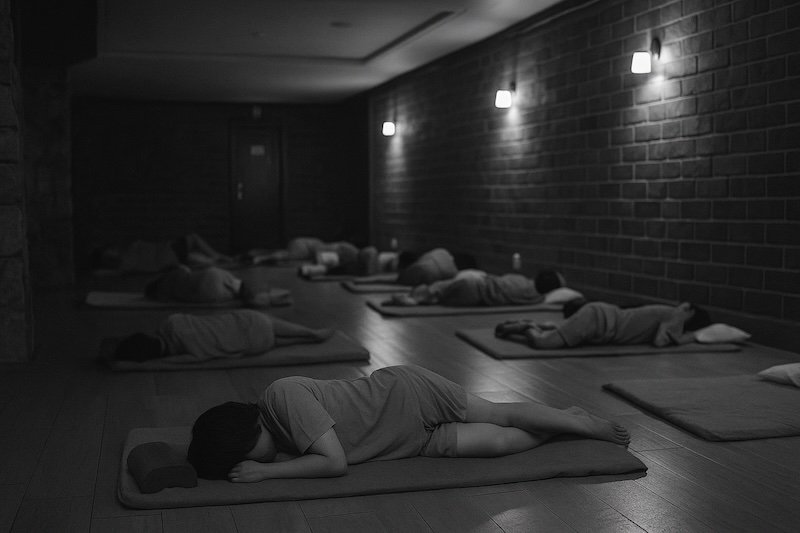
Many jjimjilbangs are open around the clock, which makes them one of the cheapest places to sleep in Seoul. Comfort is relative, though. While Samuel was downstairs, I fell sound asleep on a hard mat on the heated floor in a room full of strangers, and it was oddly relaxing, but that was a nap, not a full night. For a whole night, expect bright corridors, a few snorers, people coming and going, and a mat or a sleeping cubby rather than a bed. Earplugs and a light layer make a big difference.
A place that’s open 24 hours isn’t the same as a ticket that lasts all night. Before you plan to sleep over, ask whether sleeping is allowed on your ticket, how many hours it covers, whether there’s a night surcharge, where your luggage can go and whether you can leave and come back. Bath areas can also close for cleaning in the early hours even when the doors stay open. Supsok Hanbang Land and Aquafield aren’t open overnight, while the two Sparex branches, Spa Lei, Club K and Riverside Spa Land are.
Teenagers face extra rules. Korea restricts young people from 24-hour jjimjilbangs between 10 p.m. and 5 a.m. unless a parent or guardian is with them or has given written consent. The rule covers anyone under 19, except that you stop counting as a minor on January 1 of the year you turn 19. Individual places can be stricter (Sparex Dongmyo asks teens to leave by 9:30 p.m.), so teenage travellers should check the rules and bring ID.
A jjimjilbang night costs a fraction of a hotel and makes sense if you’re travelling solo and light, arriving late, leaving early or just curious. It isn’t a guaranteed bed, though, and it’s not the place for a big suitcase, small children or a night when you really need to sleep. In those cases, book a room and treat the jjimjilbang as an evening out. For late nights at Sparex Goodmorning City, Hotel Skypark Kingstown Dongdaemun is about 350 metres from Dongdaemun Station, right by the Cheonggyecheon stream and connected to a shopping mall, with triple rooms for small groups. For an early train or flight, Four Points by Sheraton Josun, Seoul Station is connected to Seoul Station by an underground passage from Exit 12, with direct access to the airport railroad, the KTX and subway Lines 1 and 4. Neither is somewhere we’ve stayed; they’re simply well placed for this plan.
Visiting a Jjimjilbang Before Your Flight Home
On that solo return trip, Samuel spent his final afternoon in Seoul exactly this way: one last meal at the restaurant, a long soak, a few rounds in the ice room, then, running late, a dash back for his bags and the airport train. Learn from him and give yourself extra time at Seoul Station. He found that the walk down to the airport train platforms took a good 15 to 20 minutes.
Seoul Station’s City Airport Terminal can take your bags off your hands first. Passengers holding an AREX Express ticket to Incheon can check in, drop their luggage and clear departure immigration in the city, as long as they’re flying out of Incheon that same day (not every airline takes part). Check-in and bag drop run from 5:20 a.m. to 7 p.m. and immigration from 5:30 a.m. to 7 p.m. Counters close three hours before departure for Terminal 1 and three hours and 20 minutes before for Terminal 2.
Those cut-offs aren’t the time to leave the spa, though. Work backwards from your flight: the gate, security, the Express ride, the walk down to the platform and the subway back to Seoul Station. Sparex Goodmorning City is four stops away on Line 4, via Hoehyeon, Myeongdong and Chungmuro to Dongdaemun History & Culture Park, so a couple of hours of soaking after bag drop is realistic with an afternoon or evening flight. With an early flight or a tight schedule, save the spa for another day, or spend the night before at one of the hotels near Seoul Station.
Quick Booking Guide
The table below matches the most common jjimjilbang plans with somewhere to stay or something to book.
| If your plan is… | Book this | Why it fits | Good to know |
|---|---|---|---|
| A last soak before your flight | Four Points by Sheraton Josun, Seoul Station | Connected to Seoul Station underground, so the City Airport Terminal and the airport train are on your doorstep | A comfortable mid-range hotel rather than a budget pick |
| A late night at Sparex and Dongdaemun’s after-dark shopping | Hotel Skypark Kingstown Dongdaemun or hotels near Dongdaemun Design Plaza | Sparex Goodmorning City sits across the road from DDP, so you can walk back after a late soak | Skypark has triple rooms for small groups |
| An early train or a tight budget | Hotels near Seoul Station | Seoul’s main rail hub, with the KTX, the airport railroad and Line 4 to Dongdaemun | Plenty of simple rooms within a few minutes’ walk |
| The scrub without the bathhouse floor | Myeongdong MUD Korean body scrub and massage | Private treatment rooms and English-speaking staff near Myeongdong Station | Scrubs are for women only; men can book massages |
| A polished spa day out of the city | Aquafield jjimjil spa entry ticket | Six hours in a modern jjimjilbang with ten themed heat rooms | Valid at any branch; the water park is a separate ticket |
Before You Go
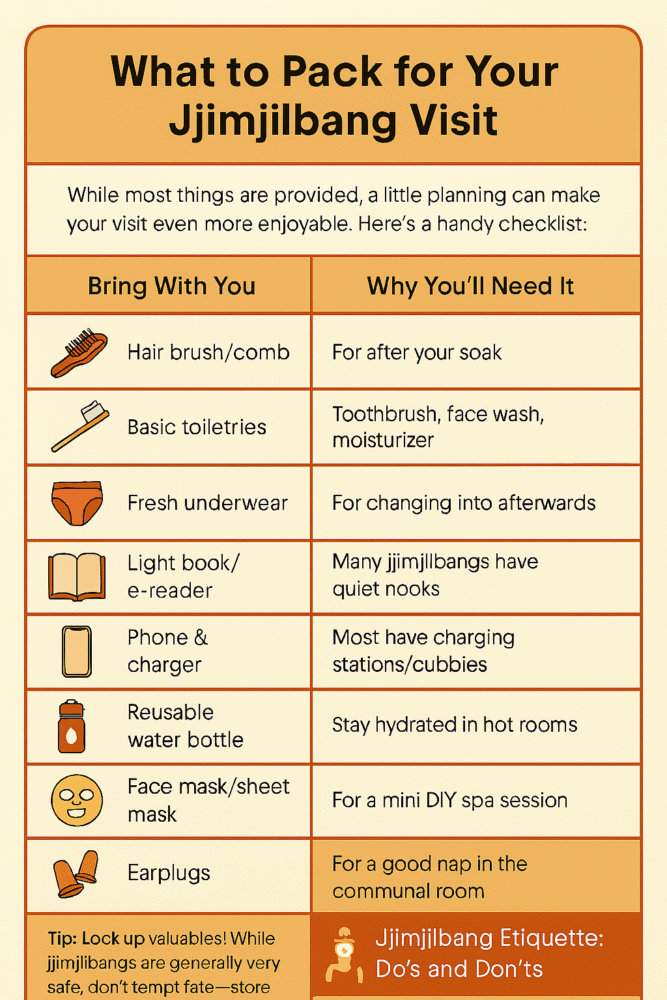
Uniforms and towels are provided, but toiletries vary, and some places, Sparex included, expect you to bring or buy your own shampoo. Pack a hair tie, a comb, the toiletries you like, fresh underwear, a little cash or a card, and earplugs if you plan to nap. If you might stay late, bring ID in case you’re asked to prove your age. Weekends and holidays are busiest, with families filling the heated floors, so a weekday afternoon is the gentlest introduction.
If the bathhouse is the thing holding you back, it shouldn’t be. Choose a place with a good shared floor, give yourself a few hours and order the eggs and sikhye. You and your travel companion don’t even have to agree on the right temperature: Samuel can have his polar plunge, and I’ll take the charcoal room and my book.
Have you ever been to a Korean jjimjilbang?
Is this a must visit Seoul attraction?
Or have you been to sauna / bath house in a culture different from your own?
Very detailed information about jjimjibang. I find it is quite similar with the same public bath houses in Japan aside from the foods and other things one can do there. All in all, a wonderful post, one I found very informative since mostly I come across various places in Korea but this is the first time I’ve read a post about this.
Getting naked is the best part! haha. My friend and I stayed at Siloam one night after a concert when we missed the last KTX back to Daegu. I was hesitant about jimjilbangs at first too but eventually my friends and I got into it and came to love it. My favorite was Spaland in Busan! I’m glad you finally gave them a try. Your pictures are making me miss Korean food something fierce, too!
Sounds like an awesome experience! Definitely something that’s not available in my part of the world!
Very useful and detailed blog about Jjimjilbang! I have tried once in Jeju and second time was at Spaland Busan..I quite like the experience, always feel fresh after 🙂 never been to any in Seoul..this time with my mum, will bring her there tomorrow..guess she will love it too 🙂 Thanks for sharing!
Thanks for such a detailed blog post! We plan to head here in the next few days and now I feel a little less daunted and more excited!
I haver a question regarding Tattoos, I’ve heard this kind of public places don’t allow people with tattoos to go in. I’m very interested in going to a Jjimjibang but I do have a few tattoos so I’m worried it would be an issue.
From what I’ve been able to find online, the majority of Korean jjimjilbang do allow tattoos – they are not quite as strict as the onsen in Japan. I’ve only read about a handful that frown upon tattoos, but times are a-changin’.
I loved this post! Visiting a jjimjilbang without the naked part sounds like a great way to enjoy the experience without feeling uncomfortable. The tips you shared are super helpful for first-timers like me. I can’t wait to try the various saunas and snacks you mentioned!
Great post! I love how you highlighted the unique experiences at a jjimjilbang without focusing on the nudity aspect. It really makes it more approachable for anyone considering a visit. I can’t wait to try out the different saunas and relax in the communal areas! Thanks for sharing your insights!
I loved reading about your experience at the jjimjilbang! It’s great to know that you can enjoy all the relaxation and unique features without feeling uncomfortable. I can’t wait to visit and try out all those cozy rooms and the delicious snacks you mentioned!
I loved reading about your experience at the jjimjilbang! It’s great to hear you enjoyed the unique atmosphere and various treatments, even without the nudity part. Your tips on what to expect and how to enjoy it fully were super helpful. Can’t wait to try it out on my next trip to Seoul!
I loved your take on visiting a jjimjilbang! It’s great to see how you captured the essence of the experience without focusing on the nudity aspect. I could definitely relate to the clean, relaxing vibe you described, and your tips on what to do there were super helpful. Can’t wait to try it out on my next visit to Seoul!
I loved your take on visiting a jjimjilbang! It’s great to hear you found a way to enjoy the experience without the nudity aspect. Your tips on the different saunas and the overall atmosphere made me really excited about trying it out on my next trip to Seoul!
I loved this post! Visiting a jjimjilbang sounds like such a unique experience. I appreciate how you shared tips for enjoying it without feeling overwhelmed by the nudity aspect. Can’t wait to try out the various saunas and the delicious snack options you mentioned!
I loved your insights on visiting a jjimjilbang! It was refreshing to read about the experience without focusing on the nudity aspect. The tips on what to expect and how to enjoy the different saunas were super helpful. Can’t wait to try it out on my next trip to Seoul!
What a fun and informative read! I had no idea there were so many unique experiences at jjimjilbangs beyond just the naked part. I’m definitely inspired to visit one during my next trip to Seoul! Thanks for sharing your insights!
I loved your take on visiting a jjimjilbang! It’s great to see the experience highlighted without the pressure of nudity. I appreciate how you emphasized the cozy atmosphere and unique treatments. Can’t wait to try it on my next visit to Seoul!
I loved your take on visiting a jjimjilbang without the nudity! It’s great to know I can still enjoy the unique experience and relax without feeling uncomfortable. Your tips on the different saunas and treatments were super helpful. Can’t wait to try this out on my next trip to Seoul!