
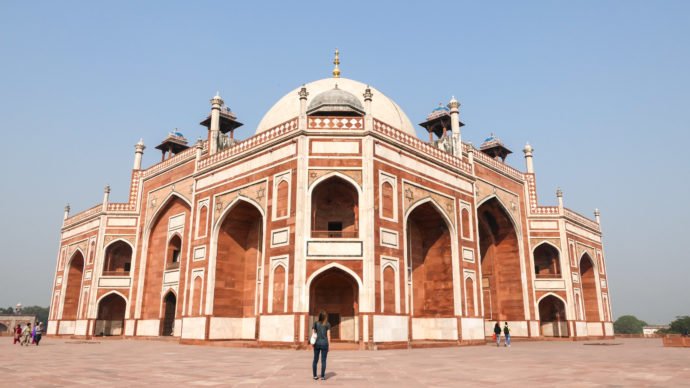
Today, we’ll explore Mughal architecture in Delhi by visiting the Red Fort, Humayun’s Tomb, and Jama Masjid.
During my third year of university, I signed up for a course titled Islamic Art and Architecture for one of my electives. I was travelling in Argentina at the time my enrolment window opened, and I remember sitting in a hostel in Cordoba battling a slow internet connection while I tried to figure out what classes still had seats remaining.
There were a few different courses I was considering and not being the most assertive decision-maker, I turned to my friend Rebecca and asked her which one she thought I should go for. Being the art major and talented visual artist that she is, she suggested the art course.
I signed up.
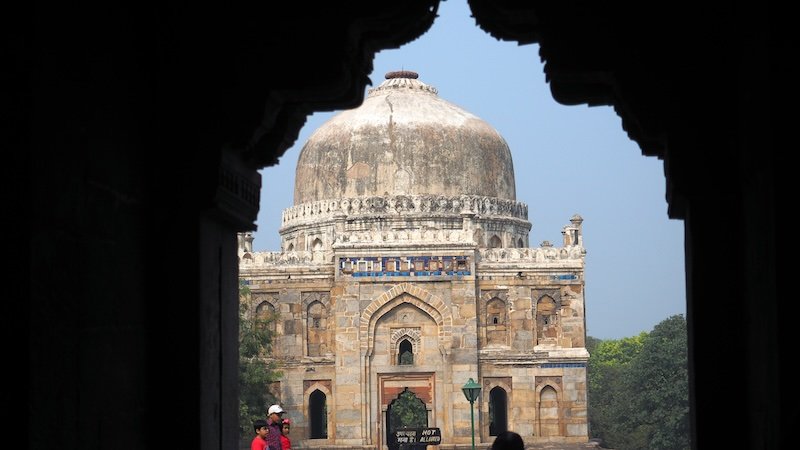
That course ended up being one of my favourites of the year. It sparked my slight obsession with Central Asia (Uzbekistan is still a dream destination of mine!) and it also taught me to decipher the subtle meaning behind buildings which is often hidden in plain sight.
One period that we covered extensively in that course was that of the Mughals, an empire that ruled the Indian subcontinent from the early 16th century to the early 18th century and left a wealth of structures scattered across the land. Coming to Delhi, India those exquisite structures that I had once marvelled at on the pages of my textbook finally came to life.
Must-Visit Landmarks in Delhi: Red Fort, Humayun’s Tomb, and Jama Masjid
Red Fort
My first stop in Delhi was the Red Fort. We purposely booked a hotel within walking distance and on our first morning there Sam, his parents and I were out the door and on our way soon after sun-up.
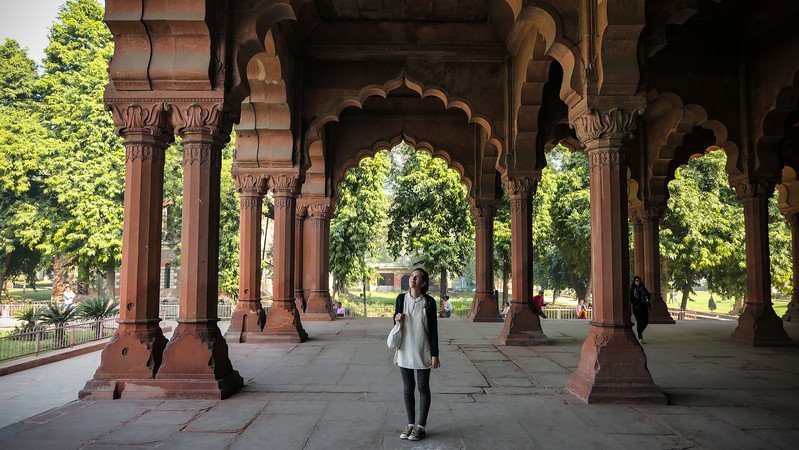
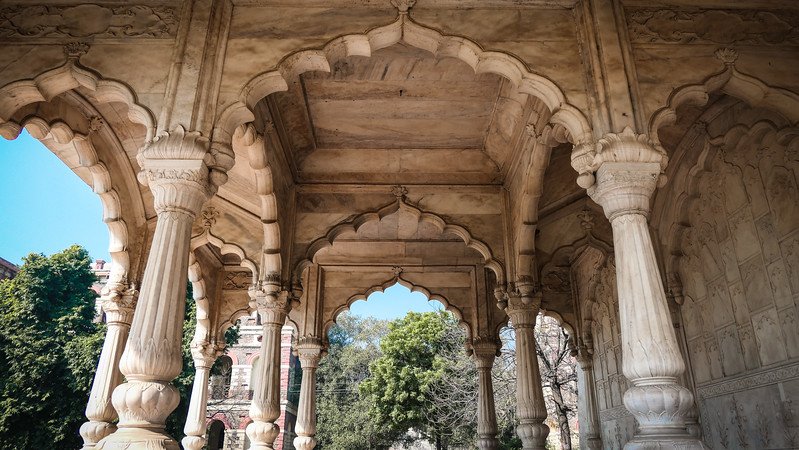
The Red Fort was the main residence of the Mughals for almost 200 years and though it may be called a fort, this place is more like a walled city. After the Mughals moved their capital from Agra to Delhi, this became their primary residence and inside you can find a bazar, a mosque, various courts and pavilions, as well as imposing red sandstone gates that will make you feel tiny.
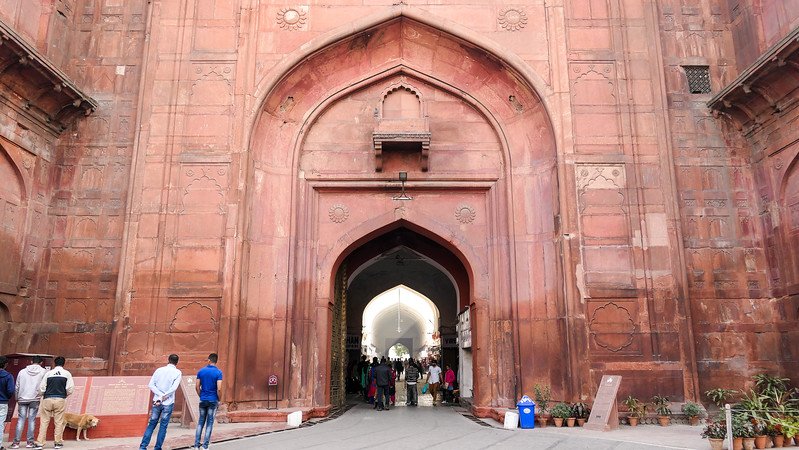
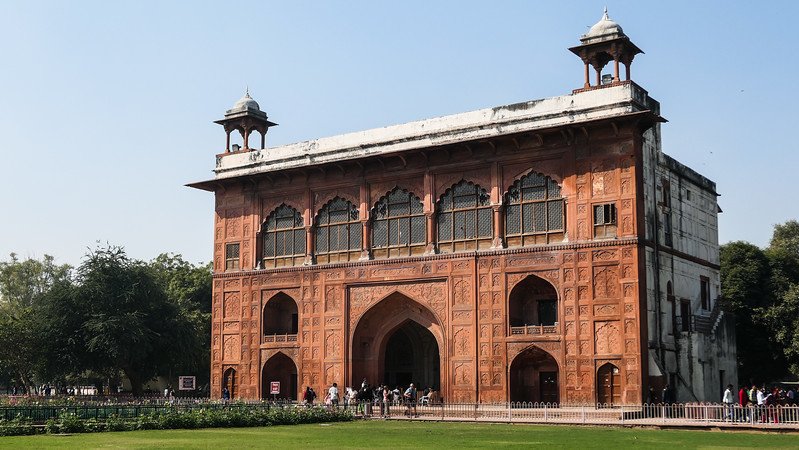
The whole place is beautiful, but the one structure that took my breath away was the Lahori Gate, named so because it faces towards Lahore, Pakistan. The gate is a giant mass of red sandstone, and the arch carries your eyes all the way up until you reach a roof pavilion, which I sadly couldn’t fit into one picture. Imagine setting foot through those gates several centuries back and finding yourself in the heart of a bustling bazaar!
Humayun’s Tomb
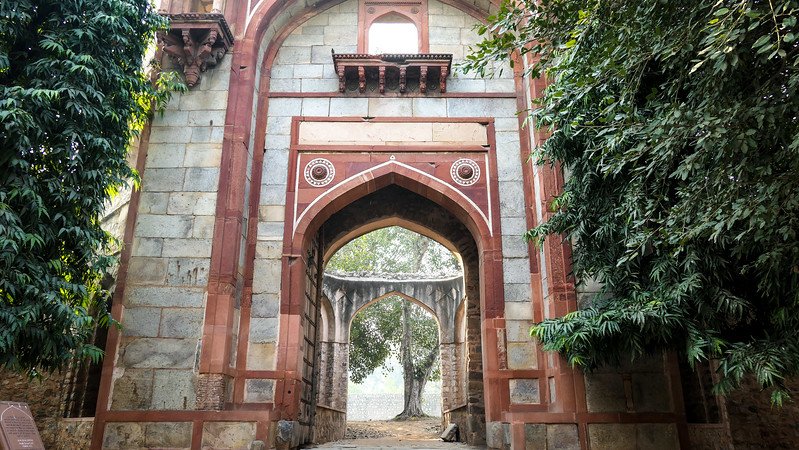
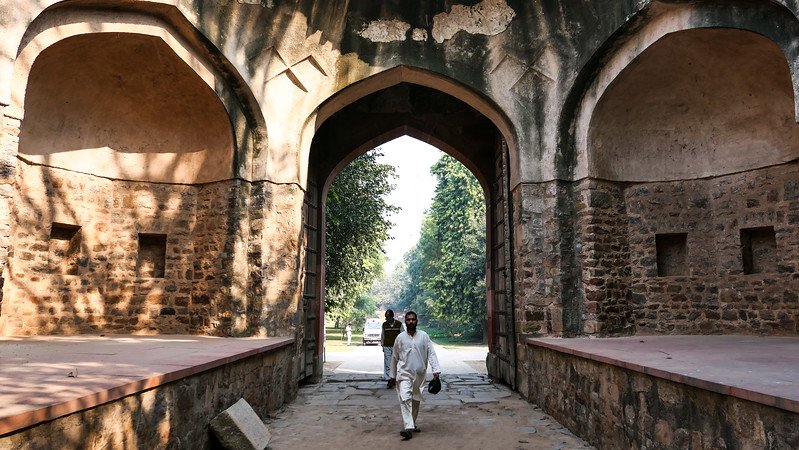
Our second day in Delhi was reserved for the place I had been most looking forward to Humayun’s Tomb – a name that had been uttered in class at least a thousand times.
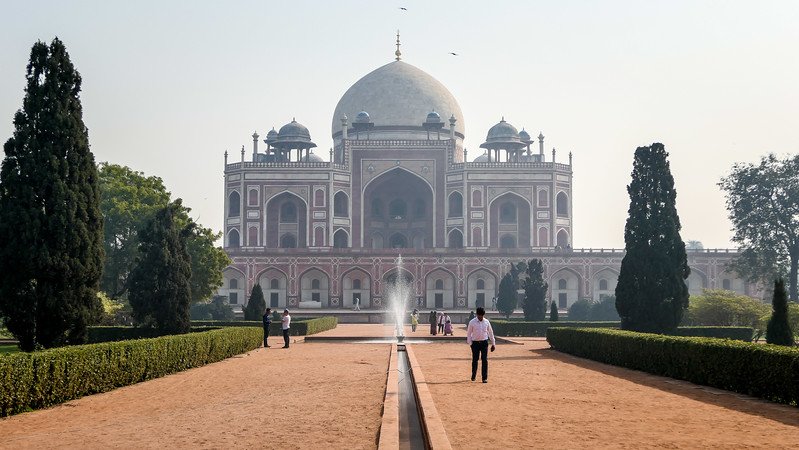
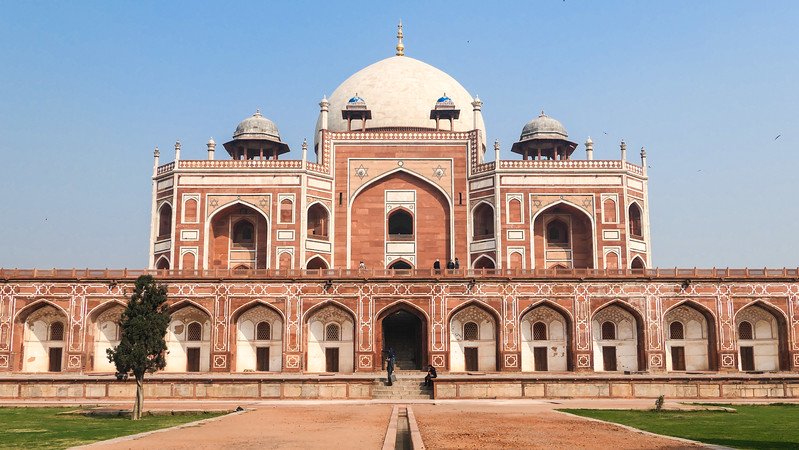
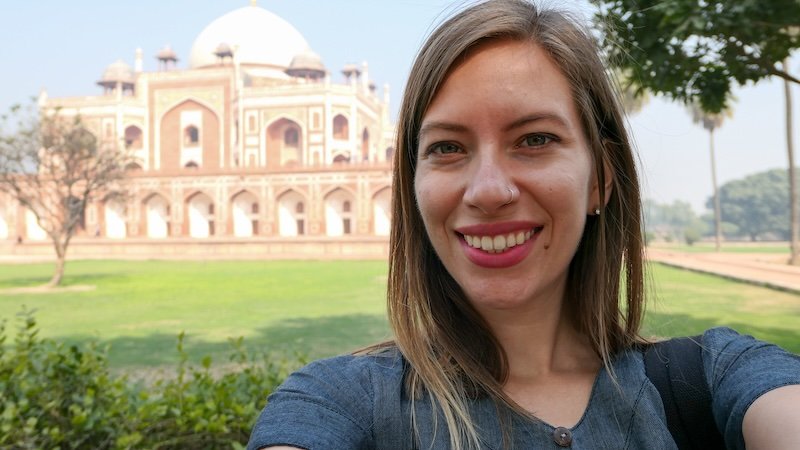
The tomb was commissioned by Humayun’s first wife, Empress Bega Begum, who deeply mourned his passing and consequently dedicated her life to building the most beautiful mausoleum to keep his memory alive. I think she did a pretty good job because, for me, this was the most beautiful building I saw in Delhi. When the sunlight hits the red sandstone it just glows, and then once you get up close and see all the intricate details on the facade, you can appreciate its beauty all over again.
Humayun’s Tomb was the first garden-tomb of its kind in India and it also provided the inspiration for the Taj Mahal which would be built many decades later, so if you’re heading to Agra this is a nice little sneak peek at what’s to come!
Jama Masjid
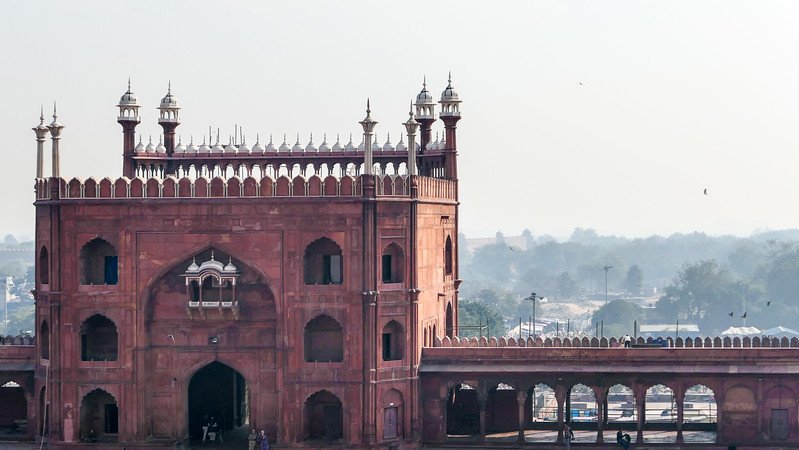
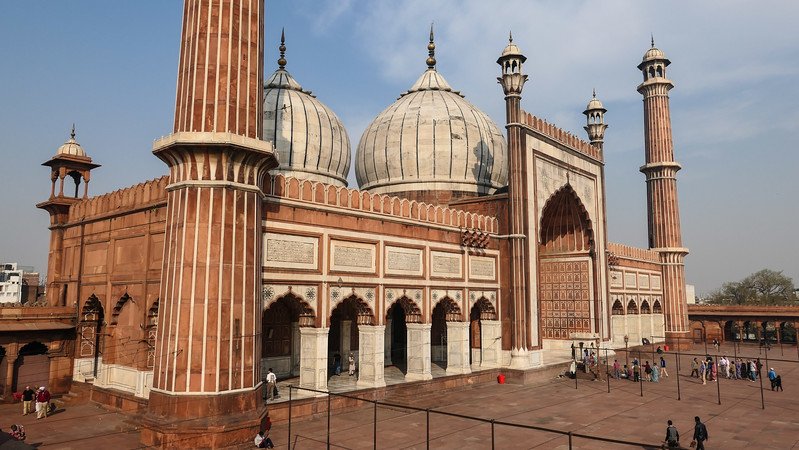
Lastly, on our third and final morning in Delhi, we went to Jama Masjid which is the largest mosque in India. We had attempted a visit the previous day, but we arrived just as they were closing for noon prayers, so we only got a quick glimpse of the exterior. Not this time!
After leaving our shoes at the door, we climbed the southern minaret for views of Old Delhi. While I’m not sure I would repeat the experience (it is a very narrow staircase with people competing to go up and down, plus once you reach the top there’s only a tiny platform to stand on – hello vertigo!), I did enjoy wandering the rest of the grounds.
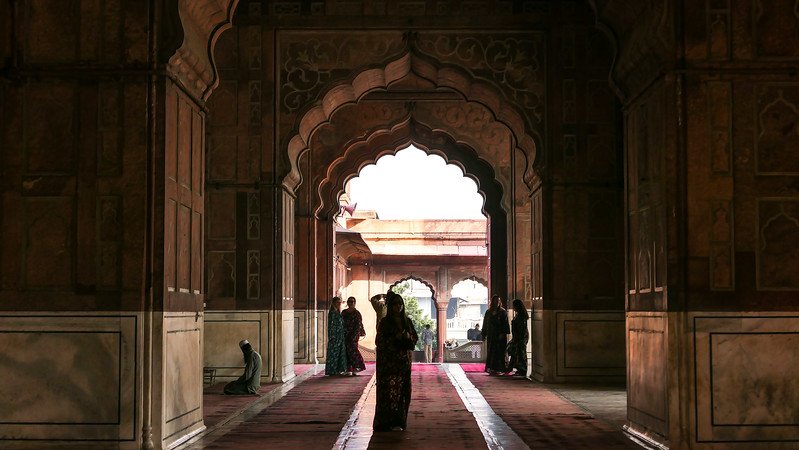
Inside the prayer hall you’ll find white marble floors with black inlays that outline individual places for each prayer mat, the walls are decorated with sweeping arabesques, and you have an enormous crystal chandelier in the centre of the hall.
That was my grand introduction to Delhi: three days, three Mughal structures, and enough sandstone to leave me seeing red in the city.
As I write this I’m sitting in a homestay in Agra where the rooms are full of books and artefacts from around the world and you wouldn’t believe what I spotted. On a wooden coffee table with carved elephant figures lay the very same 600+ page title, Islam: Art and Architecture, which first introduced me to these buildings. I had to pick it up, flip through the pages, and laugh at the serendipity of it all.
Visiting Mughal Delhi: Planning Your Own Day at Red Fort, Humayun’s Tomb and Jama Masjid
The video above covers the visual experience. This section is the practical planning layer — how to order the three sites across one day or three, what to actually look for once you’re standing in front of these buildings, what to eat nearby, and what to pack for a day in Delhi heat.
How to Structure Your Visit
All three sites are doable in a single ambitious day, but two or three days lets the buildings reveal more. Mughal spaces reward slow looking.
Option A: One Full Day
- Sunrise at Humayun’s Tomb
Arrive right as the gates open. The red sandstone glows, the gardens are quiet, and the symmetry is genuinely calming. Bring water and take your time. - Late morning at Jama Masjid
Reach Old Delhi before lunch. Explore the courtyard and prayer hall, then wander the lanes for a snack. Check posted prayer times at the gate — tourist access pauses during prayers, especially at midday. - Late afternoon at the Red Fort
Let the heat mellow before heading in. Soft, angled light makes the arches and jali screens worth photographing. If you’re a museum person, allow extra time for the galleries inside the complex.
This order gives you the best light at Humayun’s Tomb in the morning, lets you navigate Old Delhi before the heat peaks, and ends with the fort as the day cools. A practical note before you plan around it: the Red Fort has traditionally closed on Mondays, though reporting on this has been inconsistent recently, with some sources describing revised, every-day access. Confirm the current schedule on the official ASI site or at the gate the day before, rather than assuming either way.
Option B: Two Gentle Days (My Favourite)
- Day 1: Humayun’s Tomb plus nearby additions — the Nizamuddin Basti lanes and Sunder Nursery gardens are a five-minute walk and entirely worth the detour.
- Day 2: Jama Masjid and Old Delhi food in the morning, Red Fort in the late afternoon.
Option C: Three Days (For Slow Travellers and Architecture Enthusiasts)
- Day 1: Humayun’s Tomb complex — explore the satellite tombs too, take a late lunch, browse a bookshop.
- Day 2: Jama Masjid, Old Delhi food crawl, heritage walk through the lanes.
- Day 3: Red Fort in depth — museums, pavilions, then a sunset rickshaw ride along the outer walls.
Reading the Buildings
The Three Signatures of Mughal Architecture
- Symmetry and axial planning
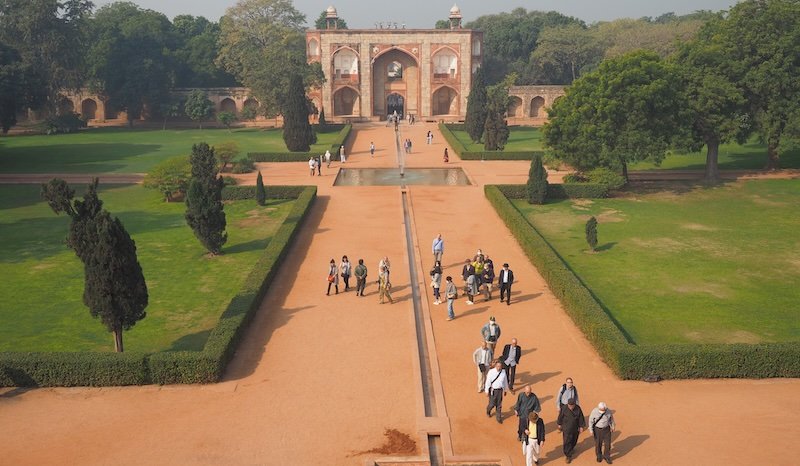
Stand at the centre of any doorway, dome, or garden path. Notice how everything balances left-right and front-back. At Humayun’s Tomb especially, the alignment is so precise it feels almost mathematical. - Red sandstone and white marble
A cherished contrast: earthy warmth meets luminous cool. From a distance it’s bold graphic design; up close it’s delicate inlay work you could spend an hour in front of. - The charbagh (four-part garden)
Particularly at Humayun’s Tomb: water channels and paths divide the garden into four quadrants, a pattern rooted in Persian paradise imagery that you’ll also see at the Taj Mahal.
Details Worth Finding
- Jali screens: Stone lacework casting patterned shadows across floors and walls — find them in pavilions and screened balconies.
- Lotus and cypress motifs: Floral carvings that blend Persian and Indian sensibilities in the same carved surface.
- Calligraphy bands: Qur’anic verses in elegant script tracing the edges of portals.
- Cusped arches: The soft scalloped arches that feel almost like ripples frozen in stone.
- Chhatris: The small domed kiosks punctuating rooflines — more interesting than they sound once you start noticing them everywhere.
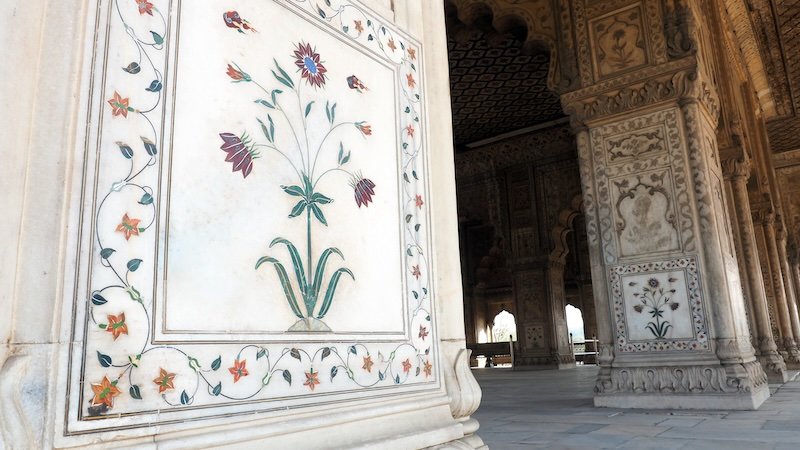
- Pietra dura: Coloured stone inlay forming flowers and vines on white marble — the same technique that would reach its apex at the Taj Mahal.
How Humayun’s Tomb Nearly Lost Its Garden
The charbagh you walk through today is not, strictly speaking, the one Bega Begum built. After 1857, British administrators in Delhi began reworking Mughal gardens across the city into the flatter, hedge-lined style fashionable in England at the time, and Humayun’s Tomb was not spared: its four water-fed quadrants were leveled into English lawn, and the underground channels that once carried flowing water through the site fell dry and were largely forgotten. Lord Curzon pushed back on some of this in the early 1900s, ordering overgrowth cleared and the original gateways reconstructed, but the garden itself stayed a British-style lawn for most of the twentieth century.
The reversal only came in 1997, when the Aga Khan Trust for Culture committed to restoring the gardens as a gift marking fifty years of Indian independence. It took until 2003 just to get water flowing through the channels again, at a gradient so precise the beds rise barely a centimetre every forty metres. The tomb itself came next: craftsmen spent years removing roughly a million kilos of twentieth-century concrete and cement patchwork from the roof, walls, and floors before the original stone and lime plaster underneath could be properly restored, finishing in 2013. That same restoration effort spilled outward into the neighbourhood — it’s the reason the Sunder Nursery gardens and the Nizamuddin Basti lanes you might wander after your visit look and feel the way they do today, since they were part of the same decades-long project rather than separate attractions that happen to sit nearby.
The Red Fort’s Second Life as a Courtroom
Long after the Mughals stopped ruling from it, the Red Fort kept being used to send a message. In 1858, the British put Bahadur Shah Zafar — the last Mughal emperor, who had fled to Humayun’s Tomb during the 1857 uprising before being captured there — on trial for treason inside the fort’s Diwan-i-Khas, the same hall built for private royal audiences. He was exiled to Rangoon and died there four years later, never seeing Delhi again. Nearly ninety years afterward, the British staged a second, far more consequential trial in almost the same rooms: the 1945 court-martial of three Indian National Army officers, deliberately chosen to invoke the memory of Zafar’s humiliation. It backfired. The trial galvanised nationalist sentiment across religious lines, drew crowds outside the fort demanding the officers’ release, and is credited by some historians as more decisive to Britain’s exit than any single civil disobedience campaign.
Two years later, Jawaharlal Nehru hoisted independent India’s flag from the fort’s Lahori Gate, and every prime minister since has addressed the nation from those same ramparts each Independence Day. Standing at that gate today, it’s worth remembering it was chosen as a courtroom of humiliation twice before it became a stage for the opposite.
Practicalities: Entry Fees, Timing, Dress and Getting Around
Entry Fees and Opening Hours
- Humayun’s Tomb: Foreign-visitor pricing has ranged roughly INR 500–600 across recent listings; open daily, sunrise to sunset. Mornings are beautiful and quieter; midday heat is real.
- Jama Masjid: Free entry; a small camera fee applies. Closed to tourists during prayer times — check posted times at the gate, particularly for the midday closure.
- Red Fort: Foreign-visitor pricing has recently ranged roughly INR 500–600. Reports differ on whether the long-standing Monday closure is still in effect — treat this as a live detail rather than a fixed rule and check before you plan around it. Late afternoons offer better light and smaller crowds; if you’re a museum visitor, allow extra time inside.
Entry fees are set by the Archaeological Survey of India and adjust periodically — verify current rates and hours at the gate or through the official ASI website before your visit. Keep tickets handy; multi-gate complexes may check again inside.
What to Wear
- Respectful clothing is appreciated at all three sites and required inside Jama Masjid — shoulders and knees covered.
- A light scarf is the single most useful item: sun protection, dust, and head covering at the mosque.
- Shoes you can remove easily — you’ll leave them before entering the prayer hall; socks help when the ground is hot.
Bags and Security
- Standard security checks at fort and tomb entrances.
- Pack light: water, hat, sunscreen, a small power bank, and tissues.
Getting Around
- Metro: Fast and reliable. Pair with short auto-rickshaw hops to reach sites near the stations.
- Auto-rickshaw: Good for hops between nearby sites; agree on a fare or request the meter.
- Ride-hailing apps: Useful for longer journeys or when you’re too tired to negotiate.
What to Eat Nearby
- Near Humayun’s Tomb: The Sunder Nursery café for a calm, leafy brunch if you’re pairing the gardens with your tomb visit. Small bakeries and tea stalls in the Nizamuddin Basti lanes are worth following with curiosity.
- Old Delhi around Jama Masjid: Seekh kebabs, nihari, jalebi, and kulfi in the lanes just beyond the mosque. Look for busy, well-established shops; early mornings and evenings are the best times. Midday heat flattens enthusiasm for street food.
- Red Fort side: Grab a snack near the gate, then consider a taxi to a restaurant away from the tourist corridor for a proper sit-down meal.
Across all three areas: bottled or filtered water, freshly cooked foods, and high-turnover stalls are your most reliable choices.
The Three Sites Compared
| Feature | Red Fort | Humayun’s Tomb | Jama Masjid |
|---|---|---|---|
| Vibe | Walled city, pavilions, long axes | Serene garden-tomb, pure symmetry | Living mosque, vast courtyard |
| Time needed | 2–3 hours (more with museums) | 1.5–2 hours (longer for satellite tombs) | 45–90 minutes plus area wander |
| Best light | Late afternoon to sunset | Sunrise to early morning | Morning or late afternoon |
| Don’t miss | Arches and pavilions, jali, Lahori Gate | The long garden approach, marble inlay, charbagh | Courtyard geometry, calligraphy, city views from minaret |
Jama Masjid Is Still a Working Mosque
It’s easy to walk into Jama Masjid treating it the way you’d treat the Red Fort — a monument to look at, photograph, and move on from. That framing misses what’s actually happening there. The mosque has had an unbroken line of religious leadership since Shah Jahan installed its first Shahi Imam at the 1656 inauguration, a Bukhara-born cleric whose descendants have held the position ever since, and it functions today as Delhi’s principal congregational mosque, with the courtyard filling for Friday prayers and swelling further for Eid. Tourist access pauses around those prayer windows not as a bureaucratic inconvenience but because the building is doing the job it was built for.
That living role has shown up at moments beyond scheduled prayer, too. Displaced families sheltered in and around the mosque during the upheaval of Partition in 1947, and it has repeatedly become a gathering point during moments of national tension since, most visibly during protests in 2019. None of this makes it less worth visiting — if anything, standing in a courtyard that has held prayer, refuge, and protest in roughly equal measure over nearly four centuries is a different experience than photographing a preserved ruin, and it’s worth carrying that distinction with you as you walk through.
Where to Stay in Delhi
The three sites are spread across Delhi — Old Delhi for the Red Fort and Jama Masjid, South Delhi for Humayun’s Tomb. Your choice of base shifts which site gets the early-morning slot. Five properties span the range from backpacker budget through honeymoon splurge, so pick based on which itinerary above you’re following as much as on price.
- Zostel Delhi — the best-known backpacker hostel in the city, tucked into Paharganj just steps from New Delhi Railway Station. Dorms and private rooms, a rooftop common area, and a genuinely social atmosphere for solo travellers who want to meet people before heading into Old Delhi. Confirmed bookable on Booking.com.
- Bloomrooms @ New Delhi Railway Station — a bright, well-reviewed mid-range option in Paharganj with air-conditioned rooms, a fireplace lounge for cool winter evenings, and an easy walk to Connaught Place. Good middle ground for couples who want more privacy than a hostel without paying heritage-hotel prices. Confirmed bookable on Booking.com.
- Haveli Dharampura — a UNESCO-awarded boutique heritage hotel sitting in the historic alleyways of Old Delhi, within walking distance of the Red Fort and Jama Masjid. The building itself is a heritage property, which means staying here is an extension of the architectural experience rather than a break from it. Confirmed bookable on Booking.com.
- The Metropolitan Hotel and Spa New Delhi — a 5-star property in Connaught Place with an outdoor pool, connecting rooms, and kids-stay-free policies for younger children, making it the most practical pick on this list for families balancing sightseeing with downtime. Confirmed bookable on Booking.com.
- The Lodhi — a contemporary luxury property in South Delhi, close to Humayun’s Tomb, with rooms built around private plunge pools and some suites overlooking the tomb itself. For anyone doing the two- or three-day version of this visit with Humayun’s Tomb as the priority, or planning a honeymoon splurge, this is the right base. Confirmed bookable on Booking.com.
Book These Delhi Experiences
If you’d rather not navigate Old Delhi’s lanes or the tomb complexes solo, these three cover a heritage walk, a private guided tour, and an evening spectacle — each a genuinely different way to experience the sites above.
- Old Delhi Heritage Walking Tour with Rickshaw Ride — a roughly three-hour guided walk through Chandni Chowk and the lanes around Jama Masjid, finishing with a cycle-rickshaw ride to the spice market. Well suited to Option A or B above if you want the food-and-bazaar side of Old Delhi narrated rather than self-navigated.
- Skip-the-Line Humayun’s Tomb Tour with Transfers — a private guided walkthrough of the tomb, gardens, and charbagh with hotel pickup included. Worth it if the restoration history above made you want the fuller story on-site rather than from a plaque.
- Red Fort Light and Sound Show Guided Tour — an evening visit built around the fort’s sound-and-light show, which narrates the building’s history — including the trials described above — against the illuminated ramparts. A good way to close out a day that started at Humayun’s Tomb.
What to Pack
Essentials:
- Water (refillable bottle)
- Hat, sunscreen, sunglasses
- Light scarf — sun protection, dust, head covering at Jama Masjid
- Comfortable, respectful clothing and easy on/off shoes
- Tissues and hand sanitiser
- Small power bank and cable
- Cash for small purchases, tips, and auto-rickshaws
Useful additions:
- Foldable fan or cooling towel (Delhi heat is not a suggestion)
- Mini first aid — plasters, ibuprofen, rehydration salts
- A small notebook for jotting motifs and impressions as you go
Common Mistakes and How to Avoid Them
- Assuming the Red Fort’s Monday closure still applies without checking: Reports on this have been inconsistent recently — verify current hours before you build a day around it.
- Rushing the sites: Slow down. You’ll notice significantly more.
- Arriving at Jama Masjid during prayers: Check the posted times and plan a snack break in the lanes while you wait.
- Underestimating the heat: Hydrate consistently and find shade between sites.
- Forgetting a scarf: It’s the single most useful piece of fabric on the Indian subcontinent.
- Shooting into harsh midday sun: Early mornings and late afternoons are when the sandstone does what it’s supposed to do.
Mughal Architecture in Delhi: FAQ
What’s the best order to visit Red Fort, Humayun’s Tomb and Jama Masjid in one day?
Sunrise at Humayun’s Tomb (soft light, quiet gardens), late morning at Jama Masjid (avoid midday prayer closure), and golden hour at the Red Fort (dramatic sandstone glow). Over two days, pair Humayun’s Tomb with Sunder Nursery and Nizamuddin Basti, and save Old Delhi and the Red Fort for day two.
How do I get between sites?
Delhi Metro plus short auto-rickshaw hops is the most efficient combination. Ride-hailing apps work well between clusters such as Nizamuddin and Old Delhi. Traffic thickens around Chandni Chowk and Daryaganj at midday; early mornings and after sunset are significantly easier.
What should I wear at Jama Masjid specifically?
Shoulders and knees covered; a light scarf for head and shoulders if requested. Shoes off before entering the prayer hall — socks help with hot or cool floors depending on the season.
Can I photograph freely at all three sites?
Outdoors, yes — avoid restricted areas, security checkpoints, and prayer spaces. At Jama Masjid, don’t photograph worshippers closely without asking first. Early and late light is best for sandstone and marble; harsh midday contrast is unflattering and hot.
What architectural features should I look for?
Make a simple checklist: the charbagh garden plan at Humayun’s Tomb; jali stone screens; calligraphic bands; cusped arches; chhatris (domed kiosks on rooflines); and pietra dura floral inlay on marble. Stand on the axial centrelines to appreciate the symmetry.
How much time should I allow at each site?
Humayun’s Tomb: 90–120 minutes (include the satellite tombs nearby). Jama Masjid: 45–90 minutes plus lane wandering. Red Fort: 2–3 hours, more if you’re visiting the museums. Add buffer for security queues at busy periods.
Are there any closures I should know about?
The Red Fort has historically closed on Mondays, though recent reporting on whether that still holds is mixed — check before you plan a day around it. Jama Masjid pauses tourist access during prayer times — particularly the midday closure. All sites are busiest late morning to mid-afternoon; sunrise or late-afternoon visits mean fewer crowds, cooler temperatures, and better photographs.
Are guided tours worth it?
A good guide brings the dynastic context, the inscriptions, and the planning logic of the buildings to life — particularly inside the Red Fort pavilions and through Old Delhi’s lanes. If self-guiding, read the plaques and carry a short primer on Mughal symbolism. The architectural vocabulary section above is a starting point, and the guided options listed above cover each site differently if you’d rather not go it alone.
What about entry fees and tickets?
Recent foreign-visitor pricing has ranged roughly INR 500–600 at both Humayun’s Tomb and the Red Fort, though figures vary by source and change periodically; Jama Masjid is free with a small camera fee. Most ticket windows accept cards or digital payment, but carry small cash for lockers, shoe-keeping, tips, and auto-rickshaws. Fees are set by the Archaeological Survey of India — verify current rates on arrival or via the official ASI site.
Family and accessibility notes?
Humayun’s gardens have shade and mostly level paths, though some tomb thresholds have steps. The Red Fort spans long distances — water and sun hats are necessary, not optional. At Jama Masjid, expect staircases and shoe removal; socks or disposable foot covers help.
Where and what should I eat nearby?
Pair Jama Masjid with Old Delhi staples: seekh kebabs, nihari, jalebi, kulfi at busy, high-turnover shops. Near Humayun’s Tomb, the Sunder Nursery café and Nizamuddin Basti bakeries are the natural stop. Hydrate with bottled or filtered water throughout the day.
What should I have in my day bag?
Refillable water bottle, hat and sunscreen, light scarf, comfortable modest clothing, easy on/off shoes, tissues and hand sanitiser, small power bank, and a short list of architectural features to spot. The detail-hunting makes the buildings click in a way that passive looking doesn’t.
Mini-Glossary
- Charbagh: Four-part garden plan.
- Chhatri: Small domed pavilion on a roofline.
- Jali: Ornamental perforated stone screen.
- Pietra dura: Stone inlay decoration in marble.
- Iwan: Vaulted hall or portal with an arched opening.
- Mihrab/Minbar: Prayer niche indicating direction of Mecca / pulpit in a mosque.
Have you checked out the Mughal architecture in Delhi?
These pictures are gorgeous! I had never heard of Humayun’s Tomb. I would probably visit this site before the Taj Mahal after seeing these photos. What strikes me (which you probably covered in your art history class) is the scallops in the architecture. They are really unique. Other architects are praised around the world for their clean lines or large domes. The scallops are such a rare example of this kind of attention to detail. Just beautiful!
I hope you get to visit, Leah! It’s amazing to see the amount of detail that went into these buildings, especially once you get up close.
Delhi looks beautiful though! And I really love their architecture!
-Kiara
http://www.viaisabelle.com
There are some real gems scattered across the city. There were so many other temples and tombs that I wanted to visit, but I ran out of time!
Lovely photos! While I openly admit that Delhi is not my favorite city in India, it is certainly picturesque. Thank you for capturing its beauty and for reminding me of the good memories I have of the city. I hope you enjoy the rest of your travels in India! 🙂
Thanks Veena! I ended up enjoying Delhi a lot more than I thought I would. Some parts were overwhelming – especially around Old Delhi – but it was these little pockets of tranquility that made all the difference.
Wow, as an art lover and history addicted I am sure I would love these sights. I think Islamic architecture deserves more attention: it is really amazing.
Agreed! You could turn a trip to India into an architecture themed tour. There are so many amazing structures scattered across the country.
It looks amazing and I love the sound of the class you took – a good way to have a taste of travel while studying! Do you still plan to make a video about earning money as a digital nomad? You mentioned it in January and I’ve been on the edge of my seat ever since! Thanks for all the great videos and blog posts – I am saving up all your tips as I save up for my trip : ) Hope you have a great time in India. Try Idli Samba while you are there if you can. (It’s a dish from South India and it’s amazing!)
Hi Frey! Yes, we’re planning to make that video now that we’re back in Canada for a bit. We’re currently editing Nepal and India, so that one’s next on the list. In the meantime I’ll say that when I first started out, I was doing a lot of freelance writing for various travel websites, but these days I’ve been doing more to monetize my blog and YouTube.