
Planning a day trip to Malbork Castle so you can visit the largest castle in the world? Here’s everything you need to know!
If you’re travelling to Gdansk, a beautiful city on Poland’s Baltic Sea, then you’ll want to make time for a day trip to Malbork Castle. This historic redbrick castle is one of the most famous in all of Poland and for good reason – it is the largest castle in the world by land area, plus it’s super easy to get there by train.
We went on a lot of different day trips during our visit to Gdansk: we spent a day in the seaside resort town of Sopot, we visited good friends in Gdynia, and we, of course, tacked on a day trip to Malbork where we had a really fun day getting lost in the maze that is the castle.
In this article, we’re going to share everything you need to know to plan your own visit to Malbork.
Things to Do, See, Eat, Drink & Experience at Malbork Castle
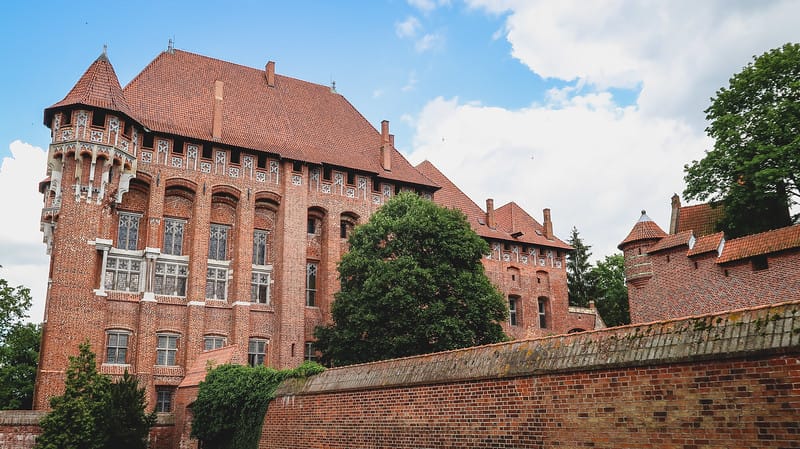
How to get to Malbork Castle
Malbork Castle is best visited on a day trip from Gdansk, which is just under 1 hour away.
If you’re coming to Malbork Castle by train, you have two options: you can either take the slow train which costs 11 PLN ($3 USD) and takes 50 minutes, or you can take the fast train which costs 55 PLN ($15.25) and takes 30 minutes. At that price, it’s worth taking the slower train if you ask me!
Both trains depart from Gdańsk Główny Train Station and once you arrive in Malbork, it’s about a 15-20 minute walk to the castle.
Alternatively, this Malbork Castle tour from Gdansk includes a guided castle visit and transportation there and back.
A Brief History of Malbork Castle
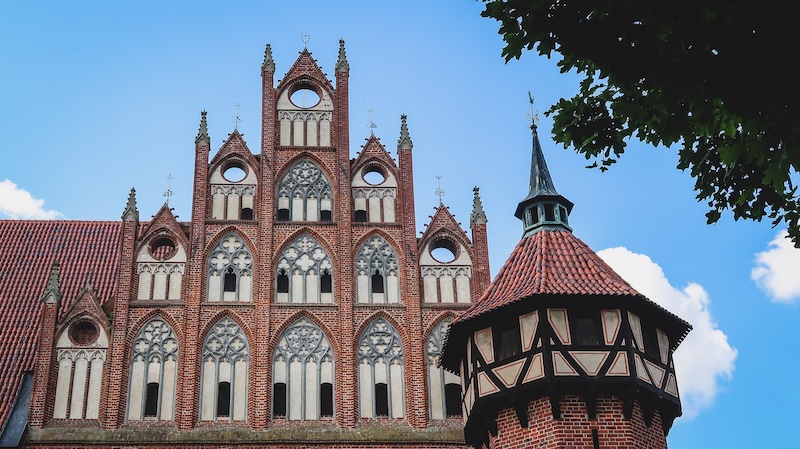
To give you a bit of background, Malbork Castle, also known by its full name as the Castle of the Teutonic Order in Malbork, dates back to the 13th century.
The castle was originally built as a fortress by the Teutonic Knights, a German-Roman Catholic religious order of crusaders, and it served as a stronghold in the region encompassing Malbork and what was then known as Danzig (present-day Gdansk).
The purpose of the fortress was to strengthen the Teutonic Knights’ control in the area, plus the castle’s favourable position on the banks of the River Nogat gave the Teutonic Knights easy access to both the Vistula and the Baltic Sea. That’s right, the knights collected river tolls from passing ships to fund their ventures!
The castle remained under the control of the Teutonic Knights until 1457 when it was seized by King Casimir IV Jagiellon and Polish forces. Over the subsequent 500 years, the castle witnessed a tumultuous history, oscillating between German and Polish control.
During the Second World War, the castle suffered significant damage, with around half of the structure being destroyed. However, it has since been rebuilt and restored.
Today, Malbork Castle is listed as a Historic Monument of Poland and a UNESCO World Heritage Site.
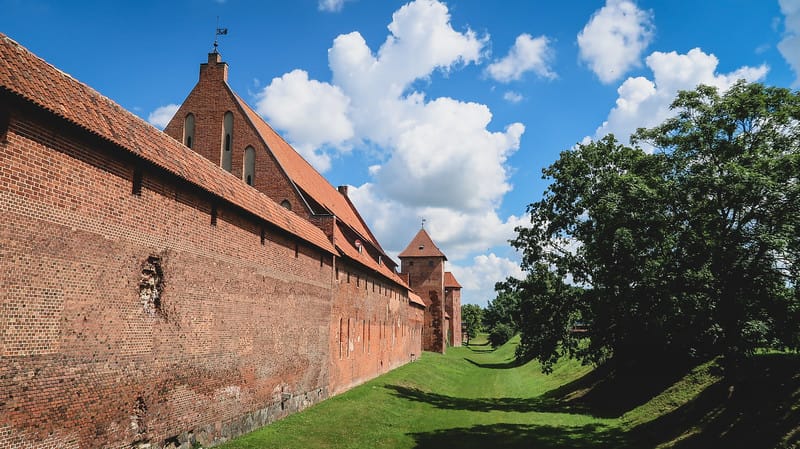
How big is the biggest castle in the world?
It turns out that measuring a castle’s size isn’t a very straightforward task.
Are you looking at just one building or an entire complex? Do you take into account the land within the walls of the castle, or does that not count? What about later additions and expansions that veer from the original plan? And do fortresses count as castles? So many questions!
For classification purposes, Malbork Castle is the largest castle in the world measured by land area, and it occupies a whopping 143,591 square meters. Let me tell you, that means you’re going to be walking a lot on your day trip to Malbork Castle.
Also, when it was completed in 1406, Malbork Castle was the world’s largest brick castle, so this place has been setting records for centuries!
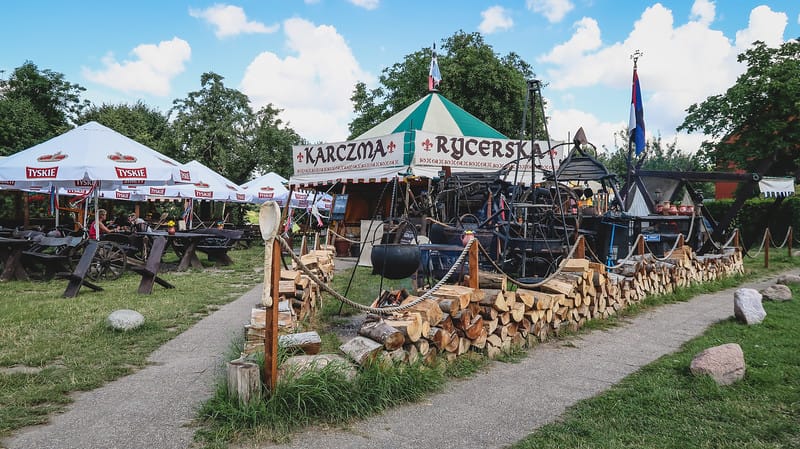
A Medieval lunch at Malbork Castle
But first, let’s talk about food because being the foodies that we are, we were hungry halfway through the morning (I’m talking as soon as we reached the castle) and we couldn’t imagine sightseeing around the biggest castle in the world without a little bite to eat.
Well, it wasn’t long before we sniffed out an outdoor restaurant by the name of Karczma Rycerska, which had a bit of a medieval theme going on. Bonus points!
They had a big cauldron of Hunter’s Stew cooking (this is also known as bigos and it’s a typical Polish dish made with cabbage and different types of meat) so our curiosity was piqued.
Once we wandered a little closer, the tantalizing aromas lured us in further, and before we knew it we were sitting at a table with two platefuls of food in front of us.



I ordered the Hunter’s Stew with Roasted Potatoes and Kielbasa, and it was a meal fit for a king! I already love Sauerkraut so I thought the stew tasted delicious, the potatoes were golden and perfectly seasoned, and the sausage was crispy on the outside but juicy on the inside.
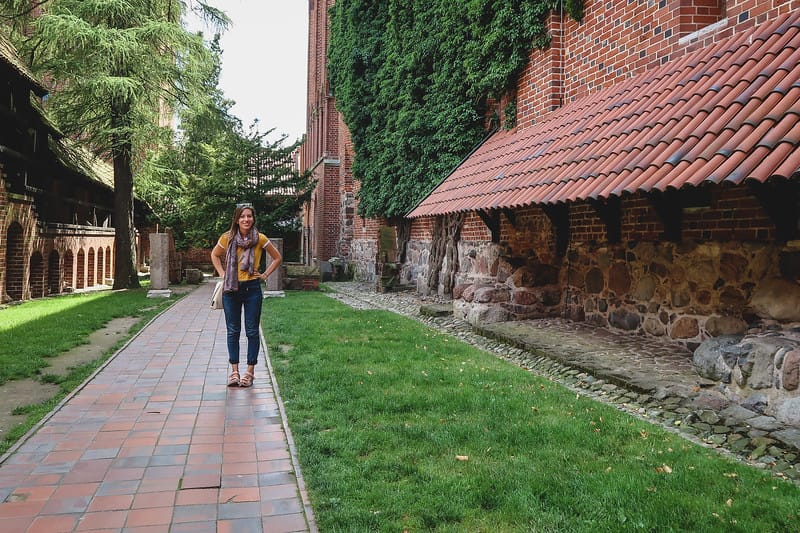
Visiting Malbork Castle
With appetites satiated, we could now focus on exploring the castle. We paid our admission ticket with an audio guide (the cheapest option), which came to 39.50 PLN ($11 USD) and we set out to explore the castle. Once we walked through the main gates and into the central courtyard, we discovered that there’s quite a bit to see and do there.
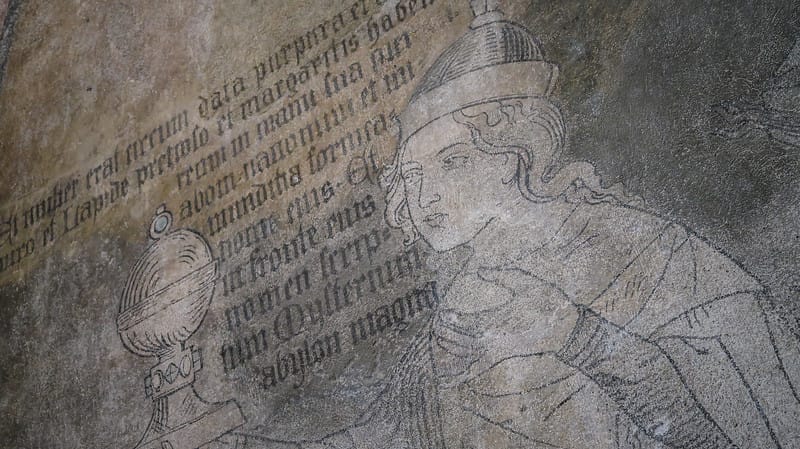
Malbork Castle is divided into 3 sections: the Lower Castle, the Middle Castle and the Upper Castle.
- Lower Castle: This includes the entrance to Malbork Castle where you walk across a drawbridge and through the portcullis. This was the castle’s main line of defence.
- Middle Castle: This is where you’ll find the Grand Master’s Hall, which was used as a royal residence and it’s where key decisions were made; the Amber Collection, a museum dedicated to the history of amber in Poland; and the Historic Weapons Collection, where you can see weapons and armour that would have been used by the Teutonic Knights.
- High Castle: This is home to the Central Courtyard, where the Teutonic Knights had a well in case they got caught in a siege; the Chapter Room, where Grand Masters of the Order were elected; St. Mary’s Church, which was used as the main castle chapel; and Wiezna Glowna, a tower that you can climb for the best castle views.
How Best To See Malbork Castle
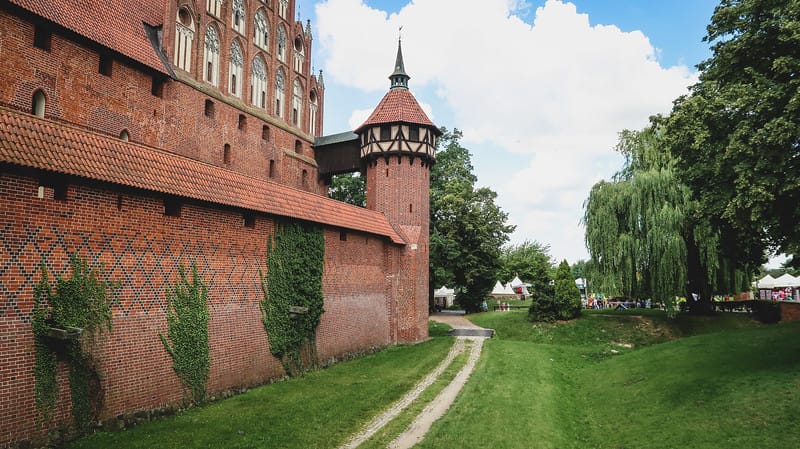
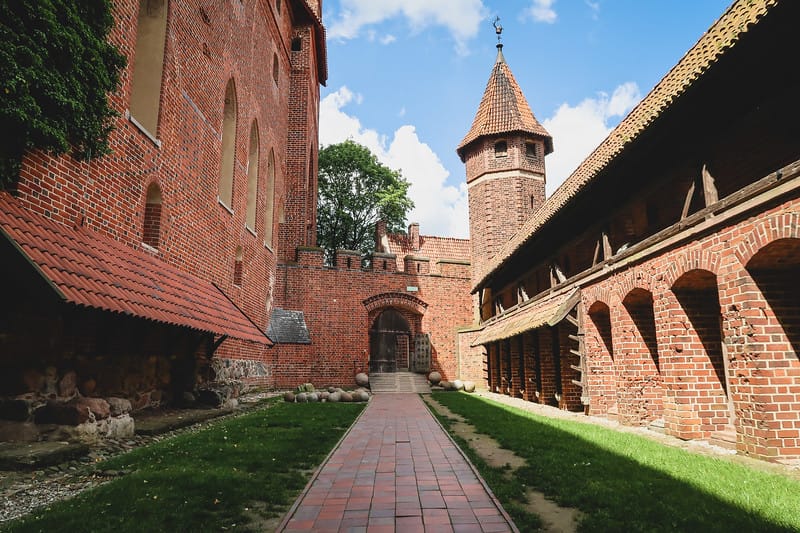
Because this is one of the biggest castles in the world, you really need to have a bit of a strategy if you want to see it all and it’s best to tackle one section at a time.
That was not our approach! We went on our own little exploration wandering down halls, through courtyards, popping in and out of museums, turning wherever something caught our attention, and avoiding crowds whenever we came across a place that was a little too crowded. I’m sure we missed plenty of things because we were winging it!
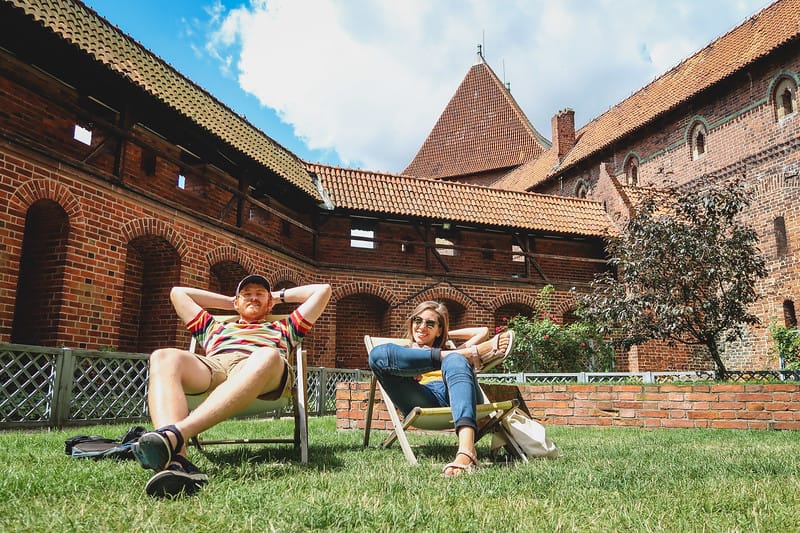
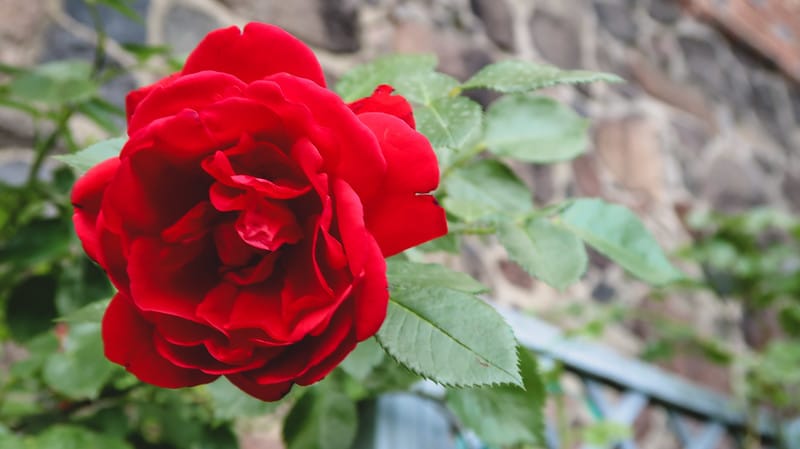
However, there were some nice surprises along the way. For example, we discovered this rose garden down one of the little paths and it basically felt like our very own secret garden. We plopped into the free lounge chairs for a bit of sunshine…but not for too long because I am married to a freckly redhead.
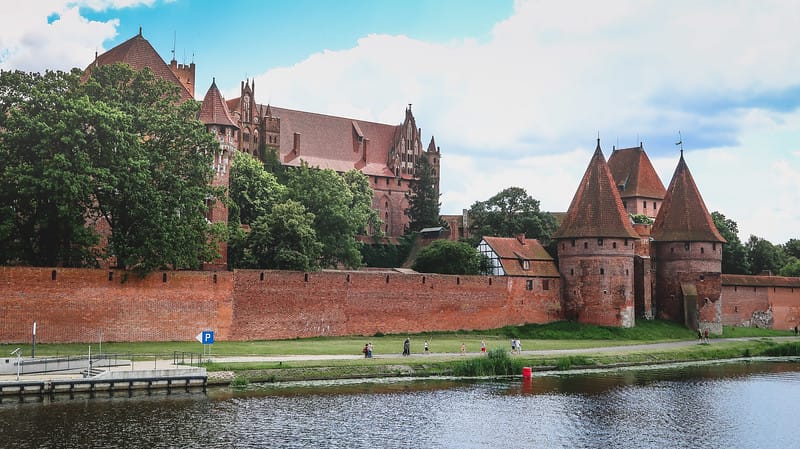
After a bit more wandering around the castle grounds, we reached the backside of the castle, which looks over the Nogat River. As a tip, this is a really nice spot if you’re looking to photograph the whole castle (though the light is better in the morning), and this view also helps put into perspective just how big Malbork Castle is.
Other Ways To Enjoy Malbork Castle
We also noticed there were river cruises on offer right along the banks, as well as a few cute little outdoor cafes just on the other side of the river, so there’s plenty to do once you’re done visiting the castle.
That being said, we were wiped from a long day of walking around, so we decided to call it a day soon after. We retraced our steps back through the town, stopped for a bite of cake and ice cream, and then hopped on the train back to Gdansk.
Malbork Plan: Tips & Time‑Saving Hacks
(Because the world’s largest castle deserves more than a quick lap around the moat.)
Beat the Crowds with Smart Timing
- High Season (late Apr – Sep): Gates open 09:00–20:00, but the interior route has a last-entry cutoff of 16:30 (grounds stay open later), and daily entry is capped at 500 visitors per hour. Lock in an online ticket for the 09:00 a.m. slot or aim to arrive by mid-afternoon so you’re not turned away at the interior cutoff.
- Low Season (Oct – Apr): Shorter opening hours overall, though gloriously empty courtyards make it perfect for drone‑free panoramas. Worth knowing year-round: Mondays are free-admission, grounds-only days (no interior access) at Malbork, whatever the season — pick up your free ticket at the office on site.
Quick math: You’ll need 3.5–5 hours to do the audio tour justice. Add another hour if you like reading every placard.
Ticket Tactics & Audio‑Guide Gold
| Ticket Type | Price* | What You Get |
|---|---|---|
| Historical Route (Standard) | PLN 80 (60 reduced) | Full castle + audio guide (multiple languages) |
| Walking / Grounds-Only Route | PLN 35 | Great for quick photographers on tight budgets |
| Night Tour | PLN 70 | Story‑telling evening walk through courtyards and select interiors; runs Wed–Sat, seasonally May–December |
*Prices fluctuate—double‑check the museum’s site before you tap “book.”
Where to Stay for Your Malbork Day Trip
Most visitors base themselves in Gdansk and treat Malbork as a day trip, so it’s worth picking a place close to Gdańsk Główny, since that’s where both the slow and fast trains depart from.
- World Hostel – Old Town is a budget-friendly pick a short walk from the station, with breakfast included — good for solo travelers or backpackers keeping costs down before an early train.
- Scandic Gdańsk sits just 0.18 km from Gdańsk Główny and has a 24-hour health club, sauna, and an arcade/game room — a solid fit for families who want easy access to the train with a bit of downtime built in.
- Podewils Old Town Gdańsk is a 19th-century-style boutique property near the Neptune Fountain and Long Market, with its own terrace — a romantic choice for couples or a honeymoon stay.
- Hilton Gdańsk overlooks the Motława River within walking distance of St. Mary’s Church, and includes a rooftop indoor pool, spa, and free bicycle rental — the splurge option if you want full comfort after a long day of castle walking.
Prefer a Guided Option?
If navigating Polish trains solo isn’t your idea of a relaxing day, a guided tour handles the logistics for you. The From Gdansk: Half-Day Malbork Castle Tour with Audioguide includes hotel pickup, an English-speaking driver, and an audio-guided visit — a straightforward option if you’d rather not think about train timetables. For something more flexible, the Malbork Castle: Private Tour from Gdansk, Sopot or Gdynia offers a private car with pickup from any of the three cities, which suits families or small groups wanting their own pace.
How Malbork Became a Royal Residence
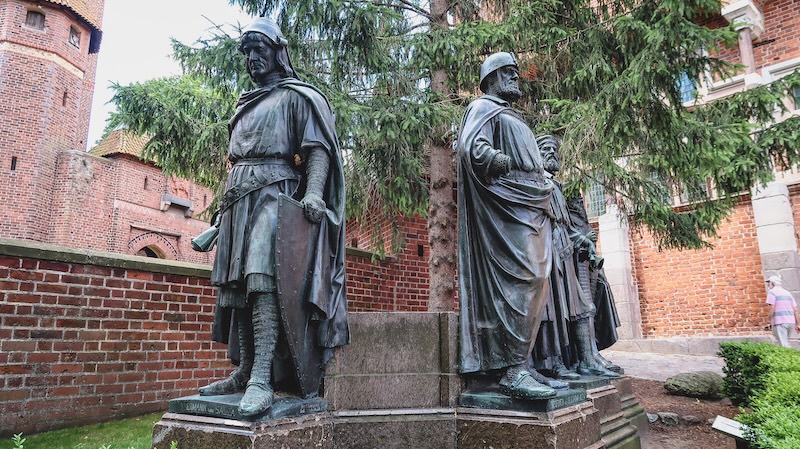
The castle’s story doesn’t end when the Teutonic Knights lost control of it. After Poland’s victory in the Thirteen Years’ War, the Polish Crown took over Malbork and turned it into something quite different from a military headquarters: a royal residence. Polish kings used the castle as one of their seats for centuries afterward, right up until the partitions of Poland in the late 18th century carved the country up between its neighbors and ended that chapter of its history.
That long stretch as a royal residence is part of why Malbork feels less like a single building and more like a small fortified town — successive rulers kept adding to it, adapting rooms and courtyards to new purposes long after the last Teutonic Grand Master had gone.
The Castle Comes Alive: The Siege of Malbork
If you can time your visit for the fourth weekend of July, Malbork puts on one of Poland’s biggest historical reenactments. Hundreds of costumed performers — knights, cavalry, and craftspeople — descend on the castle grounds for a multi-day festival re-staging the 1410 siege, when Polish-Lithuanian forces under King Władysław Jagiełło laid siege to the Teutonic stronghold.
By day, there’s a medieval craft fair inside the castle walls with blacksmiths, potters, and other artisans working the old way. By night, the reenactment itself takes over the grounds with jousting, cavalry charges, and a full battle sequence lit by torchlight. It’s a completely different way to experience the castle than a standard daytime visit, though expect much bigger crowds than usual if you go.
Quick‑Draw Budget (per person)
| Item | PLN | € | US$ |
|---|---|---|---|
| Slow train return | 22 | 4.8 | 5.3 |
| Castle + audio (Historical Route) | 80 | 17.5 | 19 |
| Feast share | 80 | 17.5 | 19 |
| Beer flight | 24 | 5.2 | 5.8 |
| Apple cake | 8 | 1.8 | 2 |
| Total | ≈214 | ≈47 | ≈52 |
Tips
- Scan the QR codes inside the audio handset for bonus video clips—yes, they work offline.
- Bring wired earbuds if you want hands‑free wandering; the castle’s free sets are…well‑loved.
- Skip‑the‑line desks are typically separated from the standard queue at the ticket hall—look for signage rather than assuming a fixed side, since layout can shift.
Practicalities You’ll Be Glad You Knew
- Cash vs. Card: Ticket desks and restaurants take cards, but market stalls and festival booths are cash‑only.
- Lockers: Free lockers are available near the ticket hall—ditch backpacks before clambering towers.
- Family‑Friendly: Strollers manage fine in the Lower and Middle Castle sections; a carrier is more practical for the Upper Castle’s stone stairwells.
- Accessibility: Parts of the castle grounds, ticket office, and toilets are wheelchair-accessible—check with staff at the info desk about interior routes on the day.
- Wi‑Fi: Patchy. Pre‑download your train e‑tickets and Google Translate Polish before arrival.
Sample Half‑Day Itinerary (Slow‑Travel Version)
| Time | Plan |
|---|---|
| 08:30 | Train from Gdańsk Główny (slow line—save those złoty) |
| 09:30 | Walk the riverside path, snap the classic reflection shot |
| 10:00 | Enter castle, audio guide on, start at Lower Castle drawbridge |
| 12:30 | Medieval lunch at Karczma Rycerska |
| 13:15 | Climb Wieża Główna, then loop through Amber & Weapons halls |
| 15:00 | Exit via rose garden, grab a coffee or ice cream at one of the small cafés across the river |
| 16:00 | Train back to Gdańsk—or linger for golden‑hour photography |

Malbork Castle Day Trip: Your Questions Answered
Is Malbork really the largest castle in the world?
Yes—by land area. Malbork Castle (the Castle of the Teutonic Order) covers ~143,591 m², so expect plenty of walking. It was also the world’s largest brick castle when completed in 1406.
What’s the easiest way to get there from Gdańsk?
Train from Gdańsk Główny is the easiest option, with both slower regional and faster intercity services running throughout the day. From Malbork station, it’s a 15–20 min walk to the castle following clear signs. Exact fares shift with the season and booking window, so it’s worth checking current prices when you book rather than relying on a fixed figure.
How much time should I budget—and when should I go to avoid crowds?
Plan 3.5–5 hours for the standard route with the audio guide. To dodge groups, book the 09:00 entry or note that last entry to the interior route is around 16:30—arriving in that final window means a quieter (if shorter) visit.
Which ticket should I buy? Do I need a guide?
Common options (prices vary by season, always check the official site before booking):
- Historical Route (~80 PLN, 60 PLN reduced): Full access + audio guide—great value and the most complete visit.
- Walking / Grounds-only (~35 PLN): Quick wander/photography, no interior access.
- Night tour (~70 PLN, seasonal Wed–Sat, May–December): Atmosphere over depth.
A private guide is optional; the audio guide is excellent.
How is the castle laid out—and what are the highlights?
- Lower Castle: Drawbridge, portcullis, defensive works (your grand entry).
- Middle Castle: Grand Master’s Hall, Amber Collection, Historic Weapons.
- High (Upper) Castle: Central Courtyard well, Chapter Room, St. Mary’s Church, and Wieża Główna (main tower) for views.
Best photo spots and times?
- Nogat River embankment (opposite bank) for the classic full-castle panorama—morning light is kinder.
- Central Courtyard for symmetry, walls and walkways for textures, rose garden for a quiet green pocket. Golden hour adds warm tones and long shadows.
Where can I eat at/near the castle?
Inside the complex you’ll find Karczma Rycerska (medieval-style outdoor spot). Classic picks: bigos (Hunter’s Stew), roasted potatoes, kielbasa. Across the river, small cafés offer cakes, ice cream, and coffee for a soft landing post-tour.
Anything fun to add beyond the walls?
Yes—short river cruises along the Nogat leave from near the embankment, and the riverside path is perfect for a scenic stroll or extra castle photos. If you can time it for the fourth weekend of July, the annual siege reenactment turns the whole town into a medieval festival for a few days.
Is it family-friendly? What about accessibility?
Very. Kids love the scale and knights’ lore. Strollers: manage fine in Lower/Middle sections; a carrier is more practical for the Upper Castle’s stairs and tower. Parts of the grounds, ticket office, and toilets are wheelchair-accessible—ask staff at the info desk about the day’s interior access.
What should I bring/pack?
Comfy shoes, a refillable water bottle, layers (breezy riverside), and wired earbuds if you prefer your own for the audio guide. Card widely accepted, but a bit of cash helps at small stalls.
Are there lockers, Wi-Fi, and other practicalities?
Yes—free lockers are available near the ticket hall (great for backpacks). Wi-Fi is patchy, so pre-download tickets/translation. Toilets are well signed throughout the complex.
Can you suggest a simple half-day plan?
- 08:30 Slow train from Gdańsk
- 09:30 Riverside walk & panorama
- 10:00 Enter; audio guide on (Lower → Middle → Upper)
- 12:30 Lunch at Karczma Rycerska
- 13:15 Amber & Weapons rooms + tower view
- 15:00 Rose garden exit, coffee or ice cream, stroll to station
- 16:00 Train back to Gdańsk
Read more about Poland
- Learning How to Make Pierogi in Poland
- Where to Eat in Warsaw: A Guide for Foodies
- Cool Things to do in Warsaw
- Fun Weekend Guide to Wroclaw
- Must-Visit Places in Krakow
- Things to Do in Wroclaw
- A Travel Guide to Poznan
Do you enjoy visiting castles?
What’s the most impressive castle you’ve ever visited?
I think the only castles I’ve visited are Scottie’s Castle in Death Valley and Sleeping Beauty Castle in Disneyland, both on the same trip when I was very young. I’m assuming that White Castle doesn’t count.
Haha, that might be a bit of a stretch! 😉
That Hunter’s Stew looks so good. But with all that walking, you deserved it 😉
It was so tasty! It’s one of my favourite Polish dishes.
I can’t believe that I’ve never been to Malbork even though I’m from Poland! But sometimes you learn to appreciate what’s in your backyard when others visit! I hope I can find some time and go, your photos surely are convincing!
Happy travels,
Ioanna
A Woman Afoot
Ahhh, I think when we have places so close to home, we feel like we can go anytime, so we often put it off. I’m guilty of doing the same with attractions in my own backyard! 😉
Wow, that looks beautiful and massive!!
It was impressive! A great little spot for a day trip.
Looks beautiful! I definitely do enjoy visiting castles, but it’s been a while since I’ve managed to visit one. It’s always neat to think about how it would have been used in earlier times.
I know what you mean! It feels like a little glimpse at the past.
OMG! That really looks like a huge castle in the photographs. Did you explore it all in one day only? I wonder. 🙂
Yup, it can easily be done as a day trip.
Thank you for letting me know! I’ll give it a try 🙂
Being the biggest castle in the world sure helped in preserving its medieval charm. It’s quite impressive and I can see how you could spend an entire day just visiting the castle. It looks very interesting.
That’s huge! I loved how the castle still preserved its beauty. Thanks for featuring this. Looking forward to seeing more photos of you travel.