
Today I’m here to tell you about what may very well be the coolest festival in Austria: the Almabtrieb!
You may not have heard the name before, but if you’ve ever come across photos of cows with bells around their necks and flowers on their heads, you’ve probably had a glimpse of the Almabtrieb. This is basically a massive welcome home party…for cows!
Yes, you read that right; a party for cattle. I know this probably sounds a little bit confusing, so let’s get to the history of this unusual festival.
Almabtrieb: Cattle Drive From The Mountain Pasture
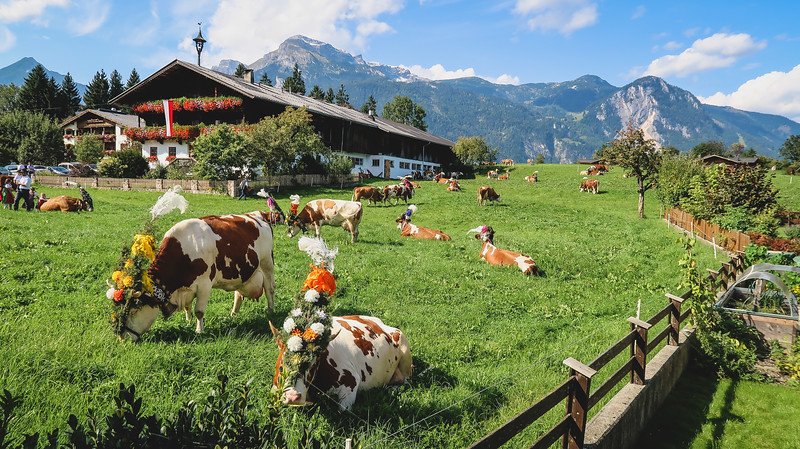
What is the Almabtrieb?
During the summer months, cows are lead up to the Alps by their farmers, where they’ll spend a few months grazing the pastures at a higher elevation. Then, when autumn rolls around and the temperatures begin to drop, the cows make their descent from the mountains and return to their farms for the winter. This practice is called ‘transhumance’, and it’s a type of Alpine nomadism that dates back thousands of years.
The festival itself is a celebration of a good summer season and a safe return home, and these days it’s also a good party that draws tourists from far and wide!
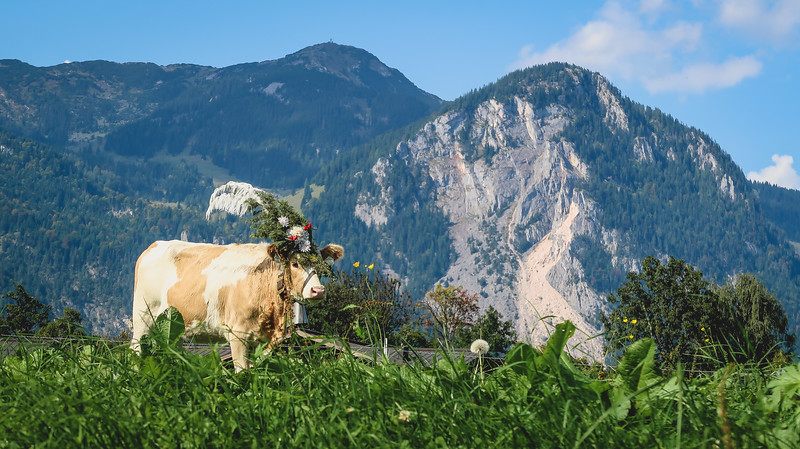
What to expect from the Almabtrieb?
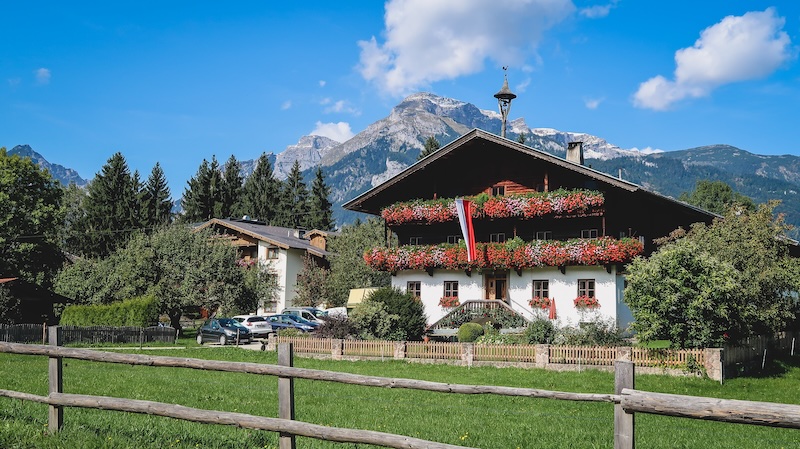
My visit to Tyrol just so happened to coincide with the start of autumn and that meant there were cow parades happening all over the region. Since I was staying in Reith im Alpbachtal, I attended the parade happening in town, but this is just one of many celebrations.
This peaceful little town completely transformed overnight and the streets filled with thousands of visitors; this is the biggest event of the year, so everyone came out to celebrate!
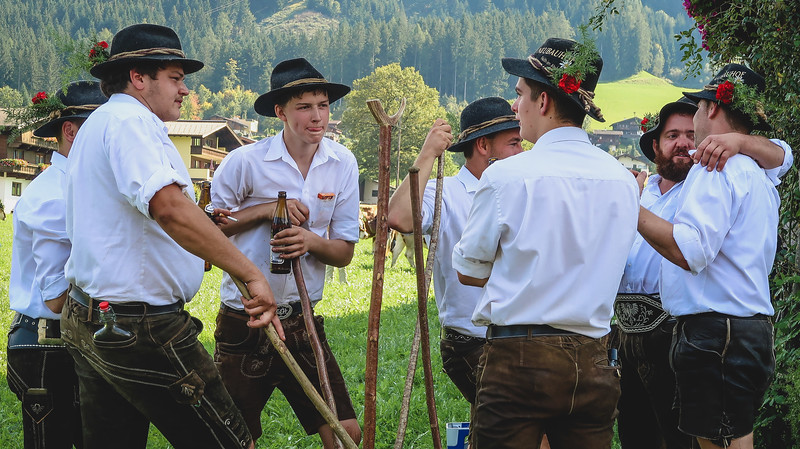
Live music could be heard across the town and the mood was festive. There were Tyrolean bands playing traditional tunes in the main bandstand, all donning their very best lederhosen and feathered hats. As the day progressed the streets turned into a makeshift dance floor with people singing, dancing, and for those who had imbibed too much, some swaying.
There were also lots of stands serving up traditional Tyrolean dishes. There was Hendl (roasted chicken), Prügeltorte (lemon zest cake cooked on a rolling pin), Kasspatzen (noodles with lots of melted cheese) and so much more! Honestly, this was some of the best Austrian food we’ve tried! And it wouldn’t be a proper celebration without a few pints of Bier, so as you can imagine, there was plenty of that flowing.
But it wasn’t all food at the Almabtrieb; there was also a massive craft market set up that ran the length of the two main streets. There were all kinds of locally handcrafted souvenirs like Tyrolean felt hats, knit sweaters, hand-painted glass ornaments, ceramic cow figurines, bottles of schnapps, and just about anything you could imagine.
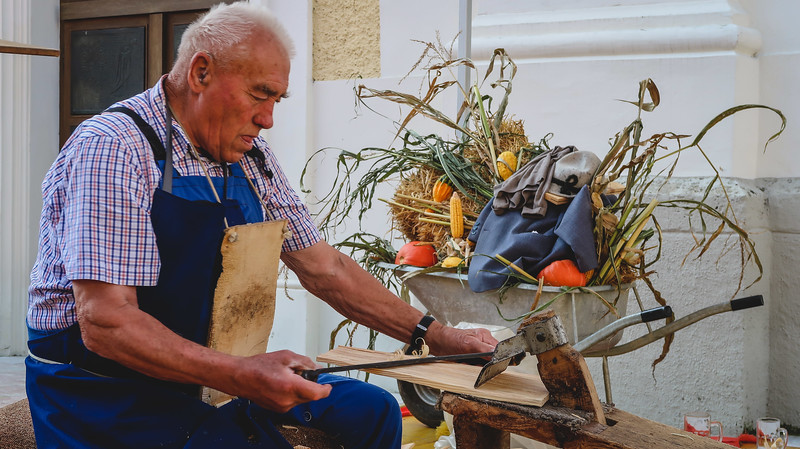
Aside from the craft market, there were also craft demonstrations happening across the town. We watched a man demonstrate the art of shingle making (something that you still see in use in Tyrolean architecture), a woodcarver meticulously sculpting a pattern onto what would become a key holder, and a group of three ladies turning wool into yarn. I also appreciated that for many of these demonstrations, it was the older generation showcasing their craft to the younger generation.
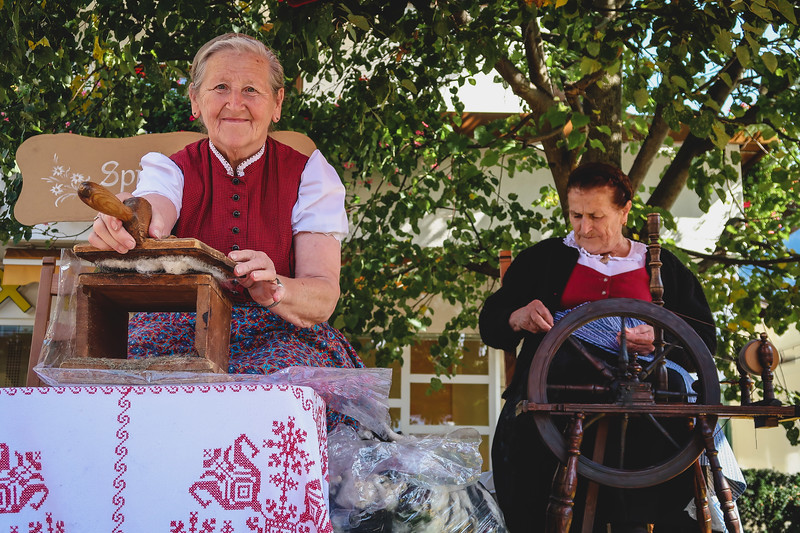
And then, of course, there was the main event: THE COW PARADE!
Throughout the afternoon, the cows paraded through town in different groups, so it’s not one of those events where you blink and you miss it.
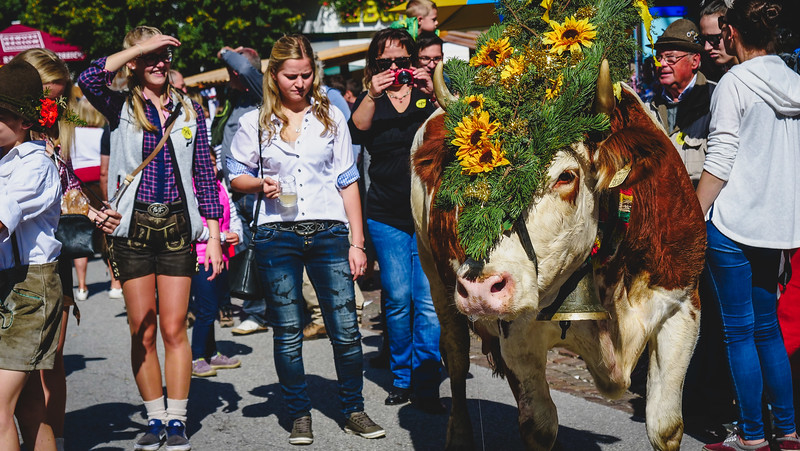
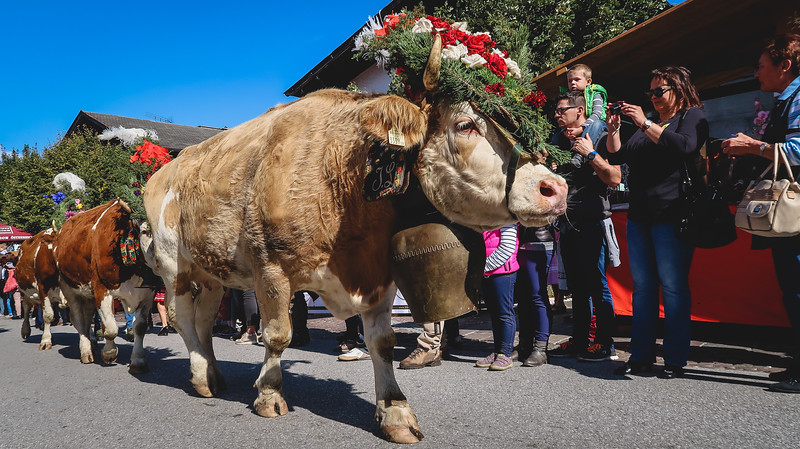
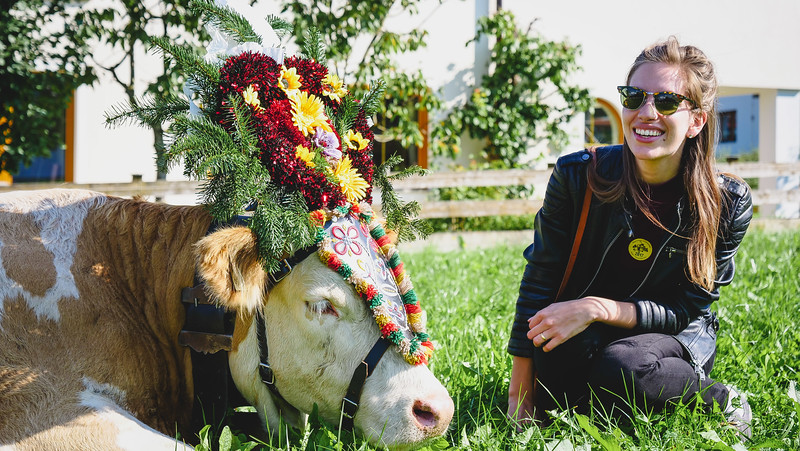
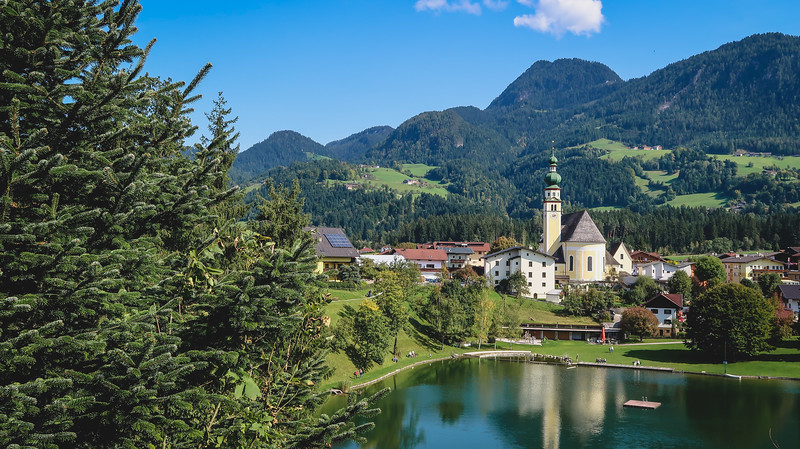
After watching three different groups parade down the main street, we walked over to two of the farms to see the cows up close in their beautiful headdresses. (Don’t worry about needing an exact address to find these farms; if you walk along the pond, you’ll see the cows all dressed up in the fields – you really can’t miss them!)
The farmers had opened up their fields so that everyone could admire the cows; some were grazing, others were napping, but for the most part, they all seemed unfazed by the extra attention.
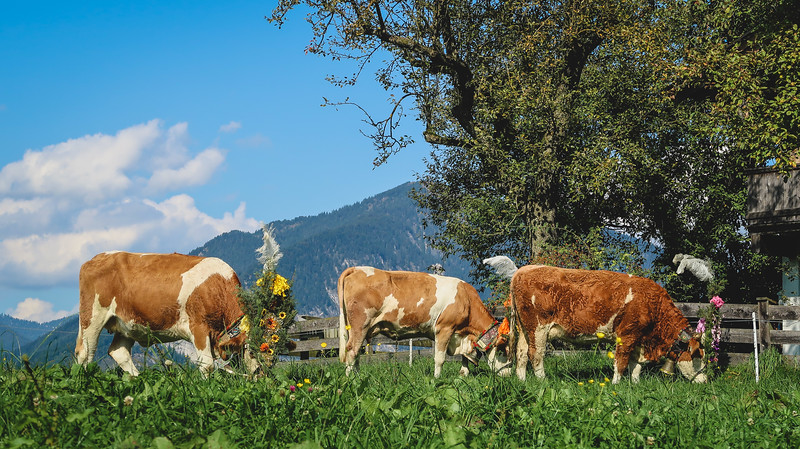
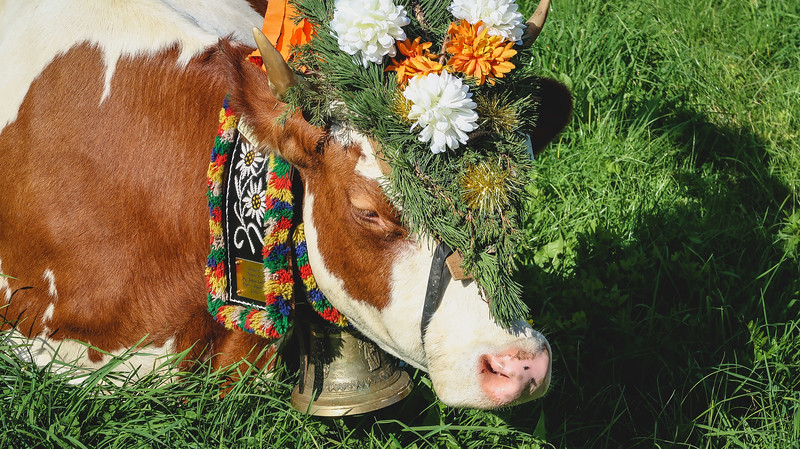
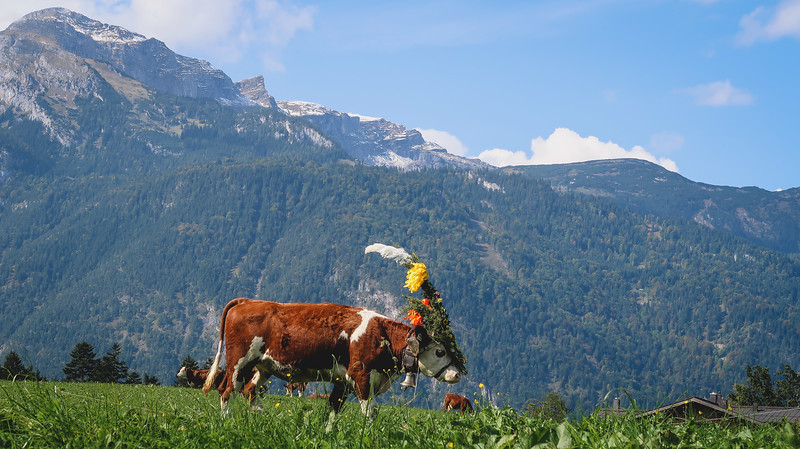
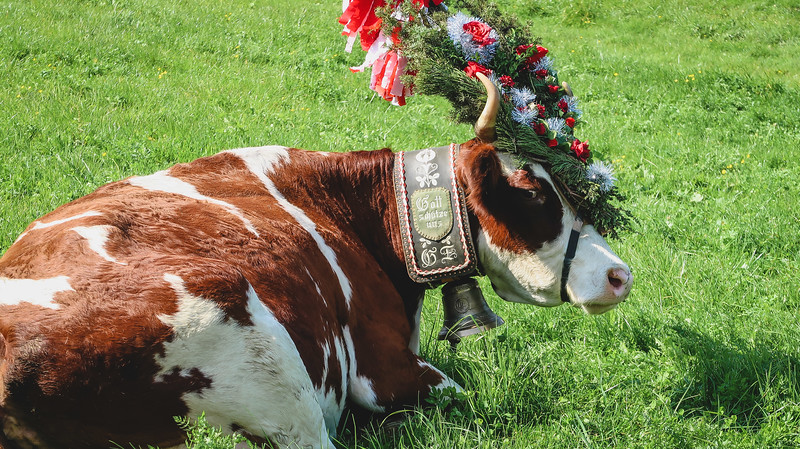
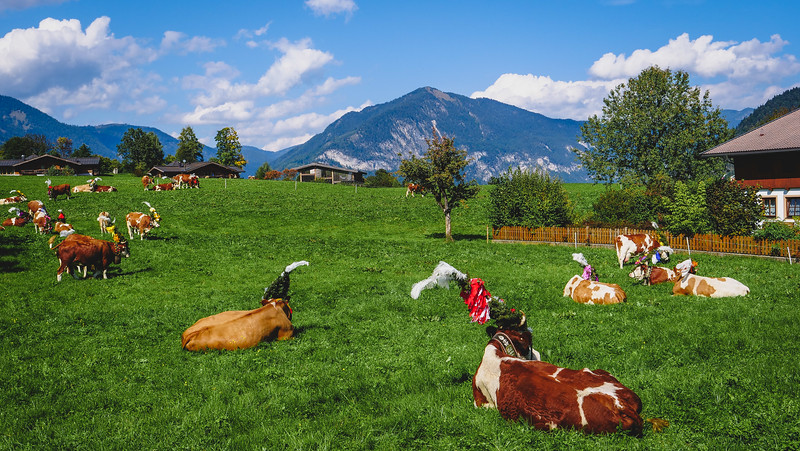
As for the headdresses, they were all quite varied; this is because they are made by the farmer and his family, so each farm has its own style. The headdresses were mostly leather, decorated with pine and paper flowers that stuck out like a giant plume, but I also spotted a few more ornate ones that looked like crowns.
Aside from their headdresses, the cows also wore big bells. The purpose of these is to help the farmer hear his cattle should they wander off in the Alps. These bells usually hang from a leather necklace and some are quite elaborate. I saw an engraved one that said “Gott schütze uns”, which means “God protect us”.
Where can you see the Almabtrieb?
Like I mentioned, I personally watched the Almabtrieb in the town of Reith im Alpbachtal in Tyrol, Austria, however, the return of the cattle is a celebration that also takes place in Switzerland and Germany.
Here is a list of the cattle drives in Austria, and here’s another list that showcases the cattle drives in Tyrol.
Tips for attending the Almabtrieb:
- When it comes to attending the Almabtrieb, you have 3 options: you can stay in town, take a shuttle into town, or drive and leave your car at the entrance of the town. (They turn the fields into a massive parking lot and it’s walking distance to the festivities.)
- If you decided to stay in town, it’s a good idea to book your accommodations well in advance. For many of the towns, this is the biggest event of the year and accommodations can fill up fast! You can view the going rate for accommodations in Reith im Alpbachtal here.
- Locals dress up for this event and tourists are also welcome to join in the fun. Men will typically wear lederhosen, while the girls wear dirndls. (If you’re going to be travelling around Germany for Oktoberfest shortly after, you can wear the same outfit!)
- Admission to the festival is € 5,00 per person, but children under 12 have free admission.
- Lastly, make sure your camera batteries are fully charged – there will be so many photo ops!
How to Plan Your Own Almabtrieb Adventure
The Meaning of Almabtrieb: More Than a Homecoming
At its core, Almabtrieb is a celebration of survival and gratitude. The safe return of the cattle is never taken for granted. For months, farmers and their families have tended their herds at high altitudes, facing unpredictable weather, treacherous slopes, and the ever-present risks of mountain life (wolves, illness, and the challenge of daily milking without modern conveniences).
Almabtrieb is also a thanksgiving for a good harvest, a bountiful supply of milk and cheese, and the health of both animals and people. Each flower, ribbon, and bell tells a story—sometimes commemorating a particular event or a family milestone.
Did you know?
If a farm has experienced misfortune—like the loss of a cow or a serious accident—their herd will often skip the ornate decorations and return more simply, as a mark of respect and remembrance.
A UNESCO-Recognized Tradition
Almabtrieb is part of a much larger practice called transhumance—the seasonal movement of livestock between summer and winter pastures—which has been carried out across Alpine and Mediterranean Europe for centuries. In December 2023, UNESCO added transhumance to its Representative List of the Intangible Cultural Heritage of Humanity, a joint listing covering Austria alongside nine other European countries. The recognition doesn’t come with a set of new rules for visitors, but it does formalize what farming families in Tyrol have always known: this isn’t a staged show put on for tourists. It’s a working agricultural practice that happens to be beautiful to watch, and the UNESCO listing exists specifically to help fund and safeguard the knowledge that keeps it going as fewer families take on the workload each year.
Festival Day: What You’ll Experience
On the morning of the Almabtrieb, excitement buzzes in the air. Here’s a taste of what you can expect if you go beyond just watching the parade:
1. Sunrise in the Alps
Early risers can sometimes watch the cows begin their descent from the mountain pastures, accompanied by the echo of bells and the chatter of herders. If you’re lucky enough to stay on a local farm, ask if you can help with preparations.
2. The Procession
The parade itself is genuinely chaotic in the best way—herds of cows, goats, and sometimes sheep, all dressed in their finest, are guided through the town. Music, laughter, and the clang of hundreds of bells fill the air. Don’t be surprised if a cow stops to munch on a roadside snack or photobombs your best shot!
3. Village Festivities
After the parade, the real party begins. Explore bustling craft markets, sample homemade cakes, sip schnapps with the locals, and listen to folk bands playing everything from yodels to polkas. Children run wild in traditional dress, while older residents swap stories and recipes.
4. Meet the Farmers & Animals
Farmers often invite visitors to their fields for an up-close look at the cows. This is your chance to ask questions, snap close-ups, and learn about daily Alpine life. Be respectful—these are working farms, and the animals have had a big day!
How to Plan the Perfect Almabtrieb Trip
If you’re inspired to witness the cows come home in person, here’s how to get the most out of your visit:
When to Go
- Timing: Almabtrieb usually takes place from mid-September to early October. Dates vary by region and can change based on weather and grazing conditions.
- Where: Tyrol is famous, but you’ll find celebrations across Austria, southern Germany (especially Bavaria), and Switzerland. Each region puts its own twist on the festivities.
Where to Stay
For festival towns like Reith im Alpbachtal, booking early matters more than the type of stay you choose—but it’s worth picking a base that fits your travel style:
- das Luggi Appartements (budget/solo travelers): A well-reviewed apartment-style stay right in Reith im Alpbachtal with free Wi-Fi, a coffee machine, and free parking—a short walk from the parade route and one of the better-value options in a town that sells out fast.
- Hotel Pirchnerhof (families): A 4-star superior hotel close to Lake Reith with an indoor pool, spa area, and a buffet breakfast and dinner included—a practical pick if you want kids entertained without leaving the property between festival outings.
- Schloss Matzen (honeymoon/splurge): A genuinely 1,000-year-old castle hotel near Brixlegg, a few minutes from Reith, with a spa built into the old keep (Finnish sauna, Turkish steam bath) and individually decorated rooms named after former castle owners. Note there’s no elevator, in keeping with the historic structure.
- Farm stays: Consider spending a few nights on a local farm (Bauernhof), where you can help with chores, sample fresh milk, and get a behind-the-scenes view of life in the Alps.
- Nearby villages: If accommodation in the main town is full, check smaller nearby villages and drive or take a shuttle in.
What to Wear & Bring
- Dress the part: Don’t be shy! Dirndls and lederhosen aren’t just for locals. Many shops rent or sell traditional outfits.
- Comfortable shoes: You’ll walk a lot—across cobbled streets, muddy paths, and grassy fields.
- Weather prep: Autumn in the Alps can be sunny and warm or misty and chilly. Bring layers, a rain jacket, and sunblock.
- Camera essentials: Extra batteries, SD cards, and maybe even a lens wipe—there’s a lot of cheese grease and hay dust!
Festival Tips
- Arrive early: The best spots for photos and parade-watching fill up fast.
- Try everything: Local cheeses, sausages, cakes, and beers are part of the experience. Some towns host cheese-making demos or offer samples from prize-winning cows.
- Cash is king: Many stalls don’t accept cards, so bring euros in small bills and coins.
- Ask questions: Most locals love sharing their traditions. A few words of German (or even just “Danke!”) go a long way.
Making it Meaningful
- Support local: Buy crafts directly from artisans or farmers. These purchases help keep small-scale agriculture and traditional crafts alive.
- Be respectful: Always ask before photographing people, especially during craft demos or private farm visits.
- Learn the backstory: Read up on Alpine farming and festival history beforehand. Understanding the “why” makes everything more meaningful.
Why Dates Can Shift: Weather, Grazing, and Wolves
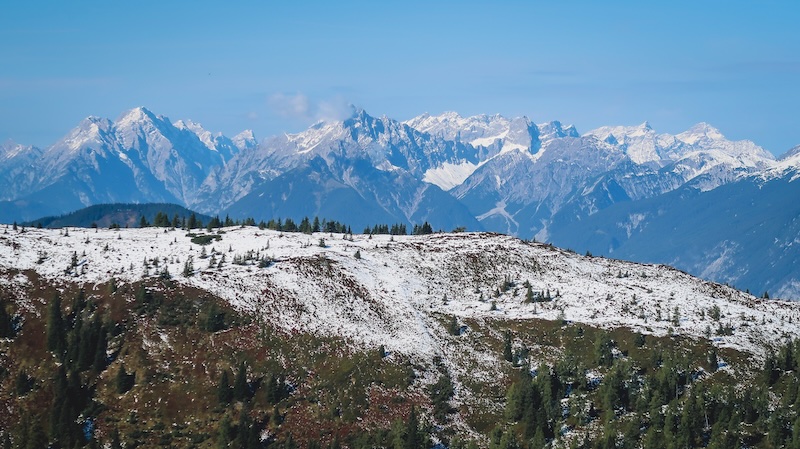
One thing worth knowing before you lock in travel dates: Almabtrieb schedules are never fully fixed. The obvious factors are weather and grazing conditions—an early snowfall or a slow growing season can push the descent earlier or later. Less obvious is the return of wolves to parts of the Alps in recent years. Unlike in Switzerland or France, herd protection with guard dogs isn’t standard practice in Austria, so farmers in Tyrol generally rely on their own experience and familiarity with the terrain rather than dogs to keep the herd together. In regions where wolf activity has caused losses, some villages have scaled back decorations or, in rarer cases, canceled the public celebration entirely, since the Almabtrieb is traditionally a celebration of a safe return—not just a parade. It’s a good reason to double-check with the specific village’s tourist office close to your travel dates, rather than relying on last year’s calendar.
Choosing Which Parade (and Why It Matters)
Not all Almabtriebe are created equal. Some villages focus on old‑school pageantry. Others key in on farmer‑market vibes. And a handful lean into a bigger street‑party atmosphere. Here’s a rundown to help match a parade to your travel style:
| Village & Typical Timing | Vibe | Scale | Why Go |
|---|---|---|---|
| Reith im Alpbachtal – last two weekends of September | Balanced: heritage + street‑party | One of the larger, more publicized Tyrolean Almabtriebe | Flat terrain (stroller‑friendly), large craft market, easy Innsbruck bus link. |
| Mayrhofen – first Saturday of October | Zillertal energy, brass bands | Large, well-attended | Farmers arrive from several side valleys (Zillergrund, Stilluptal, Tuxertal), so the procession runs in waves rather than all at once. |
| Kufstein – mid-to-late September | Small‑town authentic | Smaller, local-feeling | Also hosts a separate Haflinger horse Almabtrieb nearby in early September if you want to see both traditions. |
| Pertisau am Achensee – late September | Lakeside, quieter | Smaller | Cows are decorated with images of saints on their headgear; the Achensee backdrop (Tyrol’s largest lake) makes for a different kind of photo than a village street. |
| Stubai Valley (Neustift, Fulpmes, Telfes) – early-to-mid September | Family-friendly, farmers’-market focused | Small, low-key | Several villages hold their own drives across a couple of weekends, each paired with a small farmers’ market—good if you want a mellow, less touristy version of the tradition. |
Villages generally keep a similar weekend pattern year to year, but exact dates are confirmed by each village’s tourist office—not guaranteed in advance. Always check close to your travel dates.
Weekend Blueprint From Munich / Innsbruck
| Time | What | Notes & Approximate Cost |
|---|---|---|
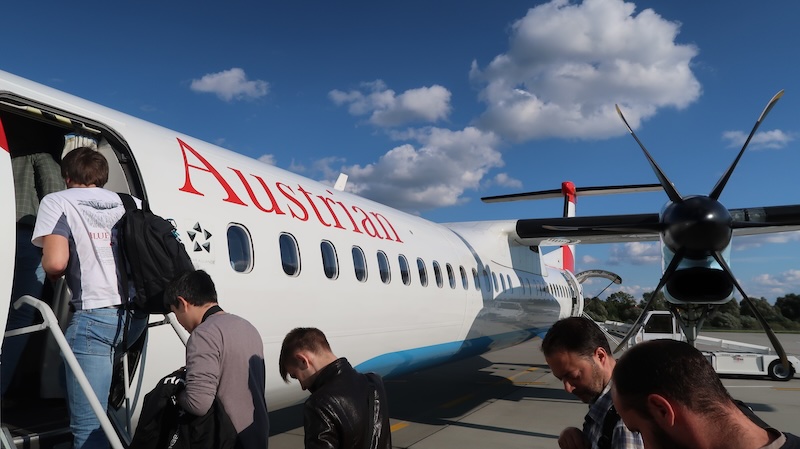
| Friday afternoon | Fly/rail into Munich or Innsbruck | Munich–Reith train is roughly a 2–2.5 hour journey; check current fares before booking. |
| Friday evening | Check‑in at a Gasthof in your chosen village | Expect a modest per-person rate including an Alpine breakfast. |
| Saturday morning | Wander craft stalls before they’re picked clean | A folding felt hat is a practical buy—keeps sun and drizzle off. |
| Saturday midday | Grab early lunch (Kasspatzen and a Radler) | Portions are generous. |
| Early afternoon | Stake out a parade spot—a bend in the road gives the best photos | A small camping stool helps; locals claim benches fast. |
| Mid-afternoon | Main parade | Timing varies by village—check locally. |
| Late afternoon | Follow cows to farmyards for close‑ups | Usually free; some farms welcome a small donation toward hay upkeep. |
| Evening | Folk‑music stage / dancing | Cash only at most stalls. |
| Sunday morning | Optional alpine hike to the now-empty high pastures, or a day trip to the Nordkette cable car or Swarovski Crystal Worlds near Innsbruck | Trailheads are marked “Almweg”; autumn foliage is at its best. |
| Sunday afternoon | Train/drive return | Leave a buffer—post-parade traffic can be slow. |
Food Hunt: Beyond Bratwurst
| Must‑Try Dish | Pronunciation | Tastes Like | Stall‑Spotting Tip |
|---|---|---|---|
| Kiachl w/ cranberry jam | Kee‑ah‑chl | Fluffy doughnut‑meets‑funnel cake | Fryer on a wagon wheel, queue of grannies. |
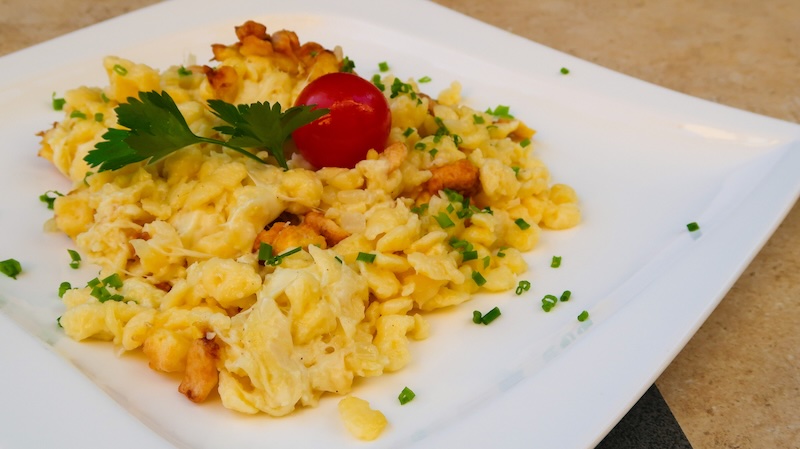
| Kasspatzen | Kahs‑shpaht‑zen | Cheesy egg-noodle comfort food | Usually topped with crispy fried onions. |
| Graukäse with onions | Grau‑keh‑zuh | Pungent, sour cottage‑cheese | Usually sold with rye bread slices. |
| Zirbenschnaps | Tseer‑ben‑shnaps | Pine‑cone infused spirit | Look for dark‑amber bottles and pine branch decor. |
Budget: A modest daily food-and-drink budget will comfortably stuff you the whole afternoon—portions and beer refills tend to be generous.
What to Wear (and Pack)
Autumn alpine weather can shift from warm sun to cold drizzle within hours.
| Item | Why You’ll Thank Yourself |
|---|---|
| Merino base‑layer | Parade mornings can start cold, even in September. |
| Packable rain shell | Mountain drizzle sneaks in—even under sun. |
| Waterproof boots / sneakers | Fields, not pavement; cow “souvenirs” everywhere. |
| Reusable cup | Some stalls give a small discount on refills. |
| Small tote | You’ll likely impulse‑buy cured sausage or felt slippers. |
Want to blend in? Men: checkered shirt and neutral trousers, maybe secondhand lederhosen suspenders. Women: dirndl rentals are available in Innsbruck.
Booking a Bed Without Splurging
For festival towns, accommodation strategy matters more than budget alone:
- Book early — For headline villages, rooms can open up to six months ahead and sell out fast; set alerts for your target village if you’re flexible on dates.
- Agritourism Gems — Search “Urlaub am Bauernhof” for farm stays including mountain‑view breakfast.
- Commuter Hack — If your target town is sold‑out, stay in a nearby rail hub or village and use the festival shuttle instead.
- Where to actually stay in Reith im Alpbachtal: das Luggi Appartements for a solo or budget-conscious base, Hotel Pirchnerhof if you’re traveling with family and want a spa and pool on-site, or Schloss Matzen if you want to turn the trip into a proper splurge—a real medieval castle a short walk from town.
Cost Snapshot (Per Person, Two‑Day Visit)
Costs vary by season, village, and how you travel, but here’s a rough approximation to budget around:
| Item | Approximate Euros |
|---|---|
| Return rail Munich ↔ Reith | ~30–40 |
| Two nights guesthouse | ~100–130 |
| Festival entry (where charged) | ~5 |
| Food & drinks | ~25–35 |
| Souvenirs (bell keychain, cheese, etc.) | ~15–25 |
| Total | ≈ 175–225 |
Beyond Almabtrieb: More Alpine Autumn Adventures
While Almabtrieb is the highlight, autumn in the Alps offers even more:
- Hiking: Crisp air, golden larch trees, and sweeping mountain views.
- Cheese festivals: Sample mountain cheeses at source (Sennerei).
- Wine harvests: Nearby regions host grape harvest festivals.
- Nordkette Cable Car: If you’re routing through Innsbruck, this round-trip funicular-and-cable-car ride climbs to Hafelekar for sweeping views over the city and the surrounding Karwendel range—a good half-day add-on to a festival weekend.
- Swarovski Crystal Worlds: In nearby Wattens, this is a family-friendly art-and-crystal attraction with gardens and playgrounds—an easy detour on the way between Innsbruck and Reith im Alpbachtal.
- Wellness escapes: Enjoy local saunas, spa hotels, or thermal baths to warm up after a brisk festival day.
Compare that with Oktoberfest, where one evening can easily cost far more just in beer steins.
Austria’s Almabtrieb Travel FAQ: Dates, Best Villages, What to Wear, Costs, Etiquette & Photo Tips
What is the Almabtrieb and why is it celebrated?
Almabtrieb is the autumn cattle drive where herds return from high Alpine pastures to valley farms. It’s both practical (ending the grazing season) and ceremonial—a thanksgiving for a safe summer, good milk yield, and the health of animals and people.
When does Almabtrieb usually happen each year?
Most villages hold their parades from mid-September to early October, typically on set weekends that repeat annually—weather permitting. Exact dates can shift with pasture conditions, so check the host village’s announcement each summer.
Which Austrian regions are best for first-timers?
Tyrol is the classic choice thanks to dense village celebrations and easy transport from Innsbruck. Zillertal, Alpbachtal, Stubai, and Kufstein areas are popular; smaller Carinthian and Salzburg-land parades offer a quieter, more local feel.
How “big” are these festivals—packed like Oktoberfest?
It varies. Some villages feel like a friendly farmers’ market with music; others draw large crowds with multiple stages and beer gardens. If you want elbow-room, choose smaller towns or arrive early and stick to side streets for the parade.
What should I wear—and do I need a dirndl or lederhosen?
Layer up for four-season weather: waterproof shoes, warm base-layer, packable rain shell. Traditional dress is optional but welcomed; you can rent outfits in larger towns (like Innsbruck) or wear smart casual with a checkered shirt and sturdy footwear.
How much cash should I bring for a day?
€25–€40 per person covers hearty food, a couple of drinks, and small souvenirs. Many stalls are cash-only; bring small bills and coins. Entry, where charged, is usually modest and kids are often free.
What local foods and drinks should I hunt down?
Look for kiachl with jam, kasspatzen, speck boards, farm-cheese tastings, game stews, apple strudel, and pine-infused schnapps (Zirbenschnaps). If there’s a Sennerei (dairy), sample mountain cheeses aged from the same summer pastures the cows grazed.
Any etiquette tips around cows and farmers?
Give animals space, never block the route, and keep fingers away from horns and bells. Ask before photographing people, close farm gates behind you, and avoid entering barns or fields not explicitly open to visitors.
Where are the best photo spots during the parade?
Aim for gentle road bends, modest rises, or where alpine backdrops frame the street. After the procession, many farms allow respectful, closer photos—morning or late-afternoon light flatters cows, headdresses, and bell details.
Can bad weather cancel the event?
Heavy rain, early snow, or unsafe mountain conditions can delay or simplify the drive (fewer decorations, shorter route). Follow the village tourism board or local notices; parades can shift times on short notice.
Is Almabtrieb kid-friendly and stroller-friendly?
Yes. Choose villages with flatter terrain and designated family areas. Arrive early, bring ear protection for little ones (bells are loud), and pack snacks and layers—parades often span a few hours.
How far in advance should I book accommodation?
For headline villages, book 3–6 months ahead. If everything’s full, try nearby towns connected by shuttle or local rail and arrive early on festival day to secure viewing spots and market goodies.
Read More about Austria:
- Delicious Food Tours in Vienna
- Wine Day Tours from Vienna
- Things to do in Vienna
- Sachertorte at Vienna’s Cafe Sacher
- Visiting Werfen Castle
- Day Trip to Gaisberg
Have you experienced Almabtrieb or a similar festival? Would you add it to your travel wish list? Let me know in the comments below!
Hi Audrey,
How cool.
I saw these images a bunch as a kid when visiting my grandparent’s home. My mom is from Germany – the Black Forest – so this was not all that far from the homeland.
Neat to see these cows all dudded up.
Always fascinating to see dudes in the lederhosen as well.
Thanks for the rocking share.
Ryan
Not too far from the homeland at all! I hope you get to see the festival sometime. 🙂
This place looks amazing. It feels like something out of a fairytale!
It was such an awesome event to witness! 😀
Austria is on the top of my bucket list! I love all the flowers!
A beautiful post Audrey! I would love to visit Austria one day. Also, you take lovely snaps.
I loved Austria as well but I didn’t as much as you did, great post.