
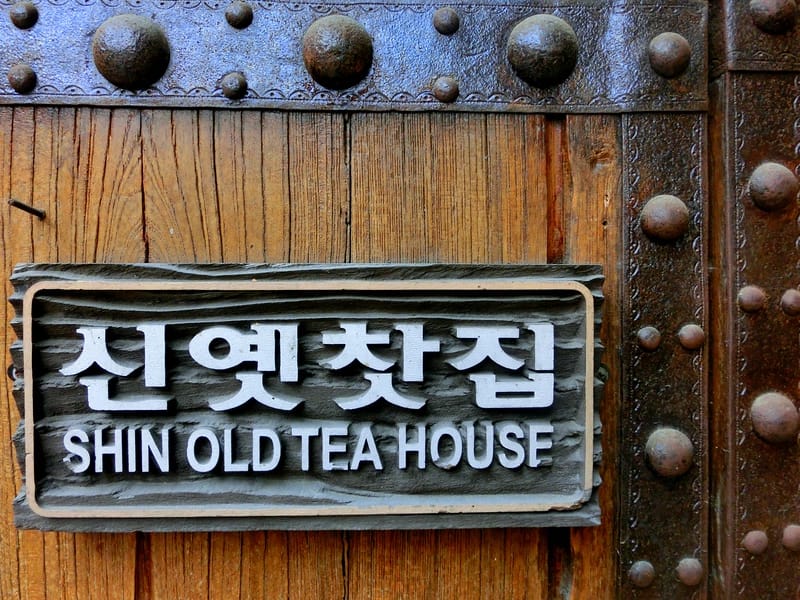
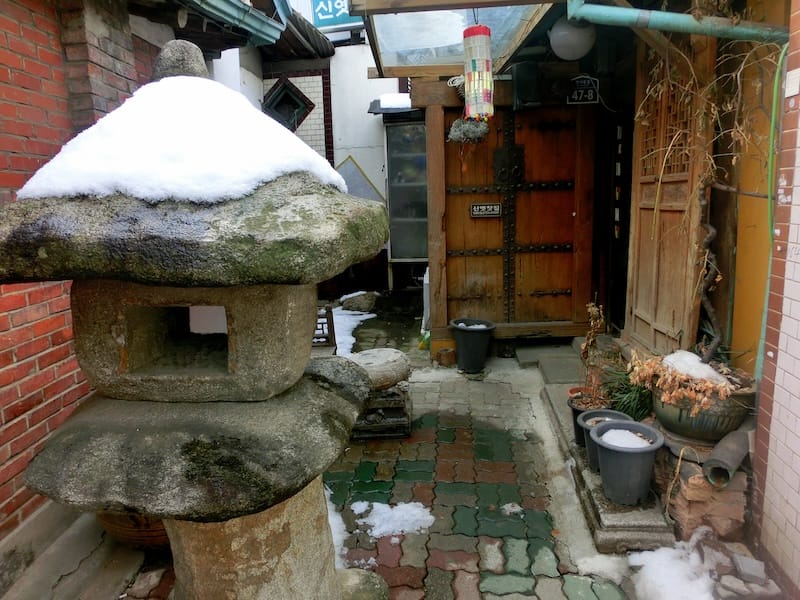
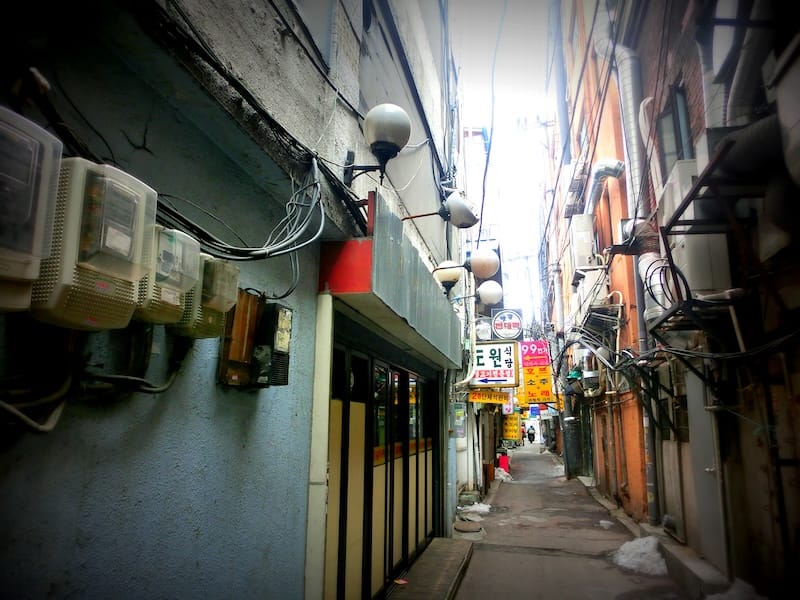
Buried down one of the many alleys that make up the back streets of Insadong is a quaint little tea house that appears almost forgotten.Its exterior is not particularly impressive, nor does it do much to advertise itself; it’s not until you are standing in front of the entrance that you notice the small wooden sign that reads “신옛찻집” – Shin Old Tea House.
Shin Old Tea House in Seoul, Korea
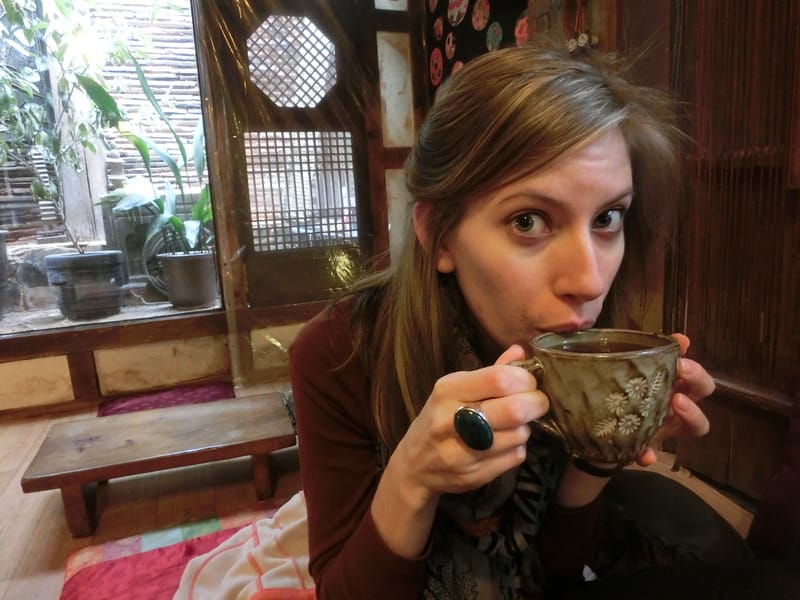
I pull the door open and a bell alerts the shop owner that two customers have arrived. The sweet ajumma smiles at us, her only guests on this chilly afternoon, and invites us to take off our shoes. We leave them on the concrete ground and step up unto the creaky wooden floors.
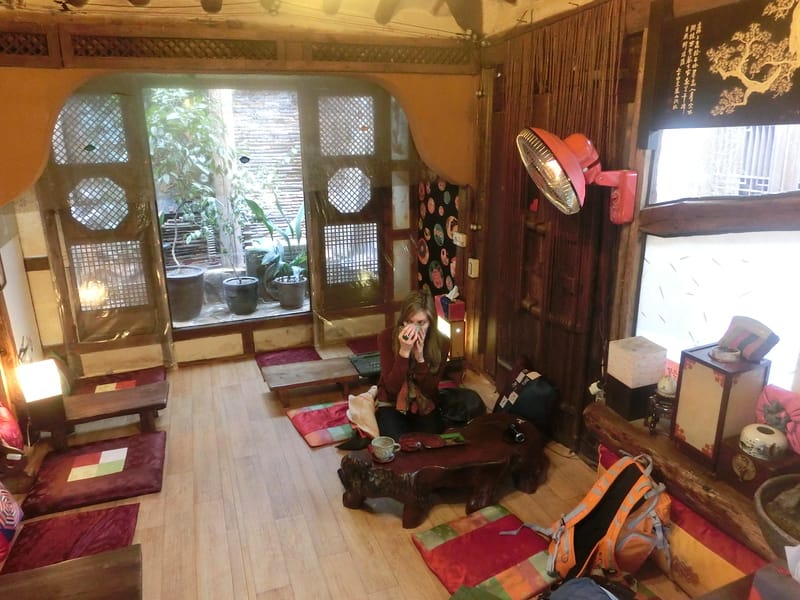
Inside it is a warm repose from Seoul’s wintry streets.
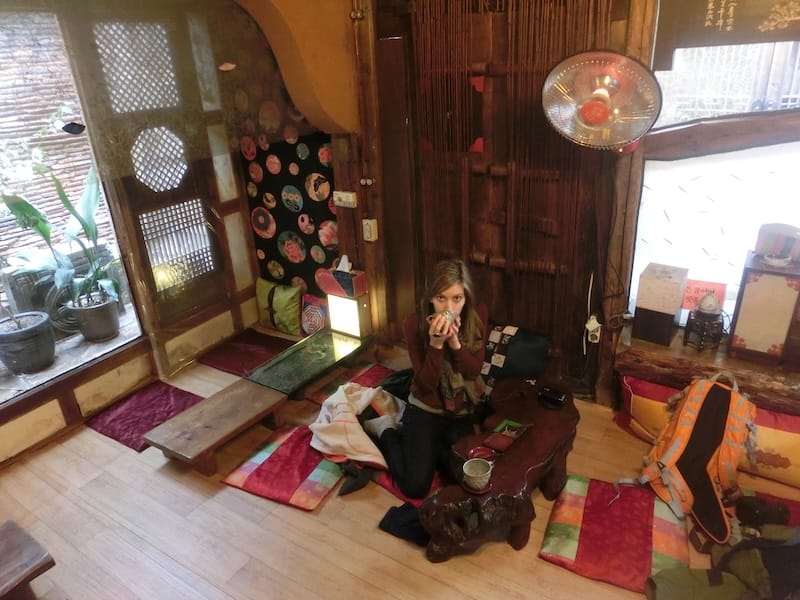
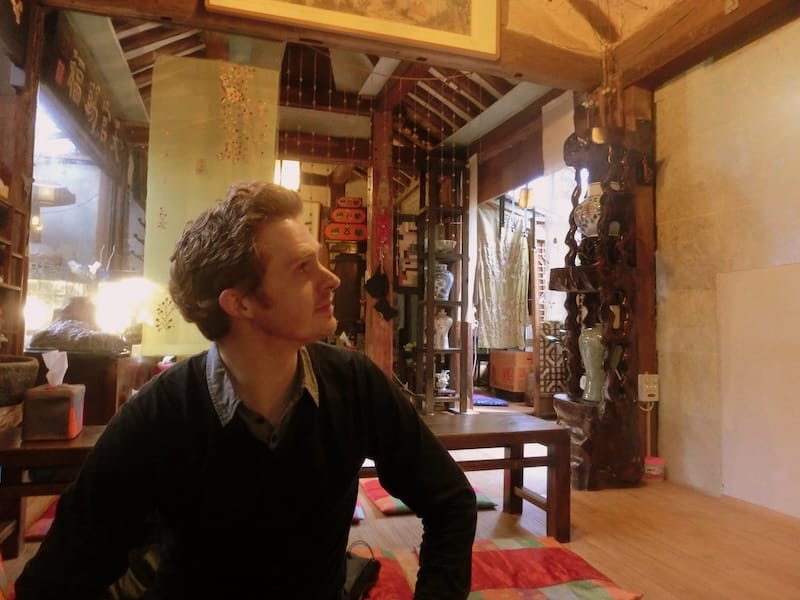
We plop ourselves down on bright silk pillows in front of a rustic table that sits just a few inches off the ground.
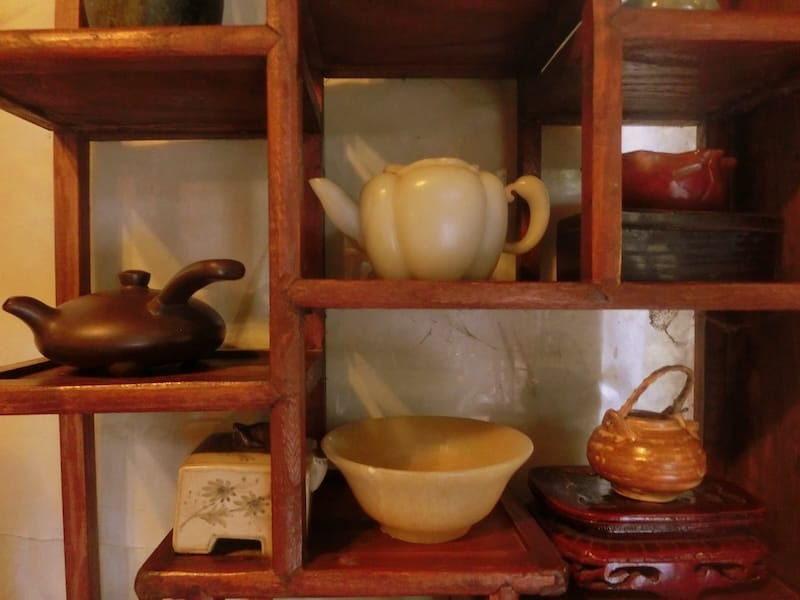
My eyes wander in all directions: colourful tapestries, ceramic teapots, a goldfish swimming in a tank, a large wooden chest, hanging lamps, beaded space dividers, a quirky frog sculpture, and more pillows and more knick-knacks.
Between the dim lighting and the heated floors, it’s difficult not to sink back into the cozy space.
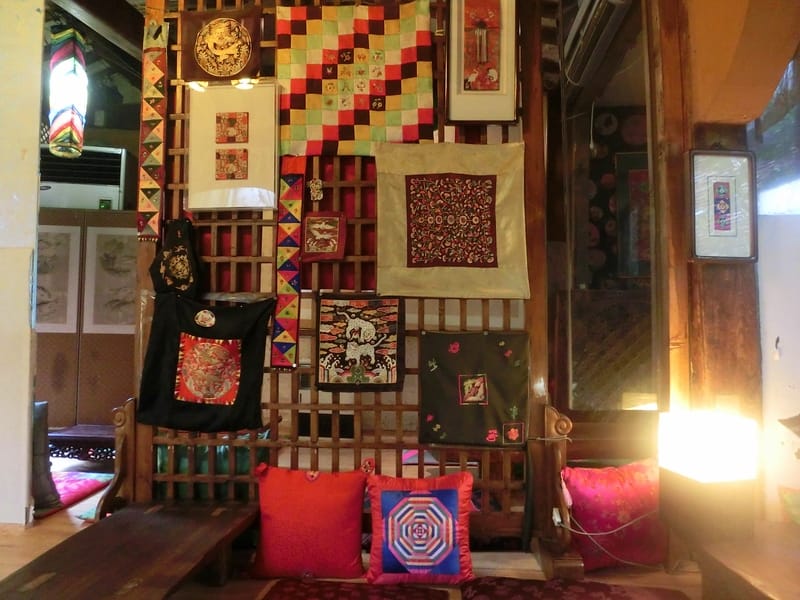
While I’m still gazing at my surroundings and making mental notes of wallpaper designs and pillow patterns, the ajumma returns with a menu.
Ice teas and hot teas, citrous and sweet – each item listed sounds more enticing than the next.

What We Ordered At The Traditional Korean Teahouse in Insadong
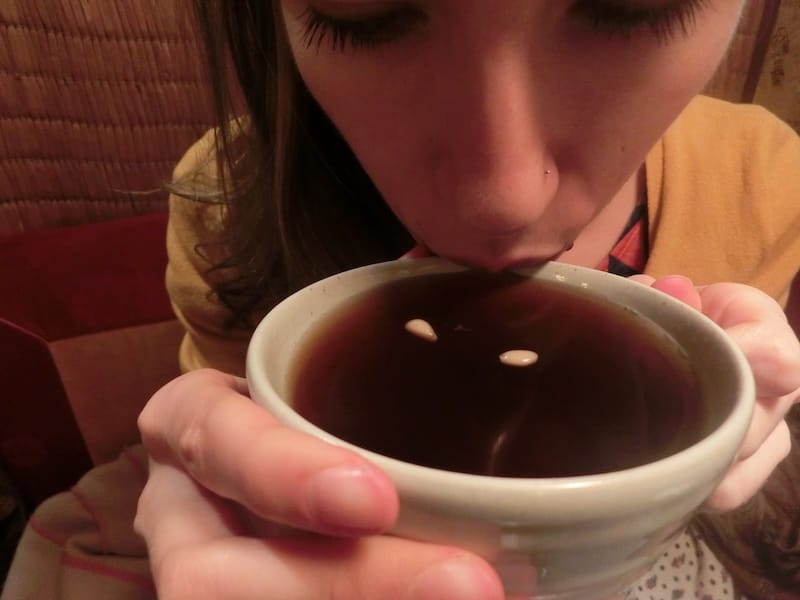
I order the plum tea off the menu, and Sam opts for the ginger tea.
Our sweet beverages are accompanied by sticky rice cakes and puffed rice. I haven’t enjoyed a single rice cake I’ve tried over the course of my year in Korea, but somehow paired with my sweet plum tea the combination is just right.
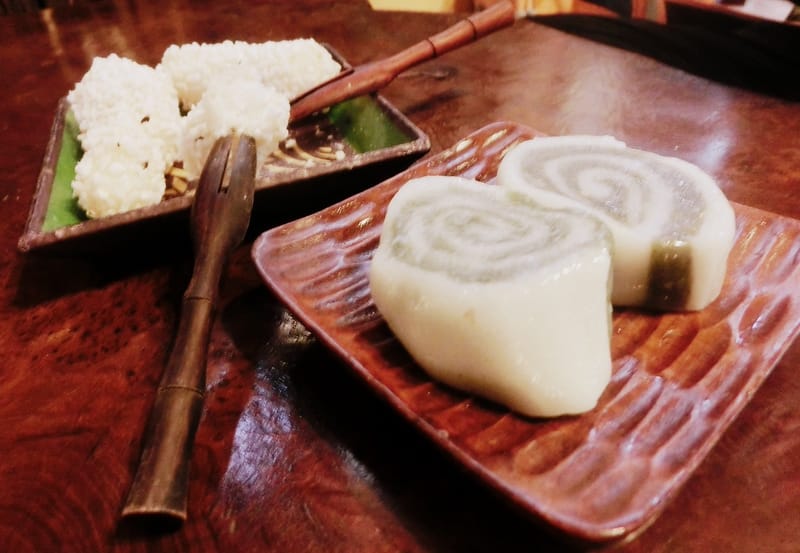
The ambiance is so serene that I find myself whispering and trying to laugh quietly even though no one is listening to us and there is no one to disrupt.
This is our second last weekend in Seoul and it feels nice to be doing something traditional yet low-key.
Sipping on our teas we reminisce about the past few months together, while plotting the adventures that await us in Malaysia in just a week’s time. This little Korean tea house is the perfect place to end our time in Korea.
Just a street away Insadong’s main strip is buzzing with activity, but seated in this cozy little tea house I feel like I am miles away.
Sometimes a neighbourhood’s best kept secret lies not too far off the trodden path.
Everything You Need to Know Before Visiting Shin Old Tea House
Tea houses like this one are the reason Insadong deserves more than a quick pass-through. The neighbourhood has anchored Seoul’s traditional arts and crafts culture since the Joseon Dynasty, and the tea houses tucked into its back alleys are among the last places in the city where time genuinely slows down. Here’s everything practical — and a little context — to help you make the most of a visit.
A Little Background on 신옛찻집
Shin Old Tea House has been welcoming guests since approximately 1992, making it one of the longer-standing traditional tea houses in Insadong. The name itself is a deliberate paradox: 신 (shin) means “new,” and 옛 (yet) means “old” — so the full name translates roughly as “New-Old Tea House.” That tension between preservation and renewal captures what the space actually offers: a thoroughly traditional environment that feels genuinely alive rather than museum-like. The building itself is a horseshoe-shaped hanok wrapped around a small courtyard, so the sense of stepping away from the city starts before you’ve even ordered — you cross a threshold of quiet greenery before you reach the door.
The broader Insadong context matters too. Traditional Korean tea culture has roots in Goryeo Dynasty court ceremonies (darye) and was deeply tied to Buddhist practice for centuries. By the Joseon era, tea had been partly displaced by grain-based drinks, but the craft survived in temple traditions and private households. When Seoul modernised rapidly through the 1980s and 90s, Insadong became the deliberate counter-current — a district committed to keeping traditional crafts, arts, and tea culture visible and accessible. Tea houses like Shin are a direct expression of that commitment.
Decoding the Menu: Five Signature Teas Worth Knowing
The laminated English menu captures the basics, but knowing a little about what’s in each cup makes ordering more satisfying. I ordered the plum tea (maesil-cha); Sam chose the ginger. Here’s the broader picture:
| Korean Name | What It Is | Flavour Profile | Why Locals Order It |
|---|---|---|---|
| Maesil-cha (매실차) | Fermented green plum concentrate diluted with hot water | Honeyed apricot with subtle tartness | Aids digestion after a heavy meal — a natural follow-up to samgyeopsal or fried street snacks |
| Saeng-gang-cha (생강차) | Slow-simmered ginger root with jujube slices | Spicy warmth with a hint of caramel | The classic cold-weather remedy — what grandmothers reach for when the temperature drops |
| Ssanghwa-cha (쌍화차) | Herbal decoction of angelica, cinnamon, and liquorice, topped with pine nuts and egg yolk | Medicinal, earthy, mildly sweet | A traditional stamina tea — historically the drink of choice for students before exams |
| Omija-cha (오미자차) | Dried “five-flavour” berries steeped overnight | Sweet, sour, bitter, salty, and pungent simultaneously | Usually served cold in summer; adds lime and the colour shifts noticeably |
| Hyeonmi-nokcha (현미녹차) | Roasted brown rice blended with green tea | Toasty, popcorn-like aroma with a grassy finish | The easiest entry point for travellers who find straight green tea too astringent |
If you genuinely can’t decide, try asking the ajumma for a smaller pour of two different teas — a less formal option that some houses accommodate for undecided guests.
How to Behave Like You’ve Been Before
- Shoes off, socks on — Remove shoes at the threshold before stepping up to the wooden floor. The heated ondol floors are part of the experience; socks are perfectly fine.
- Lower your volume — Conversation in a traditional tea room is pitched softly. If you find yourself speaking loudly you’ll notice — the room makes it obvious. Step outside for calls.
- Two-handed pour — When refilling a companion’s cup, hold the teapot with your right hand and support your forearm with your left. It’s a small gesture of respect that Koreans will notice and appreciate.
- Don’t polish the plate — If you receive complimentary yakgwa (honey biscuits) or rice cakes alongside your tea, tradition holds that leaving a little shows you’re satisfied. Finishing the plate entirely reads differently in this context.
- Pay at the antique till — Walk to the wooden chest near the entrance rather than waving for the bill. Each drawer reveals a guest ledger — it’s a detail that feels very much in keeping with the rest of the space.
Planning Your Visit
| Detail | What to Know |
|---|---|
| Address | 47-8 Insadong-gil, Jongno-gu, Seoul — tucked in a back alley off the main strip |
| Nearest Subway | Anguk Station (Line 3) Exit 6; approximately 6-minute walk |
| Opening Hours | Approximately 11:00am – 9:00pm daily; last order around 8:15pm. Hours can vary — check before a specific visit |
| Price Range | ₩8,000–₩14,000 per tea; pots are generally refillable with hot water on request |
| Cards or Cash? | International credit cards accepted; a small cash tip left in the wooden box near the till is appreciated |
| Best Time to Go | Weekday mornings for the most serene atmosphere; after 4pm on weekends you may wait 10–20 minutes for a seat |
| Finding It | The entrance is easy to miss — go to Insadong-gil 33, turn right into the second alley after Ssamziegil, and look for the small wooden sign |
Pairing Your Tea Stop With a Half-Day in Insadong
The tea house works best as part of a longer meander rather than a sole destination. This loop covers the neighbourhood without rushing:
- 11:00am — Browse antique ink stones and old books at Tongmungwan, Korea’s oldest active bookshop (founded 1934).
- Noon — Lunch at Jirisan Restaurant for a vegetarian mountain-herb set meal in the basement space.
- 1:30pm — Shin Old Tea House for plum or ginger tea during the post-lunch lull, when the seats are usually quietest.
- 3:00pm — Walk to the Kyung-In Museum of Fine Art; the admission includes access to the courtyard garden with its persimmon trees — worth lingering in.
- 4:15pm — Finish with street food on the main strip: honeycomb hotteok and dragon-beard candy are both worth finding.
Seasonal Reasons to Return
- Spring (April): The hanok’s courtyard azaleas are in bloom, and a limited cherry-blossom tea sometimes appears on the chalkboard menu — worth asking about.
- Monsoon (late June–July): Rain on the tiled roof amplifies the cave-like warmth of the space considerably. Try smoky danggwi-cha (Angelica root) on a wet afternoon.
- Chuseok (September/October): Staff wear hanbok during the holiday, and a miniature songpyeon (half-moon rice cake) often accompanies orders — one of those seasonal details that makes a repeat visit worthwhile.
- First Snow (usually December): The ondol floor heaters go to full warmth; order sujeonggwa (cinnamon-persimmon punch) and watch snow settle on the papered window lattice. This is when we visited and it was exactly as good as it sounds.
Alternatives If Shin Is Full
Insadong’s authentic hanok tea rooms are fewer than they used to be, but they still exist if you know the right alleys:
- Tteuran (뜰안) — Hidden behind a persimmon tree; specialises in persimmon-leaf tea and bamboo-leaf bingsu in summer.
- Moon Bird Only Thinks of the Moon (달새는달만생각한다) — Quirky name, creaky staircase, good pine-needle tea and homemade injeolmi (roasted-soybean rice cake). One of the more atmospheric alternatives.
- Dawon (Kyung-In Museum garden) — Inside the Kyung-In art complex; a veranda overlooking lotus pots with a five-flavour omija punch that’s excellent served cold.
How Insadong Protects Its Old-World Character
It isn’t an accident that a hanok tea room can still survive down a back alley here. Insadong-gil was made a car-free pedestrian street by city ordinance in 1997, and a follow-up designation in 2002 named it an official cultural tourism zone, which brought tax incentives for traditional businesses alongside real limits on how much the streetscape could change. Those two decisions are the reason the district still feels walkable and low-rise instead of getting swallowed by the kind of glass-and-concrete redevelopment that flattened comparable neighbourhoods elsewhere in the city through the 1970s and 80s.
The protections are still evolving. As recently as June 2026, Seoul’s city government eased its Insadong building rules for the first time in sixteen years — lowering the threshold for what counts as an official “Insadong hanok” and loosening height and floor-area limits specifically to make it easier to build or renovate traditional-style structures. The stated goal is more hanok, not fewer: encouraging new traditional-culture businesses to open rather than freezing the district in place. It’s a useful thing to know before you assume every wooden building here is original — plenty are recent, built deliberately within these rules to keep the character of the street intact.
Tea Culture in Seoul: Why It Still Matters
While Seoul now has more cafés per capita than almost anywhere on earth, traditional tea houses occupy a completely different cultural space. The techniques on display at Shin trace back through Buddhist monasteries and royal courts to the Goryeo Dynasty — the ceramic ware, the preparation method, the ondol floor seating, the unhurried pace of service aren’t aesthetic choices, they’re continuations of a much older practice that nearly disappeared during Korea’s rapid postwar modernisation.
That’s worth taking a moment to appreciate, even if you’re just there because you needed somewhere warm to sit down.
Tours Worth Booking in Seoul
Insadong is easy enough to navigate independently, but a good local guide makes a genuine difference in understanding what you’re looking at — the alleys, the craft shops, the food stalls, and the tea houses all have more context than they appear to. Here are the options worth considering:
- Downtown Seoul Guided Food & Market Tour with 8+ Local Tastings (Viator) — the most reviewed Seoul food tour available (900+ reviews) and the one I’d recommend most strongly for first-time visitors. It ends in Insadong at a hidden teahouse — a structure that makes Shin Old Tea House feel like a natural continuation of what you’ve been eating. Half-day, small groups, all dietary notes handled if you contact ahead. Well-suited to solo travellers and couples alike.
- Seoul: Half-Day Insa-dong Walking Gastroventure Tour (GetYourGuide) — specifically focused on Insadong; includes Korean herb tea and rice cake tastings as part of the tour. Well-suited to anyone who wants the cultural context of the neighbourhood rather than a general city overview, and works well for solo travellers since guides frequently run it as a near-private session for smaller numbers.
- Seoul: Gyeongbokgung & Insa-dong Gastroventure Day Tour (GetYourGuide) — a fuller day pairing the palace’s Royal Guard Changing Ceremony with an Insadong walk, a kimchi-making workshop, and a tea tasting at a traditional tea museum. Good for families or first-timers who want the palace and the neighbourhood covered together rather than as separate outings.
Where to Stay Near Insadong
Insadong sits in the Jongno district — one of the best locations in Seoul for accessing traditional sights, the palace complex, Bukchon Hanok Village, and the Cheonggyecheon stream. Staying here means mornings at Gyeongbokgung before the crowds and evenings wandering back through the lantern-lit alleys.
- Budget/solo: Hotel Sunbee Insadong — a 3-star favourite known for rooms noticeably more spacious than the Seoul average, three minutes’ walk from Ssamziegil and six from Jogyesa Temple. A reliable, well-rated base for backpackers who want comfort without the boutique price tag.
- Mid-range/couples: ibis Ambassador Seoul Insadong — newly renovated, four minutes from Jongno-3(sam)-ga Station, with a sauna, rooftop city views, and Insadong’s galleries and antique shops directly on the doorstep. A practical and comfortable base without paying a premium.
- Family: Orakai Insadong Suites — serviced apartments with kitchenettes, an indoor pool, and a sauna, ten minutes’ walk from Jogyesa Temple. Genuinely useful if you’re travelling with kids and want to self-cater some meals rather than eating out for every one.
- Honeymoon/traditional stay: Hotel Jak Insadong by Aank — a small hanok-style boutique property right in the heart of Insadong, with ondol floor heating, a traditional courtyard, and a rooftop overlooking Ssamziegil. The closest thing to actually sleeping inside the atmosphere this article describes.
- Splurge: Four Seasons Hotel Seoul — a five-star landmark a few minutes from Gwanghwamun Plaza and an easy walk to both Insadong and Gyeongbokgung Palace, with five in-house restaurants and a full spa and fitness facility. The right choice if you want luxury without sacrificing the walkable, historic location.
FAQs: Shin Old Tea House (신옛찻집), Insadong
What is Shin Old Tea House like inside?
A cosy hanok tea room with heated ondol floors, low tables, silk cushions, dim lighting, and genuinely eclectic traditional décor — ceramic teapots, a resident goldfish, tapestries, hanging lamps, carved wooden pieces. The warmth and the atmosphere combine to make it very easy to stay longer than you planned.
Where exactly is it in Insadong?
Address: 47-8 Insadong-gil, Jongno-gu. From Anguk Station (Line 3) Exit 6, walk towards Insadong-gil 33 and turn right into the second alley after Ssamziegil. The entrance is easy to miss — look for the small wooden sign and the low-key doorway rather than any signage.
Do I remove my shoes?
Yes — shoes off at the threshold before stepping up to the wooden floor. Socks are perfectly fine. The heated floors are part of what makes the experience worth staying for.
Is there an English menu?
Yes — a laminated English menu covers the main options. The table above gives you additional context on what each tea actually is and why locals choose it, which is worth reading before you arrive so you can order with some confidence.
What did you order — and what snacks come with it?
I had the plum tea (maesil-cha) and Sam had the ginger tea (saeng-gang-cha), served with sticky rice cakes and puffed rice. I’d avoided rice cakes for most of my year in Korea up to that point, but paired with sweet plum tea they worked perfectly.
How much does it cost?
Most teas run ₩8,000–₩14,000. Pots are usually refillable with hot water on request — ask if yours isn’t automatically topped up.
What’s the etiquette and vibe?
Very quiet — I found myself whispering even though we were the only guests. Keep voices soft, sip slowly, and use a two-handed pour if you’re topping up a companion’s cup. It’s calm enough that it naturally slows you down.
Do they take cards or cash only?
International cards accepted. Keeping a little cash for a small tip in the wooden box near the entrance is appreciated but not obligatory.
When is the best time to visit?
Weekday mornings are the most serene. On weekend afternoons after 4pm you may wait 10–20 minutes for a seat — still worth it, but worth factoring into your day plan.
Any seasonal specialties?
Cherry-blossom tea in spring; smoky danggwi-cha during monsoon season; small songpyeon rice cakes at Chuseok; and sujeonggwa (cinnamon-persimmon punch) on cold winter days. The first-snow visit is particularly atmospheric with the ondol floor heaters at full warmth.
Are there similar tea houses nearby if it’s full?
Tteuran (뜰안), Moon Bird Only Thinks of the Moon (달새는달만생각한다), and Dawon inside the Kyung-In Museum garden are the best alternatives within walking distance. Each has a distinct character — none of them are the same experience as Shin, but all are genuinely good.
What else can I pair with this stop?
Browse Ssamziegil’s craft complex, walk to Jogyesa Temple (particularly beautiful during Buddha’s Birthday lantern season), visit the Kyung-In Museum of Fine Art’s courtyard, and snack on hotteok and dragon-beard candy along Insadong-gil on the way back to the subway.
Have you visited a traditional tea house in Insadong? Which tea did you order — and did it live up to the setting?
Looks like a cozy place indeed!
I love a good cup of tea. It always soothes me, somehow. Haven’t had the chance to go to a traditional (here’s the word) tea house yet, but it’s definitely on the bucket list!
And that was my first ‘traditional’ tea house after a year in the country… 😉
Aww, that sounds so lovely! Wish you’d posted this just a few days sooner as I was just in Insadong last week and would’ve loved to check this out. Oh well, just an excuse to go back to Seoul for a visit. 🙂
Aw, that’s a shame! But it gives you a great reason to come back to the city. 😉 I also wish I’d found it sooner – it’s the kind of place that is worth revisiting.
A nice one. I would love to have one of those sticky rice cakes. And sweet plum tea too!!! Looks like a very relaxing place.
They sure had some good rice cakes! It was a nice little hangout for a winter afternoon. 😉
Lovely place, looks very cozy!
Unrelated but I love your ring on the first pic. I had to say it.
Thanks! My aunt actually made that ring for me. I really like it too! 😀
Looks like a great place to spend a few hours relaxing. At the moment I’m spending my afternoons going theoguh he different coffees of Indonesia, instead of teas. If I ever get around to visiting Korea I could happily do the reverse.
Nico recently posted The restaurant where Big Gay Al meets Alice in Wonderland
What a cute place! Looks like the perfect location to spend a freezing winter afternoon!
It really was! Especially with the heated floors – I didn’t want to leave.
I love it! Sometimes the simplest things, like warm tea and comfy pillows, bring about the best experiences.
What a beautifully written post, a treat to read! A nice homage to your home for the last year…
Looks like a spot worthy of repeat visits. Cozy and inviting… would be difficult to leave it.
How adorable! It’s my dream to go to an authentic tea house!
Tea houses are just my absolute dream places to go to. This places looks so magical – I can’t blame you for wanting to whisper. You set the scene so perfectly. <3
It sounds like a perfect, cozy place to reminisce and chat about future plans. You’re right, sometimes the best places are literally just down the street 🙂
Cheers.
I would love to go to a proper tea house. I went to one in China once, but it was with a tour group and everythign was so fake and touristy. And of course in the end they asked us to buy some tea. Can’t wait to read about your adventures in Malaysia. I love that country!
Hi Audrey! Thank you very much for your blog and vlog! I’m planning a trip to Seoul now and your posts really help and give me new ideas on how to spend my time in Korea. If you’ll ever by any chance come to Moscow maybe I could repay you with some ideas too :))
Glad to hear it, Katya! I hope you’ll have a wonderful time exploring Seoul.:)
Hey, Audrey!
Appreciate this article on Shin Old Tea House. Like your style of casual and leisure writing.
Reminds me of the travelogue articles featured in National Geographic magazines. Absorbing descriptive essays with just enough relevant photos.
A picture may speak a thousand words. But still written words are vital and necessary to present the wonderful travel experience.
Happy travelling!
We are here right now reading your blog post waiting for out tea and rice cakes!