This blog contains affiliate links and is a member of the Amazon Services LLC Associates Program. If you make a purchase using one of these links, I may earn a small commission at no extra cost to you. This helps keep this content free.
If there’s one thing I’ve learned from overnight bus travel in South America, it’s that no two buses are the same.
I’ve been on some incredible buses where the seats recline and the attendant comes around with a blanket and a fluffy pillow (Argentinean buses come to mind), and I’ve also travelled aboard dusty buses without air conditioning where the bathrooms are the stuff of nightmares (Bolivian buses come to mind)!
The key to making an overnight bus journey bearable is to always come prepared, and after a series of bus trips spanning from good to awful, I have a few tips to share.
Tips for bus travel in South America
Load up on snacks and water
I find that the food on buses can be hit or miss, and often times it consists of pre-packaged snacks that aren’t particularly healthy or tasty.
I would recommend stocking up on things like granola, nuts, and fresh fruits (if you aren’t crossing any international borders).
You’ll also want to bring plenty of water on board (I would go with a 1L bottle).
Be prepared for delays
You see the arrival time that’s printed on your ticket? Don’t make any plans based on that. If you have friends or family waiting for you at your final destination, it’s best to give them a call once you’re in the outskirts of town (if you’re travelling with a cell phone) or just call them from a payphone once you arrive.
It’s been my experience that buses in South America tend to encounter lots of hiccups: an engine overheating in the middle of the desert, little personnel to process crowds at an international border, and other delays that simply go unexplained.
Plan to arrive later that the time you see printed on your ticket, and don’t let it stress you because there’s little you can do about it.
Bring your own entertainment
In my experience, there will either be no entertainment, or you’ll be stuck watching a really cheese telenovela from the 90s. (I was on one bus where the telenovelas were so bad that one guy finally went up to the driver with his DVD collection and convinced him to put a movie on. We were all very thankful!
I also like to make sure that my Kindle is fully charged and loaded with a good mix of books, and I like to keep my laptop handy in case I feel like doing a bit of writing.
Buses can be really cold once they crank on the AC, so you’ll want to bring a few warm layers.
I like to wear leggings, a hoodie, and I also keep my scarf and a light jacket in my daypack.
Buses will generally also give you a blanket if you’re doing an overnight journey (that’s the case when you’re travelling in Cama Ejecutiva or Suite Primera Clase), but I like to come prepared with plenty of layers and a travel pillow of my own.
Carry your own TP and sanitizer
The not so nice part about bus travel is dealing with the toilets.
When you’re doing those long cross-country journeys, the water tends to run out halfway through, as does the toilet paper (although sometimes there isn’t even any toilet paper to begin with). That means you can’t wash your hands or flush…which makes things interesting.
I should also mention that some buses have signs that explicitly say that you can ONLY go pee. Their toilets are not equipped to handle anything else, so ummm, you better hope you don’t develop any stomach problems right before your journey!
Upgrade your seat for extra comfort
When it comes to choosing an overnight bus, there are a few handy terms that you should familiarize yourself with.
Semi-cama means ‘half bed’ and the seats generally lean between 120-140 degrees, and you may or may not get a footrest.
Cama Ejecutivo means ‘executive bed’ and the seats lean between 140-160 degrees, and they include a footrest.
Lastly, you have Suite Primera Clase which leans to a flat 180 degrees (just like a bed!.)
I will say that these offerings can vary from one company to the next, but the majority of seats should fall within these guidelines. When in doubt, just ask before booking your ticket.
Choose your seat wisely
So I’ve developed a bit of a system when it comes to choosing a bus seat and I kind of have a few no-go zones.
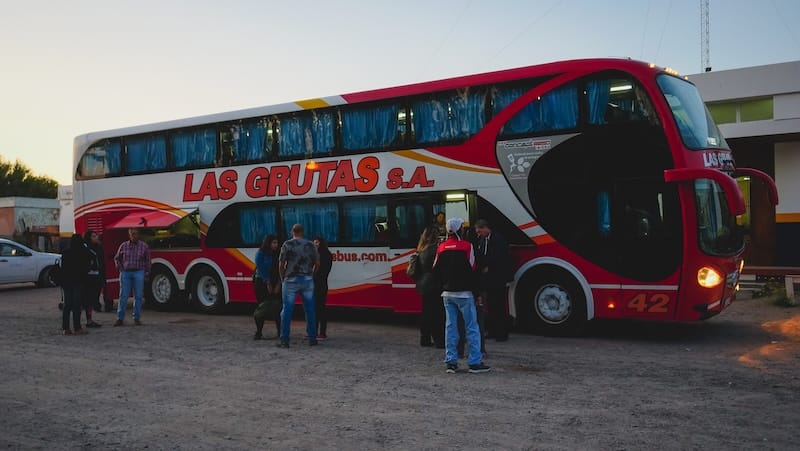
I’ll avoid sitting anywhere near the toilets if I can help it because these often go unattended and they are very unpleasant. (If you’re on the top level, you should avoid the back of the bus, and if you’re on the lower level you may want to avoid the front).
I would also suggest avoiding the very back of the bus (on either the top or lower level) because the AC tends to be a lot weaker, and that combined with the proximity to the engine means that it can get a bit warm in those seats. Anywhere else is fair game!
Getting More From South America’s Bus Network
The tips above cover the survival basics. Here’s the deeper layer — how to pick the right company, protect your gear, handle altitude and winding roads, and know when to skip the bus altogether.
Choosing the Right Company
Country
Worth Looking At
Why
Argentina
Via Bariloche / Andesmar
Fully horizontal suite seats, hot dinner, wine service
Chile
TurBus Premium
Attentive staff, USB ports, functional Wi-Fi on city routes
Peru
Cruz del Sur
GPS-monitored speed, fingerprint ID at boarding, individual screens
Bolivia
Trans Copacabana 1º
Newer fleet on the La Paz corridor; blankets that have actually been washed
Brazil
Águia Branca
2+1 seating layout and decent AC even in Amazon heat
Prices can vary 30–40 percent between companies on the same route, but shaving a few dollars off a 15-hour journey usually means skipping supper service or riding an older coach without suspension — false economy when your back pays the bill.
Buying Tickets
Apps and aggregators: Use Plataforma10, Busbud or Recorrido to scan schedules, then consider paying at the terminal counter in cash. Station kiosks sometimes waive the service fee and occasionally offer promotional seats.
Last-minute seat discounts: In Argentina and Chile, unused executive seats sometimes sell at a discount in the two hours before departure — useful for spontaneous upgrades.
Holiday surcharge alert: Semana Santa, Christmas week and Argentina’s July ski season can double fares. Book 15–20 days ahead or expect to piece together regional buses.
Luggage and Valuables
Baggage stubs: Always insist on a tag when your pack goes in the hold — you will need it at 3 a.m. checkpoints to reclaim your bag.
Carry-on priorities: Anything you can’t replace — camera, passport, medication — lives in your daypack at your feet, not overhead. Overhead racks near busy urban stops are easy targets.
Border crossings: On international routes, collect your bag at customs and keep an eye on both ends of the bus during the stop.
Personal Security at Night
Choose the lower-deck front row when available. Better ride stability, quicker exit if needed, and closer to the driver and attendant.
Cable lock your daypack. Loop a lightweight cable through the zippers and around the seat leg — enough to deter anyone lazy enough to try.
Keep small bills accessible. Slip rest-stop cash into a hoodie pocket; your main stash stays on your person and out of reach in the dark.
Sleep strategy. Earplugs first, eye mask second — you’ll wake naturally at lit checkpoints without losing sleep to loud music from the driver’s speakers.
Altitude, Motion and Roadside Food
High-altitude routes: On Peruvian and Bolivian altiplano crossings above 3,500 m, coca-leaf sweets help and prescription acetazolamide is worth discussing with your doctor before you leave. Buses ascend quickly and your sinuses will notice. If you’re regularly doing high-altitude routes, check that your travel insurance covers high-altitude medical evacuation — World Nomads does; cheaper alternatives often don’t.
Winding roads: The Cuenca–Baños stretch in Ecuador and Colombia’s Pasto “Trampoline of Death” are hairpin central. Ginger chews settle stomachs better than anything that makes you drowsy.
Roadside food: You will be offered a seafood cocktail at a late-night stop. Stick to sealed biscuits and bananas — you’ll be grateful by morning.
Making the Most of Station Layovers
Station
Useful Feature
Watch Out For
Lima Javier Prado
Showers and 24-hour luggage storage
Taxi touts overcharge — use the official desk
Buenos Aires Retiro
Multi-level food court
Bag snatchers work in pairs — keep your pack in front of you
Bogotá Salitre
Free filtered-water taps
Bathroom stalls charge around 1,000 COP; carry coins
Santiago Terminal Sur
Clear bilingual signage
Long-haul and regional halls are separate — confirm your gate early
Technology and Power
Offline maps: Download the entire country on Google Maps before you board — GPS works without data and confirms you’re on the right road when the route starts looking unfamiliar.
Battery bank: A 10,000 mAh pack covers a full overnight journey; many onboard USB ports stop working within weeks of installation, or were decorative from the start.
Language apps: SpanishDict or DeepL offline bridges most ticket-counter misunderstandings — and remember it’s Portuguese for southern Brazil.
Social Etiquette on Board
Headphones mean “no chat,” but earphones in your lap signal you’re open to a conversation in Spanish.
Keep seat recline polite during meals — wait until trays are cleared. A quiet permiso, voy a reclinar goes a long way.
Night drivers occasionally play loud music to stay awake. Asking the attendant ¿Podrían bajar el volumen un poquito? works more often than not.
Pre-Departure Checklist
Ticket and passport within reach — for midnight police checks.
Roll of TP squashed flat — space saver, essential backup.
Flip-flops in a small bag — for bathroom trips at any hour.
Buff or bandana — to block the AC blast on your face and neck.
Small change (equivalent to US $1–2) — for terminal fees or roadside empanadas.
Two podcasts and one downloaded episode — in case the entertainment system dies at hour five.
When to Fly Instead
If your route:
crosses the Andes twice (e.g. Santiago–Mendoza–Buenos Aires)
exceeds 22 continuous hours (Salvador–São Paulo)
or costs less than 30% more by low-cost carrier (check Sky Airline, JetSMART, Gol)
…do your spine a favour and book the flight. Overnight buses are one of South America’s great travel experiences — they’re not a test of endurance.
Bus Travel in South America: FAQ
Are overnight buses in South America safe?
Generally yes — millions ride them every year. Pick reputable companies, keep valuables in a daypack at your feet rather than overhead, sit near the front on the lower deck where possible, and use a lightweight cable lock when you sleep. At terminals, buy from official counters rather than touts.
What do “Semi-Cama”, “Cama Ejecutivo” and “Suite/Primera Clase” actually mean?
They describe how far your seat reclines. Semi-cama is roughly 120–140° with limited leg support. Cama Ejecutivo is around 140–160° plus a footrest and wider seat. Suite / Primera Clase reaches approximately 180° lie-flat in a 2+1 layout. Standards vary by country and company, so check photos or specs before booking.
Which seat should I choose?
Avoid the toilet area and the very back of the bus (warmer, bumpier). On double-deckers, lower-deck front rows feel calmer and are closer to staff. On single-deckers, a mid-front window or aisle seat makes for quicker exits at stops.
What should I pack in my carry-on for an overnight ride?
Layers (hoodie, warm socks), eye mask and earplugs, a travel pillow, toilet paper and hand sanitizer, a power bank and cable, snacks and a 1L water bottle. Keep medication, your passport and electronics in your daypack at your feet — not in the overhead rack.
How do I handle food and water on board?
Bus meals range from hot trays to basic biscuits. Bring your own snacks and plenty of water. At late-night roadside stops, choose hot well-cooked items and avoid seafood or dairy on longer routes. If crossing a border, finish fresh fruit and vegetables before the checkpoint.
Why are buses so cold — and how do I stay warm?
The AC is often set to maximum regardless of what anyone wants. Wear breathable layers and bring a scarf. Premium classes may provide a blanket, but don’t rely on it. Front and mid-bus seats tend to have more balanced temperatures than the back.
What’s the bathroom situation?
Variable. Some coaches have a sign reading “solo orinar” (urine only). Carry toilet paper and sanitizer, wear flip-flops for bathroom trips, and use any scheduled rest stop as your main opportunity.
Are delays common? How should I plan arrivals?
Yes — budget for them. Delays come from roadworks, weather, border queues and the occasional unexplained stop. Never book a tight connection or a tour on arrival day. Tell anyone meeting you that you’ll be in touch when you’re 20–30 minutes from the city.
How do I pick a reliable company and buy tickets?
Ask locals or your accommodation, check recent reviews, and prioritise companies with newer fleets. Compare schedules on aggregators like Busbud or Plataforma10, then consider buying at the official terminal counter to confirm the exact seat and coach type. In peak season, book ahead.
What’s the smartest way to protect my luggage?
Get a baggage stub for anything going in the hold and keep it safe for reclaiming. Never check valuables under the bus. On board, tether your daypack, keep zippers facing inward, and avoid the overhead rack for anything important.
Any tips for border crossings, altitude or motion sickness?
Keep your passport, entry cards and a pen handy — you’ll often get off the bus with your luggage for inspections. For high-altitude routes, stay hydrated and have your preferred remedy ready (ginger works well for winding roads; talk to a doctor about altitude medication before you leave). Eat light and sit forward-facing on hairpin roads.
When is it better to fly than take the bus?
If the route exceeds around 18–22 hours, crosses major mountain ranges twice, you’re short on time, or the airfare is within about 30% of the bus price — fly. There’s no medal for the longest bus journey.
Hey oh! Your article about overnight travel is spot-on! I am from California but have been in Argentina for 2 years now and know what its like to travel overnight in long distance buses here. Some are great, and others are ok. About a month ago, I traveled overnight from Buenos Aires to Cordoba. About an hour on the bus, our bus breaks down and had to stop and wait for another bus to take us.
In Bolivia (although it wasn’t overnight but felt like an eternity) I traveled in two different buses; the first one was about a 7 hour trip through the jungle and mountains in a small precarious bus with no restroom.The second bus ride was through amazingly beautiful mountains and hills. I’m glad I went prepared for the long haul.
Riding from Cordoba to Chile was also a great experience, even though I didn’t get anything to drink after the meal. On my ride back from Santiago to Cordoba, there was an annoying lady sitting next to me, tossing and turning and constantly coughing from all the smoking she did on the stops; and don’t forget the noises from the Whatsapp messages! They kept going on aloud.
And the overnight bus rides to Uruguay have been pretty good, too.
-benny
I have done the journey from Buenos Aires to Cordoba a few times too. I find that Chevalier and Sierras Cordobesas are pretty good. I haven’t experienced any break downs to date – knock on wood! And cell phone noises on buses are my pet peeve, gahhh! I was sitting behind a lady on the route from La Paz to Arica and she played games with the sound on for hours – I was so glad when her phone battery finally died.
It also depends in which country you are and what class of buses you take. I always used to ride the cheapest local buses. But Peru and Bolivia almost never had working toilets in the buses. So my tip is to never drink too much while on the bus or before getting on, because on those long bus rides, you never know when the driver will decide that it’s reststop time, could be 3-4-5 hours away. Oh and yes bring TP, because the reststop could be on the side of the road in the middle of nowhere. Rough bus rides but I also met many interesting people on these rides.
Ah, yes! You’ve just reminded me of a ‘toilet stop’ I had on a previous trip to Bolivia. It was basically a field on the side of the road that had lots of shrubs and bushes, so we basically had to go find our own…not too much privacy out there!
I only did one overnight bus trip in India from Pune to Goa, but it’s one that I won’t soon forget. The AC was blasting and we were all shivering in there, and they also played loud music all night long! I don’t think anyone got any sleep that night!
The only experience I’ve had of traveling in a bus in South America is the ride up to Machu Picchu from the train station. It was a harrowing ride – felt like we were going to fly off the cliff at any moment. I wouldn’t mind an overnight bus ride though – at least I’d be so tired I’d sleep and not be freaking out all the time.
I was reading to compare overnight travel to India..and then I read your comment ‘from Pune to Goa’ 🙂
I lived in Pune but I am Goan.
The ghat’s (mountain pass) were terrible!
I only took that route because it was faster and cheaper.
You bundle up, drink no fluids 4 hours before departure and while traveling and do not eat spicy food(so that you don’t throw up) and carry earplugs- always 🙂
Haha
Overnight bus trips are one of the very few parts of travel I dislike. I avoid them like the plague if I can. But yes, sometimes you have to suck it up to get to a destination. Thanks for the tips!
Great tips! I always choose my seat whenever I ride a bus especially on long trips. I feel comfortable sitting in the middle seats. I can really sleep well during overnight trips in that position.
Great blog! Wish I had read this BEFORE crossing the Gran Chaco from Paraguay into Bolivia. I got it all wrong, ended up crouched at the front window beside the driver, who slurped his cacao tea the whole journey. The the only plus was being awake to see one of the best sunrises of my life. Love following your adventures!




Hey oh! Your article about overnight travel is spot-on! I am from California but have been in Argentina for 2 years now and know what its like to travel overnight in long distance buses here. Some are great, and others are ok. About a month ago, I traveled overnight from Buenos Aires to Cordoba. About an hour on the bus, our bus breaks down and had to stop and wait for another bus to take us.
In Bolivia (although it wasn’t overnight but felt like an eternity) I traveled in two different buses; the first one was about a 7 hour trip through the jungle and mountains in a small precarious bus with no restroom.The second bus ride was through amazingly beautiful mountains and hills. I’m glad I went prepared for the long haul.
Riding from Cordoba to Chile was also a great experience, even though I didn’t get anything to drink after the meal. On my ride back from Santiago to Cordoba, there was an annoying lady sitting next to me, tossing and turning and constantly coughing from all the smoking she did on the stops; and don’t forget the noises from the Whatsapp messages! They kept going on aloud.
And the overnight bus rides to Uruguay have been pretty good, too.
-benny
I have done the journey from Buenos Aires to Cordoba a few times too. I find that Chevalier and Sierras Cordobesas are pretty good. I haven’t experienced any break downs to date – knock on wood! And cell phone noises on buses are my pet peeve, gahhh! I was sitting behind a lady on the route from La Paz to Arica and she played games with the sound on for hours – I was so glad when her phone battery finally died.
It also depends in which country you are and what class of buses you take. I always used to ride the cheapest local buses. But Peru and Bolivia almost never had working toilets in the buses. So my tip is to never drink too much while on the bus or before getting on, because on those long bus rides, you never know when the driver will decide that it’s reststop time, could be 3-4-5 hours away. Oh and yes bring TP, because the reststop could be on the side of the road in the middle of nowhere. Rough bus rides but I also met many interesting people on these rides.
Ah, yes! You’ve just reminded me of a ‘toilet stop’ I had on a previous trip to Bolivia. It was basically a field on the side of the road that had lots of shrubs and bushes, so we basically had to go find our own…not too much privacy out there!
Sounds a lot like overnight bus travel in India, except we don’t have toilets on-board. Pretty much everything else goes, though!
I only did one overnight bus trip in India from Pune to Goa, but it’s one that I won’t soon forget. The AC was blasting and we were all shivering in there, and they also played loud music all night long! I don’t think anyone got any sleep that night!
The only experience I’ve had of traveling in a bus in South America is the ride up to Machu Picchu from the train station. It was a harrowing ride – felt like we were going to fly off the cliff at any moment. I wouldn’t mind an overnight bus ride though – at least I’d be so tired I’d sleep and not be freaking out all the time.
I was reading to compare overnight travel to India..and then I read your comment ‘from Pune to Goa’ 🙂
I lived in Pune but I am Goan.
The ghat’s (mountain pass) were terrible!
I only took that route because it was faster and cheaper.
You bundle up, drink no fluids 4 hours before departure and while traveling and do not eat spicy food(so that you don’t throw up) and carry earplugs- always 🙂
Haha
If you want to visit Southamerica or Chile, remember that we have a camper waiting for you!
You can visit our routes or our tips to come to Chile!
http://www.andescampers.com/eng/chile-tips.php
AndesCampers, Campers and Motorhomes rental.
Overnight bus trips are one of the very few parts of travel I dislike. I avoid them like the plague if I can. But yes, sometimes you have to suck it up to get to a destination. Thanks for the tips!
Great tips! I always choose my seat whenever I ride a bus especially on long trips. I feel comfortable sitting in the middle seats. I can really sleep well during overnight trips in that position.
When taking an overnight bus, I try to get plenty of sleep beforehand. That usually works.
Excellent tips! While no two buses are the same, that certainly spices up travel. Funny about about the guy convincing the driver to play his DVD.
Great tips. I’ll definitely bring my laptop to keep my self entertained.
Great blog! Wish I had read this BEFORE crossing the Gran Chaco from Paraguay into Bolivia. I got it all wrong, ended up crouched at the front window beside the driver, who slurped his cacao tea the whole journey. The the only plus was being awake to see one of the best sunrises of my life. Love following your adventures!
These tips are so practical and useful! I am definitely saving your post to reread it when I travel overnight! How long did the ride last, Audrey?