
When we were planning our most recent trip to Italy focused along the Bay of Naples, the big question on our minds was: where should we stay?
The destinations we wanted to visit included Naples, Herculaneum, Mount Vesuvius, Pompei and Sorrento, but because switching accommodations every few days is one of our biggest travel pet peeves, we only wanted to have one destination as our base and take day trips from there. Switching hotels means packing and unpacking, hauling your luggage on and off trains, and navigating new cities with bags in tow, so we wanted to keep that to a minimum and focus on exploring instead.
In the end, we chose to stay in Pompei for several reasons – initially, we thought we would only come here on a day trip – but I’m so glad we decided to spend a full week here instead.
Here’s what made us choose Pompei and what we feel were some of the advantages of this location:
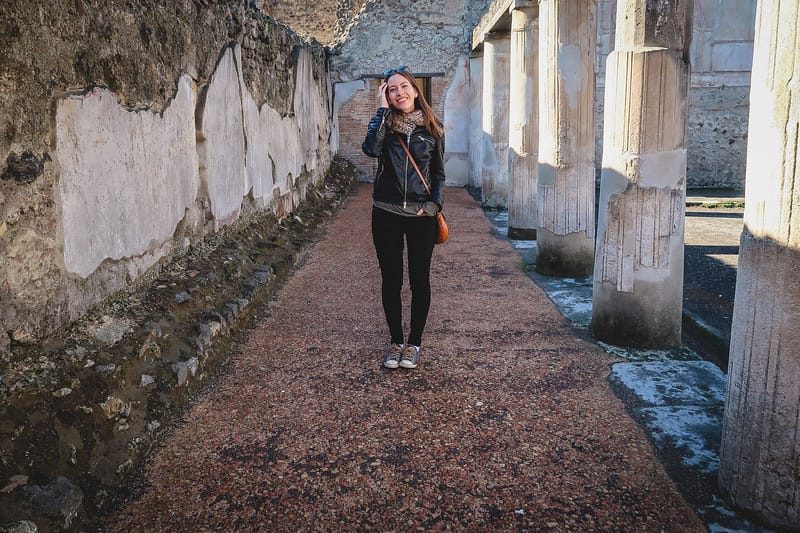
Visiting Pompei soon? Here are your travel essentials! 🇮🇹
Top Pompei Tours 🏛️
Pompeii Small Group Tour with an Archaeologist – choose between 2 hours in the Pompeii ruins OR 3 hours in the Pompeii ruins plus Villa of the Mysteries known for its frescoes!
Top Pompei Hotels 🛏️
Hotel del Sole – right in front of the Pompeii archeological site!
B&B Pompei Olympus – a small but elegant B&B close to the ruins
Nolana ’86 – hotel with terrace and amazing views
Centrally located and shorter commutes
First things first, let’s talk about Pompei’s location. Out of all the places we wanted to visit, this was the most centrally located destination on the itinerary with Herculaneum, Vesuvius and Naples to the north, and Sorrento to the south. Being the halfway point meant we had much shorter distances to travel.
Here’s a quick breakdown of travel times from Pompei to:
- Sorrento – 30 minutes
- Herculaneum (Ercolano Scavi) – 17 minutes
- Naples – 35 minutes

Cheaper than other destinations
When we were initially researching accommodations, we were looking at both Sorrento and Naples, but we weren’t really sold on either of them.
Sorrento marks the start of the Amalfi Coast, so we found the prices there to be significantly higher for an entire apartment in a central location.
As for Naples, the prices were a bit more reasonable, but we weren’t sure about booking a solid week in such a chaotic and densely populated city.
This is why we ended up looking at properties in Pompei, and once we saw that they offered more bang for our buck, we were sold!
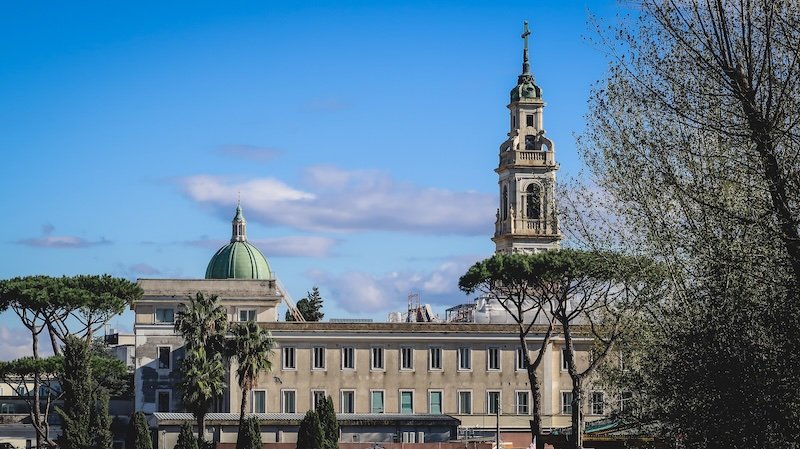
In the end, we rented a house on AirBnB for only $43 a night (during low season) and it was:
- a 5-minute walk to the main train station,
- a 10-minute walk to the centre of Pompei,
- and a 15-minute walk to the ruins of Pompeii.
Small town feel with plenty of restaurants
Once we arrived in Pompei, we were very pleased to discover that it was a small yet charming city. We found it very walkable, there was a beautiful central square flanked by a cathedral and lots of palm trees, and there was no shortage of restaurants.
Since we’re the kind of travellers who enjoy walking and eating all day long, this suited us pretty well.
We may have even found the best pizza outside of Naples at a place called Pizzeria Alleria, which we proceeded to revisit over and over again for the duration of our visit.
Lots of stations to get you places
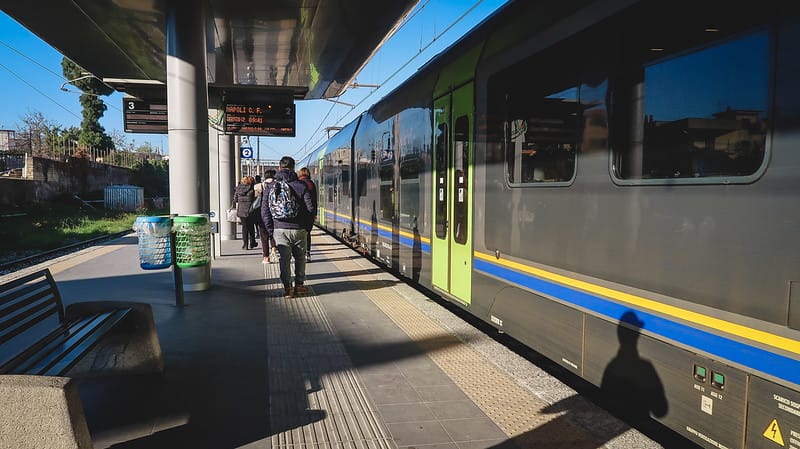
Another thing we loved about Pompei is that it was very well connected by train. We made use of 3 different train stations during our stay:
- Pompei Central – operated by TrenItalia and offering connections across Italy
- Pompei Scavi – Villa dei Misteri – located close to the ruins of Pompeii
- Pompei Circumvesuviana – located directly behind the cathedral
Whenever we hopped on the Circumvesuviana line, we only had to pay 2,00 – 2,80 Euros depending on where we were going.
Just one piece of advice, be aware that on some maps these stations only appear listed as “Pompei”, so make sure you know which station your train departs from. Otherwise, you could end up at the wrong place like we did!
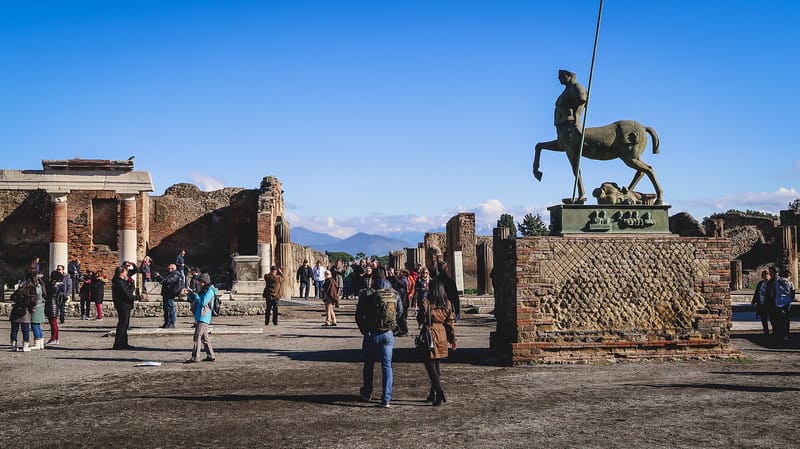
Many day-trippers but few overnighters
One thing we noticed during our week-long stay in Pompei is that the city gets a lot of day visitors, but very few people stay overnight.
The crowds in Pompei swelled during the day – mostly around the ruins of Pompeii since not many people seemed to wander into the modern city – but the numbers dropped drastically by late afternoon. If you’re looking for a bit of peace and quiet, this can be a great thing!
Easy access to the ruins of Pompeii
Last but not least, one of the great benefits of staying in modern Pompei is easy access to the ruins of Pompeii!
That means you don’t have to feel rushed visiting on a day trip or half-day trip, plus you can arrive outside of peak hours to experience the archaeological site with smaller crowds.
We arrived at the park shortly after it opened and there were areas where we felt like we had the whole place to ourselves, however, things got busier as the day progressed. So keep that in mind – early morning or late afternoon visits.

Did we make the right choice?
Absolutely!
Having visited all of the different towns and cities on our itinerary, we were very happy with our choice.
We really enjoyed getting to see Naples, Sorrento, Herculaneum and Mount Vesuvius, but it felt good to come back to Pompei at the end of the day.
Overall, this destination offered great value, excellent connections to some of the major tourist attractions along the Bay of Naples, and the city’s laidback vibe suited our travel style perfectly.
Logistics and Planning: Making the Most of Pompei as Your Base
Once Pompei is settled as the right base, the rest comes down to planning well. Here’s everything practical worth knowing before arriving — including a few details that catch first-time visitors off guard.
The Saint Who Built the City You’re Standing In
It’s easy to assume modern Pompei is just a service town that grew up to feed and house ruins visitors. It isn’t. The town radiates outward from the Sanctuary of Our Lady of the Rosary, and the sanctuary exists because of one 19th-century lawyer’s extraordinary turnaround. Bartolo Longo arrived in the area in the 1870s after a period spent immersed in occult practice, and, following what he described as a moment of spiritual conversion, devoted himself to building a shrine to the Virgin of the Rosary in a patch of land known then simply as Valle. Around that shrine he laid down a working town from scratch — a train station, a post office, running water, an observatory — funding much of it through orphanages and workshops for the children of prisoners. He was canonized in October 2025, which means the cathedral anchoring Pompei’s main square now belongs to an official saint. It’s a genuinely odd juxtaposition once you notice it: a 19th-century pilgrimage town, built almost entirely by one man’s charitable ambition, standing a few hundred metres from a Roman city frozen by catastrophe nearly two thousand years earlier. Locals still refer to the two as distinct — the “Pompei of the Madonna” and the “Pompei of the ruins” — and visitors who only come for the archaeology tend to miss the bell tower entirely, even though it offers one of the better rooftop views of the amphitheatre in town.
Understanding the Three Local Rail Systems
| Line | Destinations | Frequency | Ticket Price |
|---|---|---|---|
| Circumvesuviana | Naples, Herculaneum, Sorrento | Every 30 min | €2.60–€3.30 one-way depending on destination |
| Trenitalia Regionale | Naples Centrale, Salerno | Hourly | €2.90–€4.70 |
| Campania Express | Fast tourist train: Naples → Herculaneum → Pompeii → Sorrento | Runs year-round, several times daily | Fares vary by route (roughly €4–€15) — check current pricing before booking, as it’s periodically revised |
Quick Circumvesuviana reference for the route: Naples to Pompeii is €3.30; Naples to Herculaneum is €2.60; Pompeii to Sorrento is €2.80. Contactless payment (Tap & Go) now works at enabled turnstiles — no need for a paper ticket if your card is contactless.
Station reminder: Pompei’s three stations are spread over about a kilometre. It’s an easy mix-up — save all three in your phone maps and always double-check the station name on your ticket, not just the line.
Getting Here Directly From Naples Airport
Most guides to the area jump straight from Naples city centre to Pompei and skip the airport leg entirely, which leaves a gap for anyone flying in directly. The cheapest and most reliable route is the Alibus shuttle from Naples Airport to Napoli Centrale (around 20 minutes), followed by a Circumvesuviana train down to Pompei Scavi – Villa dei Misteri (around 35 minutes) — the whole trip runs 50–70 minutes door to door and costs roughly €8–€10 combined. There’s also a direct bus operator running a handful of departures a day straight from the airport to central Pompei, useful if a train transfer with luggage sounds unappealing, though schedules are limited and it’s worth checking current timetables before relying on it. For anyone landing late or travelling with a group, a pre-booked private transfer takes 35–50 minutes and runs considerably more, but removes the need to navigate stations at all. Whichever route is chosen, it’s worth timing the trip to arrive before Pompeii’s gates open — jet lag and a first-thing-in-the-morning entry to the ruins pair better than expected.
Booking the Pompeii Ruins: What You Need to Know Before You Go
This is the section that matters most if you’re visiting soon. Timed entry slots are now mandatory at the Pompeii Archaeological Park, and a daily cap of 20,000 visitors applies, split across a morning band and a smaller afternoon band. That means booking online in advance is no longer just a convenience — in peak months it’s the only reliable way to guarantee entry at the time you want. Tickets are also now personalised with each visitor’s name, and staff may ask to match it against a passport or ID at the gate.
- Standard entry: €20 — access to the main archaeological site
- Pompeii Plus: €25 — includes the entire site plus Villa dei Misteri and the suburban villas; if you’re staying in Pompei and planning two visits, this is the one to get
- Combined Pompeii + Herculaneum ticket: around €22, valid 48 hours — worth it if both sites are on the itinerary, since it works out cheaper than two separate tickets
- Under 18: free; EU citizens 18–25: €2 reduced (purchase at the gate with ID)
- First Sunday of the month: free entry for everyone (expect significantly larger crowds)
- Entrance gates: Piazza Anfiteatro is the calmest for security and lockers; Porta Marina is busiest with tour coaches; Piazza Esedra is a useful alternative if Porta Marina queues are long
- Large bags: not allowed inside (max 30x30x15 cm); bring photo ID for a free locker token
- Audio guides: available at Porta Marina before the ticket area — €8 first adult, €6.50 additional adult, €5 children
No, Pompeii Wasn’t Buried in Lava
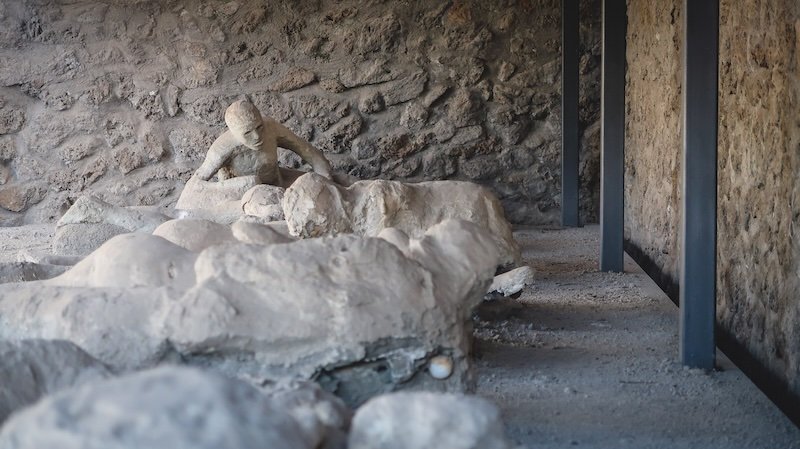
Before wandering the ruins, it helps to correct a detail almost every visitor gets wrong: Vesuvius never sent lava flowing over Pompeii. What buried the city was a series of pyroclastic surges — fast-moving clouds of scorching gas, ash and pumice that swept down the mountainside and reached temperatures high enough to kill instantly, before ash sealed everything in place. That distinction matters because it explains the site’s most famous feature. In 1863, the archaeologist Giuseppe Fiorelli noticed that decomposed bodies had left perfectly shaped hollows inside the hardened ash. Rather than dig through them, he poured liquid plaster into the voids, then chipped away the surrounding material once it set. What emerged wasn’t petrified stone or fossil, but an exact three-dimensional cast of a person’s final position — a curled arm, a covering hand, the folds of clothing. Around a hundred casts have been made this way since Fiorelli’s first attempts, including several visible near the Garden of the Fugitives, and knowing the actual mechanism behind them tends to change how people look at the ruins for the rest of the visit.
Our Favourite Spots for Food and Coffee
Modern Pompei turns out to be a genuinely lovely small city for eating and drinking, with more good options than its size suggests. Pizzeria Alleria is the one worth returning to again and again: wood-fired pies from around €5, try the smoked provola with friarelli. Beyond that standout, here’s a quick reference for the area:
| Craving | Go Here | Why |
|---|---|---|
| Morning espresso | Gran Caffè Santos (Via Roma) | Proper Neapolitan bar energy at the counter |
| Pizza | Pizzeria Alleria | Wood-fired, from €5, absolutely worth the repeat visits |
| Aperol spritz and snacks | Square-side cafés on Piazza Bartolo Longo | Free cicchetti during happy hour at several spots |
| Pastry and brioche | De Vivo Pasticceria | Fiocco di neve brioche filled with ricotta cream — don’t count the calories |
Which Part of Pompei to Stay In
| Area | Why It Works | Best For |
|---|---|---|
| Near Piazza Bartolo Longo (cathedral square) | Walkable centre with cafés, gelato, evening passeggiata; 8–12 minutes to all stations on foot | First-timers who want the classic small-town Italy feel without sacrificing train access |
| Pompei Scavi / Villa dei Misteri side | Closest to the main park entrances — ideal for early morning visits and multiple half-days at the ruins | History-focused travellers, families, anyone planning to split Pompeii across two or more mornings |
| Pompei Centrale corridor (Via Roma / Via Lepanto) | Easiest for Trenitalia connections to Naples and Salerno; quiet residential streets with lower prices | Budget travellers, longer stays, anyone prioritising quiet evenings |

Two Ways to Structure Your Week
Option A: The Hub-and-Spoke Week (minimum luggage juggling)
| Day | Focus | Tip |
|---|---|---|
| Mon | Slow morning in Pompei + Pompeii ruins (late afternoon light) | Enter at Piazza Anfiteatro for the calmest start; book timed slot in advance |
| Tue | Herculaneum + evening Naples street-food stroll | Herculaneum is compact — combine it with a walk down Spaccanapoli |
| Wed | Vesuvius crater + winery lunch | Book crater time slot online; bring a windproof layer even in summer |
| Thu | Sorrento day (marina, lemon grove, gelato) | Campania Express from Circumvesuviana — reserved seat, AC, worth it |
| Fri | Pompeii ruins, second visit — far corners and Villa dei Misteri | Buy the Pompeii Plus ticket (€25) for this — Villa dei Misteri is worth the upgrade |
| Sat | Naples museums or Paestum temples (ambitious option) | Paestum pairs perfectly with buffalo mozzarella tasting at a farm en route |
| Sun | Market, cathedral mass, unhurried pizza | Locals dress up on Sunday; it’s a lovely atmosphere if you slow down and watch |
Option B: For Early Risers and Crowd-Dodgers
| Window | Where | Why It Works | Tip |
|---|---|---|---|
| 07:30–10:30 | Ruins (Pompeii or Herculaneum) | Cooler temperatures, slanted morning light, emptier corridors | Small headlamp for dark frescoed rooms |
| 11:00–15:30 | Long lunch and rest in Pompei | Midday heat and peak coach traffic — you’re not missing anything | De Vivo pasticceria for a post-siesta brioche |
| 16:00–sunset | Vesuvius viewpoints or back inside the park | Golden hour on ancient brickwork is genuinely beautiful | This is when the light is best for photos |
What to Pack in Your Day Bag
| Item | Why It Matters | When You’ll Need It |
|---|---|---|
| 1L refillable water bottle | Dehydration creeps up in the ruins | Top up at on-site fountains — they work |
| Sun hat, SPF, light scarf | Shade is rare inside the park; high walls don’t mean cool breeze | All day from April onwards |
| Small bills and coins | Espresso, WC donations, bus kiosks | Not every machine takes cards |
| Charged phone | Timed entry ticket + offline map + audio guide drain batteries fast | Consider a power bank for full day trips |
| Thin socks | Sandals and cobblestones don’t mix well by late afternoon | Villa dei Misteri stretch especially |
| Small torch or headlamp | Some frescoed rooms inside the ruins are genuinely dark | Keep beam low; don’t dazzle other visitors |
| Light jacket | Vesuvius is windy at the crater even in August | Non-negotiable for the summit |
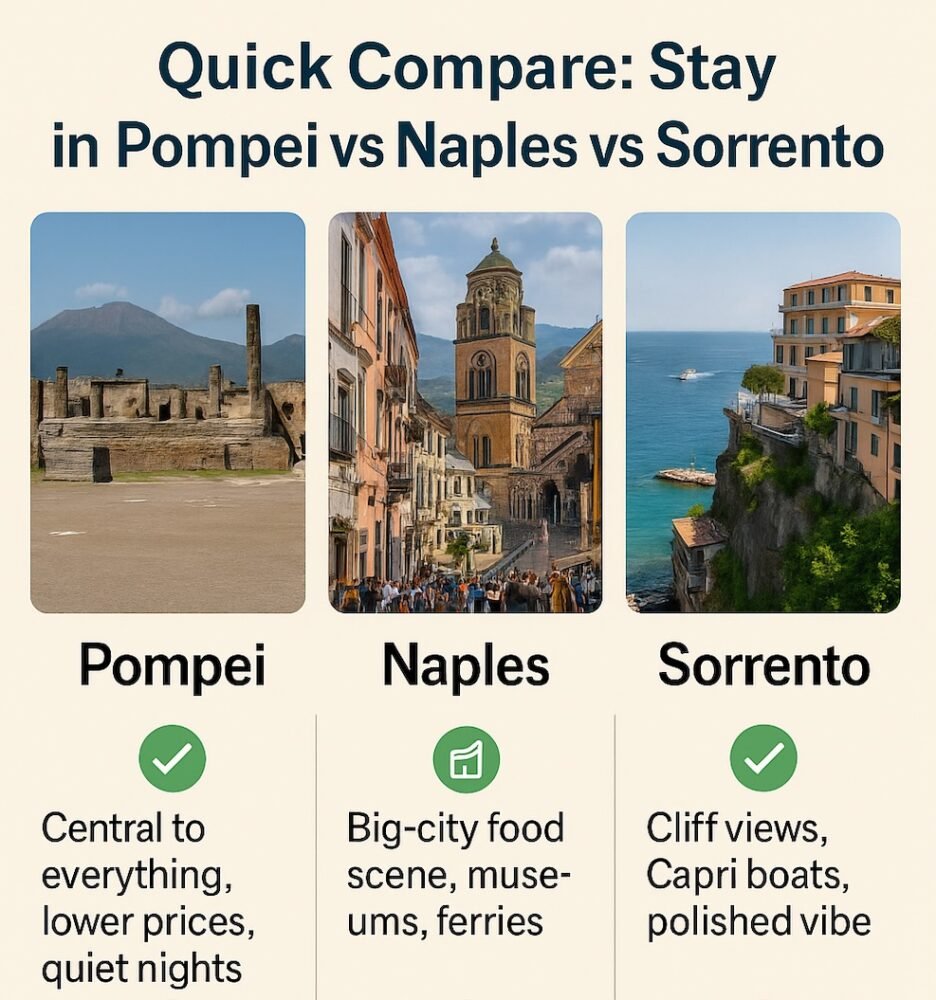
Pompei vs Naples vs Sorrento: How They Compare
| Base | Pros | Trade-offs |
|---|---|---|
| Pompei | Central to everything, lower prices, quiet evenings, three train stations, walkable city feel | Fewer late-night dining options; extra connections needed for Capri and Amalfi |
| Naples | World-class food scene, major museums, ferry connections, late nights | Longest daily commute to the ruins and Sorrento; intense city energy around the clock |
| Sorrento | Cliff views, direct Capri and Amalfi ferries, polished resort vibe | Highest accommodation prices on this route; very busy in peak months |
The honest summary: if Capri and Amalfi ferries are your daily priority, base in Sorrento. If your list reads “ruins, volcano, Herculaneum, pizza, quiet evenings,” Pompei wins clearly.
Three Day Trips Timed to Real Trains
1) Herculaneum and Naples Street Food
| Time | Where | Tip |
|---|---|---|
| 08:30 | Circumvesuviana to Ercolano Scavi (€2.60 from Pompei) | Sit near the doors for a quick exit at Ercolano |
| 09:00–11:30 | Herculaneum — entry around €13, book online in advance | Smaller and more intact than Pompeii; read the boathouse plaques |
| 11:45 | Train to Napoli Garibaldi | Keep your ticket — you’ll need it for the barriers |
| 12:15–16:00 | Spaccanapoli: pizza fritta, sfogliatelle, the cloister of Santa Chiara | Walk slowly; the best things here are vertical as much as street-level |
| 16:30 | Train back to Pompei | Aperitivo hour when you return |
2) Vesuvius Crater and Winery Lunch
| Time | Where | Tip |
|---|---|---|
| 08:50 | Circumvesuviana to Ercolano Scavi | Vesuvio Express shuttle departs from the square just outside the station |
| 09:30 | Vesuvio Express shuttle to the crater (combo shuttle + entry ~€22) | Book crater time slot online in advance — no ticket office at the summit |
| 10:15–11:30 | Hike the Gran Cono Trail to the rim | Bring the windproof layer — even in summer the crater edge is breezy |
| 12:30–14:30 | Lacryma Christi winery lunch | Call ahead for vineyard tours — not always walk-in |
| 15:00 | Train back to Pompei | Nap, then gelato — you’ve earned both |
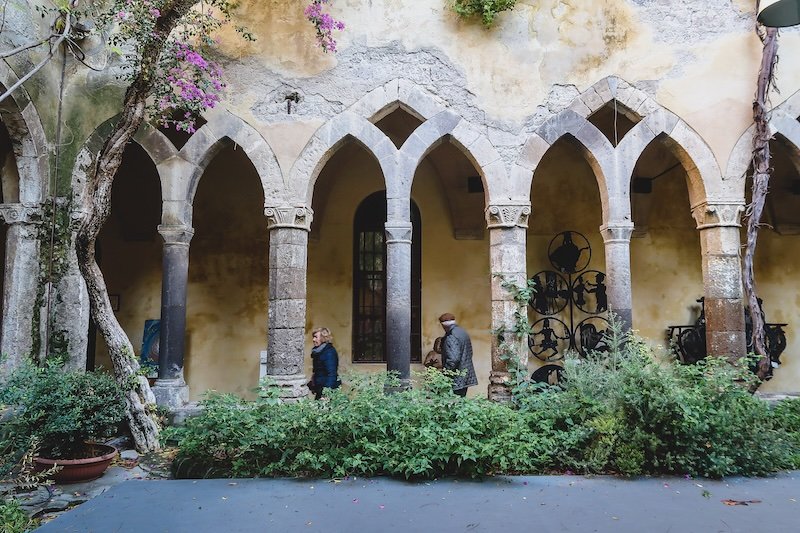
3) Sorrento and a Positano Peek
| Time | Where | Tip |
|---|---|---|
| 09:05 | Campania Express to Sorrento (reserved seat) | AC and guaranteed seating make this worth the premium over the standard Circumvesuviana in summer |
| 09:45–12:00 | Marina Grande wander + lemon grove tasting | Check ferry schedules if you’re planning to continue by boat |
| 12:15 | Ferry to Positano (April–October) | Morning seas are calmer; mid-afternoon can be choppy |
| 14:30 | Beach time + cliff cafés | Sun hat and water — shade in Positano is scarce and expensive |
| 16:15 | SITA bus back to Sorrento | Buses are frequent; buy the return ticket in advance to avoid the queue |
| 18:00 | Train back to Pompei | Pizza takeaway? Always yes |
Budget Breakdown for a Week in Pompei
| Category | Budget | Mid-Range | Splurge |
|---|---|---|---|
| Accommodation (2 people) | €45–65/night (apartment near Centrale) | €70–110 near the square or Scavi | €140+ boutique with terrace or rooftop views |
| Food (per person/day) | €15–25 (pizza, espresso, gelato) | €30–45 (add aperitivo and pastry) | €60–90 (seafood, wine, proper dinner) |
| Train day trips | €5–8 round-trip (Circumvesuviana) | €12–18 with Campania Express | €30–40 ferry add-ons (Positano) |
| Site tickets | Pompeii €20; combined Pompeii + Herculaneum ~€22 | Pompeii Plus €25 | Vesuvius ~€22 (Vesuvio Express combo) |
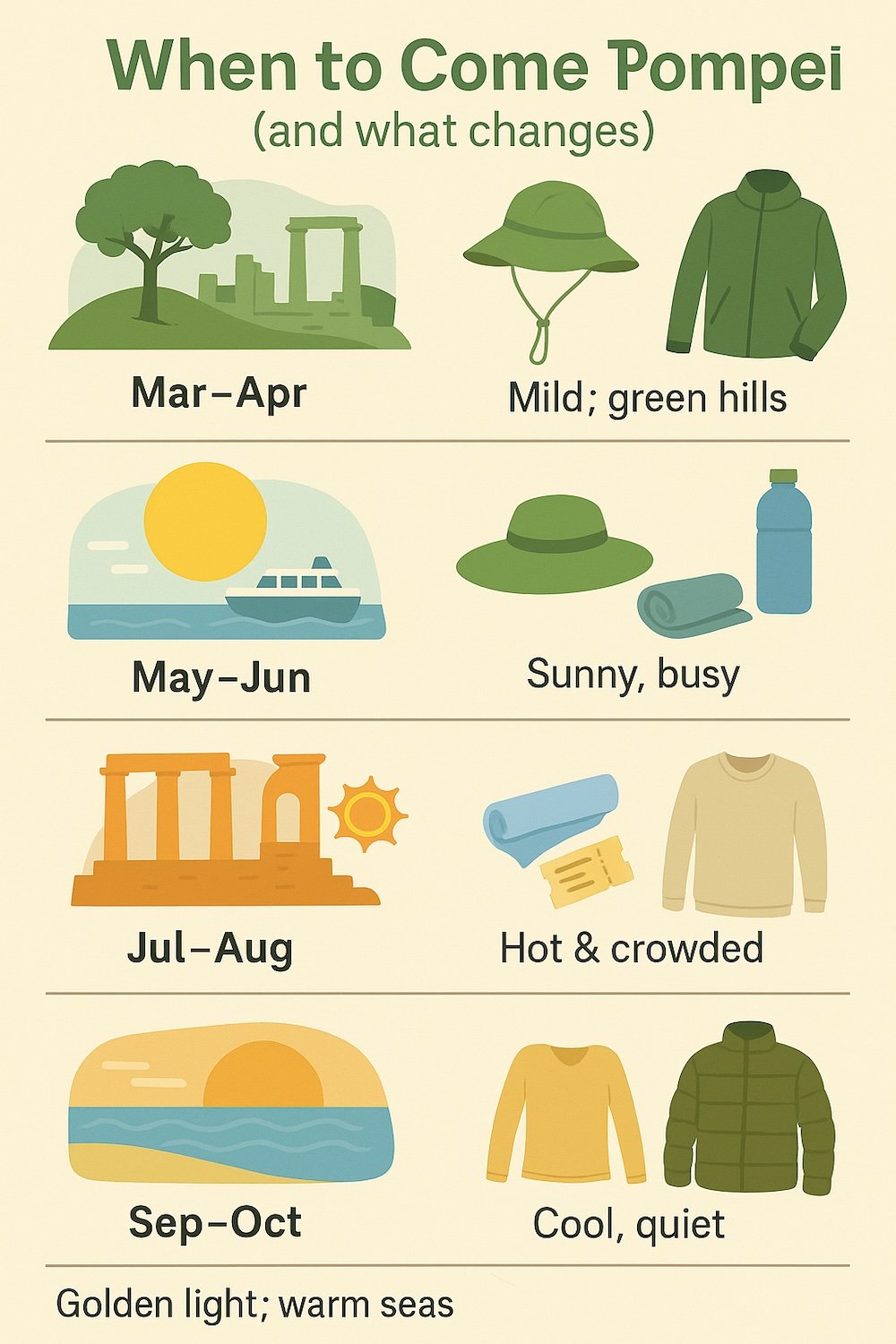
When to Come and What Changes by Season
| Season | What It Feels Like | What to Expect | Pack |
|---|---|---|---|
| Mar–Apr | Mild, green hills, manageable crowds | Occasional showers; blossoms everywhere; ruins at their most photogenic | Light rain shell, layers |
| May–Jun | Sunny, busy but not overwhelming | Ferry schedules running fully; long museum hours | Sun hat, SPF, electrolytes |
| Jul–Aug | Hot and crowded mid-day | Do the ruins at opening time or late afternoon; siesta hard between noon and 4pm | Cooling towel, early-booked timed entry tickets |
| Sep–Oct | Golden light, warm seas, harvest season | Grape harvests in the wine country; fewer day-trippers than peak summer | Light sweater for evenings |
| Nov–Feb | Cool and quiet | Some ferries reduce or stop; ruins stay open; Pompei feels genuinely local | Warm jacket, flexible plans |

Tours Worth Booking from Your Pompei Base
Some of the best experiences around the Bay of Naples are significantly better with a good guide — either because the site is complex enough to need context, because transport is included, or simply because you don’t want to think about logistics on your holiday. Here are the tour types we’d prioritise, bookable through GetYourGuide or Viator — both have strong inventory for this region.
At the Pompeii Ruins
- Small group tour with an archaeologist — the most popular option for good reason; a specialist who can explain what you’re actually looking at transforms the visit. Choose between a 2-hour highlights tour or a 3-hour version that adds Villa dei Misteri with its extraordinary frescoes. This is the tour already featured in the Quick Guide above.
- Skip-the-line ticket with guided tour — especially valuable now that timed entry is mandatory; guided tours typically have reserved slots that bypass the standard queue entirely
Combined Day Tours
- Pompeii Ruins & Mount Vesuvius Day Tour — the most popular combo tour from both Naples and Pompei; includes transport between the sites and entry tickets so you don’t have to think about shuttles or booking separately. Very efficient use of a single day.
- Pompeii + Herculaneum archaeological combo — for those who want to compare both sites with a guide who can explain the differences; Herculaneum’s preservation is exceptional and deserves proper explanation
From Sorrento (easy day trips or add-ons)
- Positano & Amalfi Coast Small-Group Boat Tour — a small-group boat departing Sorrento with swim stops and free time in both Positano and Amalfi; the most scenic way to see the coastline without the switchback bus ride. Available spring through autumn and worth booking a few days ahead in peak season.
- Capri day trip with boat tour — if you want to do Capri properly (Blue Grotto, Villa Jovis, Anacapri) without the ferry logistics, an organised tour handles the boat timings and crowds; book well ahead in July and August
Naples
- Naples street food tour — the city is one of the best food destinations in Italy and a guided walking tour through the old city and markets with tastings included is genuinely one of the highlights of the whole Bay of Naples area; 3–4 hours, small groups preferred
- National Archaeological Museum guided visit — the museum houses most of the artefacts excavated from Pompeii and Herculaneum; visiting after the ruins with a guide who connects what you’ve seen to what’s on display here is a very rewarding sequence
Common Mistakes to Avoid
- Not booking Pompeii in advance. Timed entry is mandatory and the daily cap means popular slots fill up. Book online before your trip, especially in summer.
- Mixing up stations. Save all three Pompei stations in your maps and match the station name on your ticket — this is one of the most common mix-ups visitors make.
- Trying to see all of Pompeii in one visit. The site is 44 hectares — split it across two mornings. Your feet and your brain will both thank you.
- Arriving hungry. Snack selection inside is limited; tuck a panino from a Pompei bakery into your bag before entering.
- Trying to do Capri as a day trip from Pompei. Possible but clunky — train to Sorrento plus ferry both ways is a long day. If Capri is important to you, spend one night in Sorrento at the end of your stay and do it properly from there.
- Expecting late nights. Outside the main square, restaurants close by 22:30. Night owls who want late-night trattorie will be happier based in Naples.
- Sunday supermarket runs. Two Conad markets serve the centre; stock up on Saturday as Sunday shelves thin out.
- Expecting Amalfi or Paestum to be easy from Pompei. Both are doable but involve extra connections via Sorrento or Salerno — factor in the real journey time before planning these as day trips.
Should I Stay in Pompei? Your Questions Answered
Is Pompei a good base compared with Naples or Sorrento?
Yes — if your itinerary is built around the ruins, Vesuvius, Herculaneum, and day trips along the Bay. Pompei is central, significantly quieter at night, has three train stations, and generally lower accommodation prices than Sorrento with a much calmer atmosphere than Naples. The trade-off is fewer late-night dining options and extra connections for Capri and Amalfi.
How many nights should I plan in Pompei?
Four to seven nights works well. That gives you two relaxed visits to the Pompeii Archaeological Park, a day each for Herculaneum and Vesuvius, and a Sorrento day — with room to breathe rather than just ticking boxes.
What are the commute times from Pompei?
Roughly: Herculaneum (Ercolano Scavi) about 17 minutes; Sorrento about 30 minutes; Naples about 35 minutes. That centrality is the single biggest argument for basing here over anywhere else on this route.
Which area of Pompei is best to stay in?
- Cathedral square (Piazza Bartolo Longo): walkable, cafés everywhere, 8–12 minutes on foot to all stations — the best all-rounder
- Pompei Scavi/Villa dei Misteri side: right by the park entrances; ideal for multiple early morning visits to the ruins
- Near Pompei Centrale (Via Roma): quieter and cheaper; best for Trenitalia connections and longer stays
How do the local trains work?
Pompei has three stations: Pompei Centrale (Trenitalia), Pompei (Circumvesuviana), and Pompei Scavi–Villa dei Misteri (Circumvesuviana). The Campania Express tourist train now runs year-round and offers reserved seats, AC, and a hop-on/hop-off option — worth the small premium in summer. Save all three stations in your phone maps and always verify which one your train departs from.
What do I need to know about tickets for the Pompeii ruins?
Timed entry is mandatory and daily visitors are capped at 20,000, split across a morning and afternoon band. Buy online in advance. Standard entry is €20; the Pompeii Plus ticket (€25) adds Villa dei Misteri and the suburban villas — worth it if you’re doing two visits; a combined Pompeii + Herculaneum ticket (around €22, valid 48 hours) is the better value if both sites are on your list. Under 18s enter free; EU citizens 18–25 pay €2. The first Sunday of every month is free for everyone, but expect crowds. Enter at Piazza Anfiteatro for the calmest experience; Porta Marina is the busiest gate. Tickets are personalised, so bring ID that matches the name on your booking.
When is the best time to visit the ruins?
Opening time or late afternoon. Midweek — especially Wednesday mornings — tends to have the fewest coach tours. In summer, aim for the ruins at 9am and siesta hard between noon and 4pm. September and October offer the best combination of weather, lower crowds, and beautiful light.
What’s the food scene like in Pompei?
Better than you might expect for a small city. The espresso bars are proper Neapolitan operations, the gelato is excellent, and Pizzeria Alleria really does make some of the best pizza around, outside Naples itself. The evening passeggiata around the cathedral square is a lovely way to end a day trip.
What’s a quick 48-hour plan from Pompei?
Day 1: Morning ruins via the Piazza Anfiteatro entrance, long lunch in town, return to the park for the frescoes in golden-hour light.
Day 2: Herculaneum in the morning (entry around €13, 17 minutes by train), then Naples for a street-food lunch and a walk down Spaccanapoli, back in time for pizza and gelato.
What about Vesuvius?
Go early. Take the Circumvesuviana to Ercolano Scavi, then the Vesuvio Express shuttle to the crater (shuttle + entry combo ~€22 from Ercolano; alternatively, EAV bus from Pompei at €2.70 plus around €10 park entry). Book your crater time slot online in advance — there is no ticket office at the summit. Bring a windproof layer whatever the season, and follow the time window on your ticket strictly — late arrivals are not admitted.
What are the most common mistakes?
Not booking Pompeii timed entry in advance; mixing up the three stations; trying to rush all of Pompeii in three hours; forcing a Capri day trip from Pompei when Sorrento is the right base for that; expecting late-night restaurant options beyond the main square.
Who should choose Naples or Sorrento instead?
Choose Naples if you want big-city food culture, late nights, world-class museums, and ferry access. Choose Sorrento if daily Capri and Amalfi ferry departures are your priority and higher hotel prices are acceptable. For a ruins-focused itinerary where value, central location, and quiet evenings matter, Pompei is the practical answer.
Have you stayed in Pompei as a base? We’d love to hear your experience — any tips for future visitors?
I did a day trip to Pompeii from Naples early February ’17 and everything was dead empty, I was actually quite happy to return to buzzing Napoli later that day 🙂
Ahhh, I felt the complete opposite. After a buzzing day in Napoli, I was so relieved to return to a quieter place in Pompei, but that being said, big cities are not really my thing. 😉
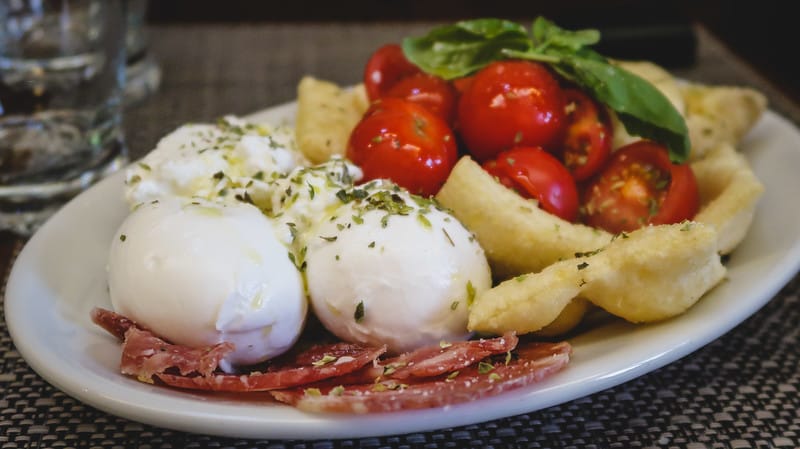
I’d skip the ruins and just eat those fresh mozzarella balls all day!
Haha, the food at this place was so good! We just kept going back for more. 😋
I went on a day trip to Pompeii when I went on a coach holiday to Rome a few years ago, it was so amazing and I wish I’d had more time to really explore, we were only there for about 2 hours!
We spoke to a couple when we were in Sorrento who said they were staying near Pompeii and I would definitely choose to stay there if/when I go back!
I didn’t make it to Pompeii on my last trip to Italy, but I definitely want to next time. I split my time in big cites and smaller towns and it was really, really nice to get out of the hustle of a big town and I found that in a lot of the smaller towns, they might get busy during the day, but the nights are pretty blissful. It definitely allows for a different look at cities that are mostly just visited for a few hours.
Hello. I was very pleased to find your piece as we are looking at doing a similar thing in a week or so. We are looking at accommodation in Pompei and will be arriving by train or bus. Is everywhere close and walkable or should we look at a particular area best for public transport connections. Where was your AirBNB located? Thanks. Helen
Hi Helen, the city of Pompei is fairly compact so it’s easy to get around on foot. I’d recommend choosing accommodations in the vicinity of Piazza Bartolo Longo or one of its surrounding side streets. That’s the main square in town with lots of restaurant options, plus you can easily walk to the ruins. My AirBnB was located behind the train station, which meant I had to cross an overpass – still walkable in terms of sightseeing, but you’d want to take a taxi if you have luggage.
Hi! Loved your video…would you suggest just walking around by yourself in Pompeii and ruins, or doing a tour. What is the cost difference?
Thanks!
I was in Pompeii and I liked it very much. I didn’t think it would make such a big impression on me.
Joined a group tour of Pompei. Lots of tours at the same time, made for tricky maneuvers while exploring the ruins. The tour guides are very competitive trying to make their group the first ones through. It was rushed, only hitting highlights of Pompei. Wish we could have spent more time there.
Thank you for this! We just booked a trip in March, (COVID willing) and it was my idea to stay in Pompeii. Out hotel looks out over the site and I was actually just beginning to think maybe I made a poor choice. But I will feel better now. I’m not a huge fan of huge cities and I really just want to see the dig sites and such in the area. Do you have any tips for getting from Naples Airport to Pompeii or from the City of Pompeii to Herculaneum? Thank you!
What a great read Audrey! We’re also planning a trip and have decided to base ourselves in Pompeii .. again I’m wondering about transport .. to Vesuvius and from Naples airport to Pompeii?
Did you visit Positano or Amalfi? Is it doable to stay in Pompeii and do day trip to Amalfi area? I too do not like changing hotel, prefer a base to come back to nightly.