
No matter where I go, I always like to dive right into the local cuisine and in Tyrol, it was no different. The foodie in me was curious to see what Tyrolean food was like, so in between exploring the mountains and valleys and attending a cow parade, I made it my personal mission to order as many traditional Tyrolean dishes as possible, and let me tell you, they were goooood! So without further delay, here are 10 mouthwatering dishes you need to try in Tyrol, Austria!
Tyrolean Dishes to Try
Kasspatzln
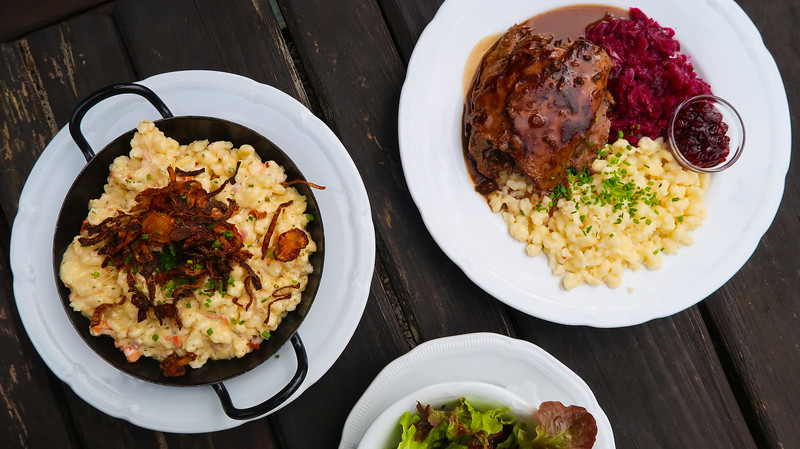
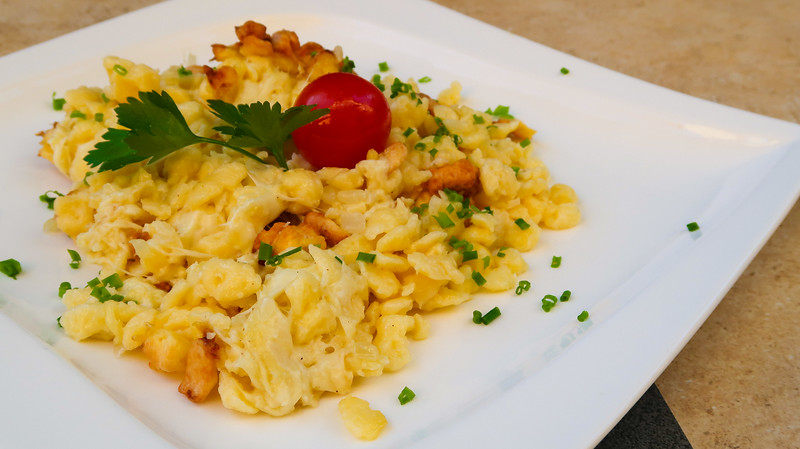
Let’s start with Käsespätzle, or as they call it in Tyrol, Kasspatzln.
This dish consists of soft egg noodles mixed with grated cheese and sprinkled with crispy fried onions on top.
Kasspatzln is oftentimes served in the same pan it was cooked it, and when it arrives at the table, the noodles are coated in melted cheese that stretches into strings as you try to take a bite.
It’s such a popular dish that you’ll find it is served in restaurants as well as out-of-the-way mountain huts – because people expect their Kasspatzln after a long day of hiking, what else!
This was my personal favourite Tyrolean dish and I guarantee it won’t disappoint your taste buds.
Tiroler Gröstl
Another dish I tried in Tyrol was the Tiroler Gröstl, sometimes just called, Gröstl.
This is yet another hearty dish that you can enjoy after an active day of skiing or hiking in the Alps.
Tiroler Gröstl is a potato, onion, and bacon fry up. Everything is fried until golden, sprinkled with chopped parsley, and then served with a fried egg on top. It’s a simple recipe, but it’s delicious!
This is a very filling dish, so if you’re really hungry, you can order it as a main, or you can get it as a side to share with your group at the table.
Tiroler Speckknödel
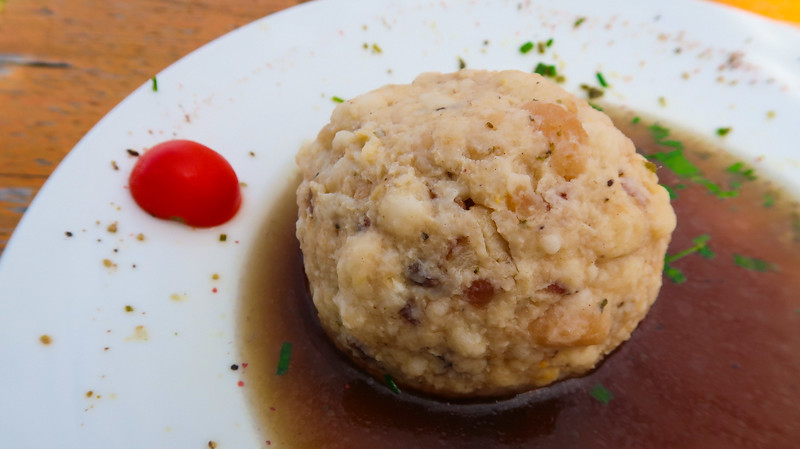
Another popular dish in Tyrolean cuisine is the Tiroler Speckknödel.
This is a large, round, boiled, bread dumpling that has little pieces of bacon. It may not fit your idea of a dumpling as it’s really the size of a fist, but it’s another tasty dish to try in Tyrol.
I’ll admit that I didn’t think this looked very appetizing the first time I ordered it, but as soon as I took a bite, I was sold!
The Speckknödel can be served with a light broth or with a side of Sauerkraut – whatever you prefer!
This is another popular choice in the mountain huts.
Kaspressknödel
This next dish bears some similarities to the Tiroler Speckknödel I just mentioned.
The Kasspressknödel is also a large dumpling, except unlike the Tiroler Speckknödel, it is thick and flat. The ingredients are also different; while the Speckknödel is a bread and bacon dumpling, the Kasspressknödel is made with cheese and potatoes.
These pancakes are cooked in butter until golden brown and then served in a broth or with a side of coleslaw. Another filling dish to add to your list of foods to eat in Tyrol!
Zillertaler Krapfen
While travelling in Tyrol, I also tried the Zillertaler Krapfen.
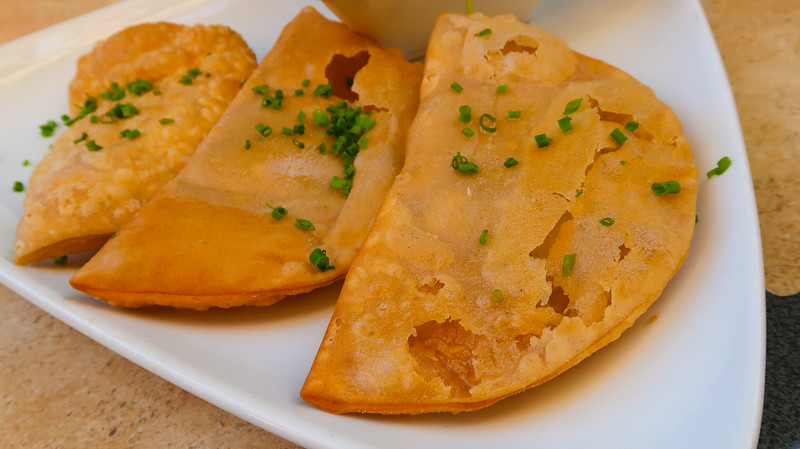
The best way to describe this dish is that it reminded me of the Tyrolean version of a South American empanada.
Zillertaler Krapfen consists of thin layers of dough that are stuffed with a potato, cheese (you need to use Graukäse) and chive filling. They are then folded into semicircular parcels and fried in oil.
This dish is a tradition from the Zillertal Valley and it’s often served during festivals.
Hirschfleisch
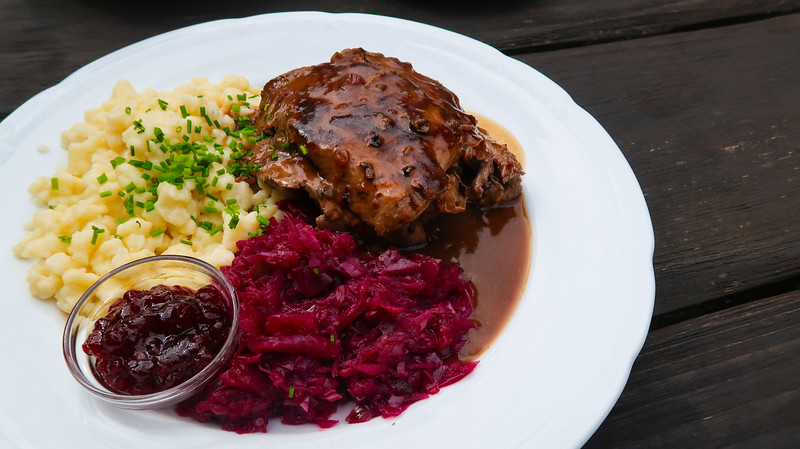
Wild game makes frequent appearances on menus around Tyrol, so another dish I decided to try was Hirschfleisch or deer meat.
I got the deer escalope stuffed with mushrooms, bacon and onions, which was accompanied by Rotkraut (red sauerkraut), Spätzle, and a cranberry sauce.
I’ve only tried deer meat a few select times, once in Canada and once in Scotland, but I was very impressed by this meal.
The meat was very tender, and it did not have a strong gamey flavour, but rather took on the flavour of the sauce it was cooked in. It was hearty and filling, and very recommendable.
Marend
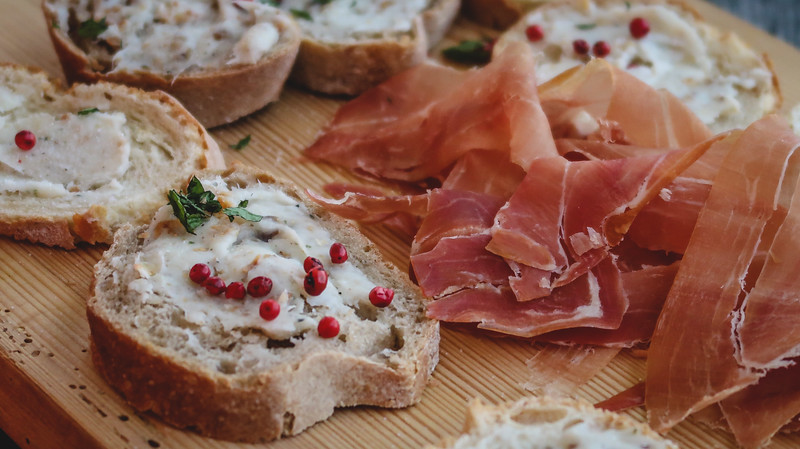
Marend is another Tyrolean dish that is best described as an assorted snack spread.
Back in the day, this used to be the meal of choice for farmers and shepherds who spent their days working in the mountains, but today, it has evolved into more of a social occasion that brings family and friends together.
Marend is a casual snack usually served on a wooden block, and it includes a mix of mountain cheeses, cured meats, sausages, lard spreads and bread. Perfect for snacking and socializing!
It can be enjoyed with schnapps, beer or wine.
Prügeltorte
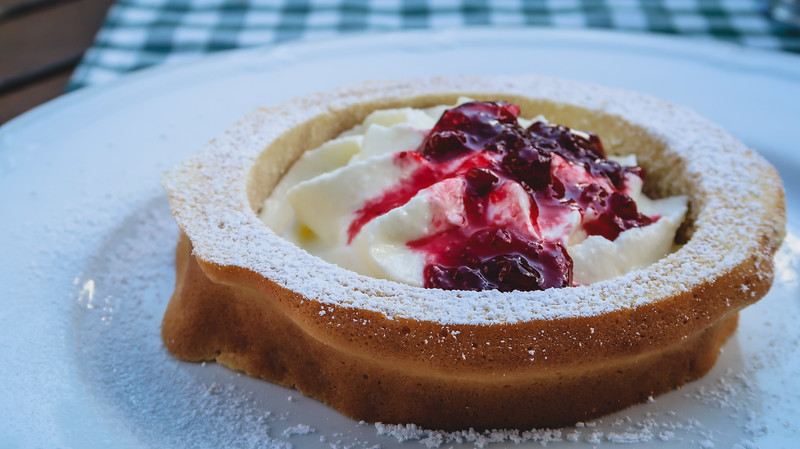
Now moving on to desserts, one that I particularly enjoyed is Prügeltorte.
This is a type of cake that isn’t cooked in an oven, but rather a spinning cylinder!
The batter consists of eggs, butter, sugar, flour, a pinch of salt and lemon zest. Once the batter is ready, it’s spread on a spinning cylinder which slowly cooks the cake over a fire.
Layers are added one at a time until the cake is about 1.5-2 centimetres in thickness. Once ready, the cake slides off the cylinder and the rings are filled with cream and a berry sauce.
Half the fun is watching the dessert be prepared right before your eyes!
Kaiserschmarren
Another dessert not to be missed in Tyrol is Kaiserschmarren.
Technically, you can find this dish outside of Tyrol, but it’s very popular here, especially in the mountain huts.
The dish is basically a scrambled pancake; while the pancake is cooking, it’s broken apart with the use of two forks, and then it’s served with a dusting of icing sugar and a fruit sauce.
Fun fact: Kaiserschmarren is named after the Austrian Emperor, Kaiser Franz Joseph I, who loved this dish and also vacationed in Tyrol.
Dessertteller
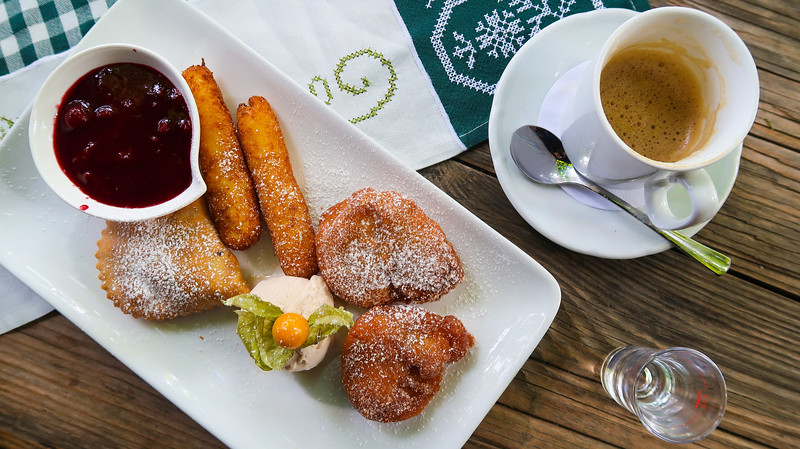
Dessertteller simply means “dessert plate”, and one of my favourite Tyrolean desserts was this assorted platter which had a selection of some of the most popular sweets in the region.
This plate featured Apfelradl, an apple fritter; Grießstrietzln, fried semolina sticks; Krapfen, poppy seed doughnuts; and Zimteis, cinnamon ice cream.
I paired this with a cup of coffee and a shot of apricot schnapps, and let me tell you, it was divine!
The Tyrolean Food Experience: Tips, Traditions and Where to Eat Like a Local
After working my way through those ten dishes, I came away with a very clear picture of what Tyrolean food is about: mountain people eating well after hard physical days, with local cheese and cured meat doing most of the heavy lifting. It’s not delicate cuisine. It’s generous, warming, and deeply tied to the landscape. Here’s everything practical I learned along the way — plus how to find the best of it wherever you end up in the region.
All 10 Tyrolean Dishes in One Table
Before sitting down to a menu, here’s every dish from this guide in one place — what it is, when to order it, and where you’re most likely to find it.
| Dish | What It Is | Course | Where to Find It | Best Season |
|---|---|---|---|---|
| Kasspatzln | Cheesy egg noodles with crispy fried onions | Main | Everywhere — Wirtshaus and mountain huts alike | Year-round |
| Tiroler Gröstl | Potato, onion and bacon fry-up with fried egg | Main or side | Wirtshaus, ski huts | Year-round |
| Tiroler Speckknödel | Fist-sized bread and bacon dumpling in broth | Starter or main | Mountain huts, traditional inns | Year-round |
| Kaspressknödel | Flat pan-fried cheese dumpling in broth or with slaw | Starter or main | Mountain huts, Wirtshaus | Year-round |
| Zillertaler Krapfen | Fried dough pockets with potato, Graukäse and chives | Starter or snack | Zillertal Valley restaurants, festivals | Autumn festivals |
| Hirschfleisch | Venison escalope with Spätzle, red cabbage, cranberry | Main | Traditional Wirtshaus | Autumn (hunting season) |
| Marend | Charcuterie and cheese snack board with bread | Snack or light meal | Inns, farm taverns, outdoor terraces | Year-round |
| Prügeltorte | Ring cake cooked on a spinning cylinder over fire | Dessert | Cafés, festival stalls, bakeries | Year-round |
| Kaiserschmarren | Shredded fluffy pancake with fruit compote | Dessert | Mountain huts, cafés, Wirtshaus | Year-round |
| Dessertteller | Assorted sweets: apple fritters, semolina sticks, doughnuts, ice cream | Dessert | Traditional restaurants | Year-round |
Why Cheese and Cured Meat Run the Tyrolean Table
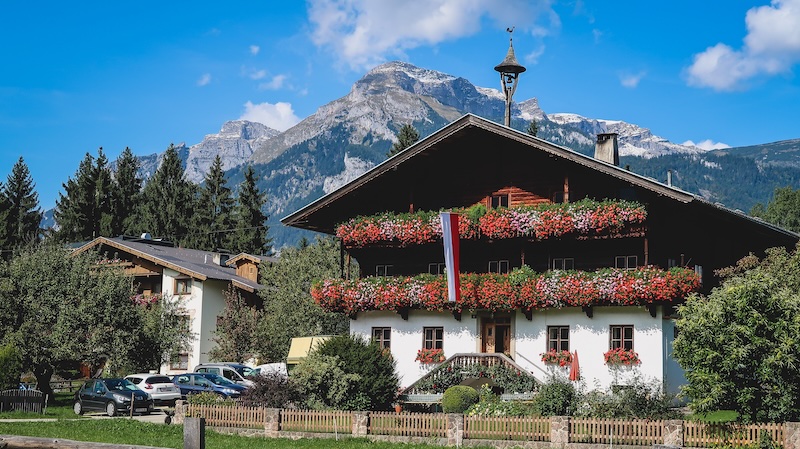
Tyrol’s cuisine makes a lot more sense once you understand the terrain it grew out of. Much of the region sits too high and too steep for arable farming, so for centuries the economy ran on cattle taken up to alpine pastures each summer — a seasonal migration known as transhumance, or locally, the practice behind the Almabtrieb. Herders spent months at altitude with the animals, and the food that traveled with them had to survive without refrigeration: hard mountain cheeses, smoked and cured meats like speck, and dense breads that kept for weeks. That’s the direct ancestor of the Marend board you’ll be served today, and it’s why so many Tyrolean dishes lean on the same short list of ingredients rather than a broad pantry.
The dumplings tell a similar story. Bread that had gone stale wasn’t thrown out — it was soaked, bound with egg, and turned into Knödel, which is why you’ll find so many variations across the region: with bacon, with cheese, with spinach, depending on whatever the household had on hand that week. Graukäse, the sharp grey cheese inside Zillertaler Krapfen, is itself a product of necessity rather than luxury — it’s made from skimmed milk left over after the cream was used for butter, aged with almost no fat content, which gives it that distinctive tang. None of this is precious, museum-piece cooking. It’s food that was built to get people through a physically hard year in a hard landscape, and that history is still on the plate at nearly every Wirtshaus and mountain hut in Tyrol.
Where and How to Try Tyrolean Dishes
Seek Out the Tiroler Wirtshaus
You may have noticed that in Tyrol, the word “Wirtshaus” comes up a lot. These family-run inns are at the heart of local food culture. Look for the “Tiroler Wirtshaus” logo — it’s the mark of the Verein Tiroler Wirtshauskultur, an association of owner-operated restaurants across the region committed to regional ingredients and time-honoured recipes rather than shortcuts. It’s a reliable way to find genuinely local cooking, even in a village where you don’t recognize a single restaurant name.
Don’t Skip the Mountain Huts
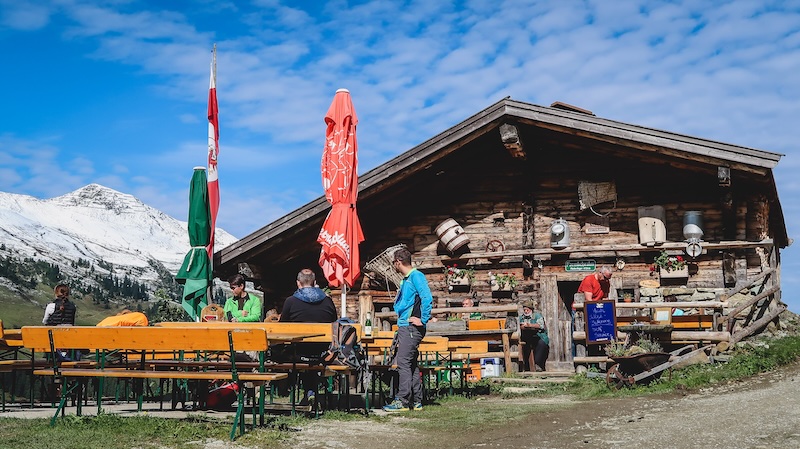
Some of the most memorable meals in Tyrol aren’t in town at all — they’re up in the mountains. Hike or ride the cable car to an Almhütte (mountain hut), where the air is crisp, the views are jaw-dropping, and the menu is hearty. The Kasspatzln arrives sizzling in the same pan it was cooked in, which you then eat while watching clouds drift past the peaks. These huts often make their own cheese, butter, and schnapps — always ask what’s homemade. That’s usually the thing worth ordering.
Café Culture for Sweets and Coffee
Austrian café culture thrives in Tyrol — perhaps even more so than in Vienna because the setting is so dramatic. Order a Melange (the Austrian take on a cappuccino) and a slice of Prügeltorte or a plate of Apfelradl at a local café. Take your time: watch the comings and goings, and let yourself be part of the morning rhythm rather than rushing to the next attraction.
Market Halls and Farm Shops
For an excellent introduction to Tyrolean ingredients before you sit down to a meal, the Markthalle Innsbruck is worth an hour of your time. This covered farmers’ market in the centre of Innsbruck has local cheese producers, speck vendors, fresh bakers, and mountain herb stalls all under one roof. You can taste Graukäse, the tangy grey cheese used in Zillertaler Krapfen, before you’ve even ordered it in a restaurant — which makes the dish make a lot more sense when you do. Go in the morning when the stalls are freshest.
Ordering in German: Phrases That Actually Help
Most restaurants in tourist areas of Tyrol have English menus, but in mountain huts and smaller village inns you may encounter German-only menus. These are the phrases that actually helped me:
| Situation | What to Say | Pronunciation Help |
|---|---|---|
| Asking for a recommendation | “Was empfehlen Sie?” (What do you recommend?) | Vass em-FAY-len zee |
| Ordering the cheesy noodles | “Ich hätte gern die Kasspatzln.” | Ikh HET-teh gern dee KASS-pats-ln |
| Asking what’s homemade | “Was ist hausgemacht?” | Vass ist HOWSS-ge-maht |
| Requesting the snack board | “Eine Marend, bitte.” | EYE-neh MAR-end BIT-teh |
| Asking about today’s soup | “Welche Suppe haben Sie heute?” | VEL-kheh ZOOP-eh HA-ben zee HOY-teh |
| Asking for local schnapps | “Haben Sie einen lokalen Schnaps?” | HA-ben zee EYE-nen lo-KAH-len SHNAPS |
| The bill, please | “Die Rechnung, bitte.” | Dee REKH-nung BIT-teh |
| Thank you | “Danke schön!” | DANK-eh SHERN |
What to Drink With Tyrolean Food
Local Wine
While Austria is more famous for white wines in the east, Tyrol has its own wine culture worth exploring. Try a glass of Blauer Zweigelt with venison or pork dishes — it’s a medium-bodied red with enough dark fruit to hold up against the richness of the sauce. For lighter dishes like Marend or Zillertaler Krapfen, a crisp Weißburgunder (Pinot Blanc) is the right call.
Beer for Hearty Fare
Tyrolean beer is excellent — look for unfiltered lagers, wheat beers, and small-batch brews that only exist at a specific inn. If you’re eating Speckknödel, Gröstl, or anything with generous quantities of bacon, a frothy Helles or Märzen is exactly right. Ask what’s brewed locally; some mountain huts and village inns make their own.
Schnapps: The Tyrolean Digestif
No Tyrolean meal feels complete without a Schnaps at the end. Locally distilled from apples, pears, plums, or mountain herbs, it’s the finishing touch that makes a long dinner feel properly done. Don’t shoot it — sip slowly and let the warmth spread. A shot of apricot schnapps alongside a Dessertteller is a classic way to end a meal in Tyrol.
What to Pour with What
| Drink | Style | Best With |
|---|---|---|
| Helles or Märzen (lager) | Crisp, malty | Speckknödel, Tiroler Gröstl, anything with bacon |
| Weißburgunder (Pinot Blanc) | Crisp, dry white | Marend, Zillertaler Krapfen, Kaspressknödel |
| Blauer Zweigelt (red) | Medium-bodied, dark fruit | Hirschfleisch, pork mains, hearty stews |
| Obstler / fruit schnapps | 40%+, sip slowly | After any meal — especially after dessert |
| Melange (espresso + steamed milk) | Austrian cappuccino | Prügeltorte, Apfelradl, Kaiserschmarren |
Eating Seasonally in Tyrol
The dishes you’ll find on menus change noticeably with the season — one of the things I love about visiting an alpine region. Here’s what to look for depending on when you’re visiting:
- Spring: Wild garlic soup (Bärlauchsuppe), fresh asparagus, young lamb dishes — lighter and genuinely seasonal in a way that feels very different from the winter menu
- Summer: Mountain huts at their best — Kasspatzln after a hike, Kaiserschmarren in the sunshine, fresh cheese from Alpine dairy farms; cold Tafelspitz or cold cuts on a terrace are also common
- Autumn: The most exciting food season — Hirschfleisch and other wild game appear on menus, wild mushroom dishes are everywhere, the Almabtrieb cow parade brings festival food to every village, and this is also when Zillertaler Krapfen is at its most festive
- Winter: Heavier and more warming — slow-cooked meat stews, pots of Kasspatzln, dumplings in broth; Christmas markets from late November fill the town squares with Krapfen, Glühwein, gingerbread, and roasted chestnuts
If you can time a visit to coincide with a food festival, do it. The Almabtrieb (cows coming home from the Alps) in September is one of the most joyful events in the Austrian calendar — every village throws a party with music, dancing, and pop-up stalls with Marend spreads and farm-fresh Krapfen. Many towns also host annual Knödel (dumpling) festivals where dozens of varieties, both sweet and savoury, are lined up for tasting.
Mealtime Traditions and Etiquette
It’s About Community
A traditional Tyrolean meal is rarely rushed. Meals are social — expect to linger, chat, and enjoy. Marend isn’t just a snack board; it’s an invitation to relax and share stories over mountain cheese and cured meat. If you sit down at a Wirtshaus in the early evening and the table next to you has been there two hours already, that’s exactly as it should be.
Bread Etiquette
Dense rye bread or sourdough is a constant companion. You’ll usually be served a basket — tear pieces off by hand rather than cutting with a knife, and pass the basket around. Some restaurants add a small bread or cover charge to the bill; if you don’t want the bread, you can decline it when you sit down.
Tipping
Service is generally included in Austria, but rounding up or leaving a euro or two for genuinely good service is the norm. Thank your server with a “Danke schön!” and don’t be shy about asking for recommendations — Tyroleans are genuinely proud of their cuisine and happy to steer you towards what’s good that day.
Food Tours and Experiences Worth Booking in Innsbruck
Innsbruck is the natural base for a food-focused Tyrol trip, and the guided tour scene here is genuinely excellent — for tastings as well as for the mountain views that make the food taste better. Here are the options worth looking at.
- Half-Day Food Tour of Tyrolean Cuisine (Viator) — the most reviewed option (298+ reviews) and the one to do first. Starts at the Markthalle Innsbruck farmers’ market, includes Graukäse tastings from a cheese sommelier, a stop at a local bread bakery, and enough food to replace lunch entirely. The recurring note in recent reviews: come genuinely hungry. Small groups, around four hours.
- Food Walk – Private Tour with a Licensed Guide (GetYourGuide) — a 3.5-hour private walk through the Old Town combining history and architecture with three food and wine stops, plus a stop to see (and taste a chocolate replica of) the Golden Roof. Reviewers consistently single out the guide for being personable and knowledgeable. Good for travellers who want city context alongside the tastings.
- Small-Group Tyrolean Cuisine Tour (Viator) — a guided small-group tasting tour through Innsbruck’s historic centre, pairing traditional Tyrolean dishes and desserts with local Austrian wines and beers at a handful of favourite local eateries. Aimed at travellers who want to avoid the more obvious tourist stops.
- Top of Innsbruck Roundtrip Cable Car Ticket (Viator) — not a food tour, but worth pairing with one: a round-trip ride on the Nordkette cable car from the city centre up to Hafelekar, with a stop at a mountain hut serving Tyrolean dumpling soup near the top. A good half-day complement if you want the landscape that shaped the food, not just the food itself. Over 500 reviews.
Where to Stay in Tyrol for a Food-Focused Trip
Innsbruck is the best base for food travellers — it has the Markthalle, the best concentration of Tiroler Wirtshaus, access to mountain hut cable cars, and an excellent restaurant scene. If you want the full mountain inn experience, staying just outside the city for a night or two is genuinely worth doing.
- Budget: MEININGER Hotel Innsbruck Zentrum — a central hostel-hotel hybrid with dorm and private family rooms, a guest kitchen, and reduced children’s rates; an easy walk from the Old Town and a solid base for day trips without spending on accommodation
- Mid-range: The Penz Hotel — Innsbruck’s first design hotel, set in the Rathaus-Galerie complex in the heart of the city, with a 5th-floor bar and breakfast restaurant looking out over the rooftops; walking distance to the Markthalle and most food tour meeting points
- Splurge / honeymoon: ADLERS Hotel — Innsbruck’s tallest hotel, with panorama rooms on floors 6–11 and a 12th-floor rooftop restaurant and spa looking straight out at the Nordkette; a five-minute walk from the Old Town and about as dramatic a view as a hotel room in Innsbruck gets
- Family: NALA Individuellhotel — individually designed rooms with a dedicated kids’ play corner, central location, and enough flexibility in room layouts to work for multi-generational groups travelling together
- Mountain valley / half-board: Alpenhotel Speckbacherhof — a family-run hotel just outside Innsbruck with a garden and bathing lake, small wellness area, and half-board dining that includes a proper breakfast and evening buffet; the traditional Gasthof experience without a long drive out of the city
10 Traditional Tyrolean Dishes: FAQ
What is Tyrolean cuisine?
Hearty alpine fare built for mountain life: cheese- and potato-forward dishes, dumplings, cured meats, wild game in autumn, and rustic desserts. Best enjoyed in village inns (Wirtshaus) and mountain huts (Almhütten) where the ingredients are local and the portions are designed for people who’ve been hiking or skiing all day.
What is Kasspatzln (Käsespätzle)?
Soft egg noodles tossed with local mountain cheese until completely gooey, then topped with crispy fried onions. Often served sizzling in the same pan it was cooked in — it stretches into strings as you try to take a bite. A universally popular Tyrolean dish, and it’s easy to see why.
What is Tiroler Gröstl?
A golden skillet fry-up of potatoes, onions, and bacon, finished with chopped parsley and a fried egg on top. Simple recipe, very filling, and exactly what you want after a morning on the mountain. Order it as a main if you’re genuinely hungry, or as a side to share.
What are Tiroler Speckknödel?
Large fist-sized bread dumplings studded with pieces of bacon, served in a light broth or alongside sauerkraut. They look unassuming, but the first bite tends to win people over completely. Very popular in mountain huts.
What are Kaspressknödel?
A close relative of the Speckknödel but flat rather than round, made with cheese and potato rather than bread and bacon, and pan-fried in butter until the outside is crisp and golden. Served in broth or with a cabbage slaw. Another filling Tyrolean classic.
What are Zillertaler Krapfen?
A Zillertal Valley speciality often compared to a Tyrolean empanada — thin dough folded into semicircular parcels filled with potato, Graukäse (a tangy local grey cheese), and chives, then fried in oil. Common at festivals and farm taverns in the valley, particularly in autumn.
What is Hirschfleisch and how is it served?
Deer meat. A common preparation is the deer escalope stuffed with mushrooms, bacon, and onions, accompanied by Rotkraut (red sauerkraut), Spätzle, and a cranberry sauce. The meat is tender and not gamey at all. This is a dish to look for in autumn when wild game is at its best on Tyrolean menus.
What is a Marend?
Tyrol’s classic snack board — mountain cheeses, cured meats, speck, sausages, lard spreads, pickles, and hearty bread, served on a wooden block. Originally the working meal of farmers and shepherds, now a social occasion worth building an evening around. Pair with local beer, wine, or schnapps and take your time with it.
What is Prügeltorte?
A cake cooked not in an oven but on a spinning cylinder over an open fire — batter is brushed on in layers until the cake is about 1.5-2 centimetres thick. It slides off the cylinder, and the rings are filled with cream and berry sauce. Half the pleasure is watching it being made. Slice it, add coffee, and enjoy.
What is Kaiserschmarren?
A fluffy pancake that’s deliberately broken apart with two forks while cooking, then dusted with icing sugar and served with fruit compote — usually plum or apple. Named after Emperor Franz Joseph I, who local legend says loved this dish and holidayed in Tyrol. You’ll find it in virtually every mountain hut and it’s always worth ordering.
What might be on a Tyrolean Dessertteller?
An assorted dessert platter — typically including Apfelradl (apple fritters), Grießstrietzln (fried semolina sticks), Krapfen (poppy seed doughnuts), and Zimteis (cinnamon ice cream), often paired with coffee and a shot of apricot schnapps. A good choice when you want to taste several things without committing to one.
Where and when should I try these dishes?
Look for the “Tiroler Wirtshaus” logo in villages — these owner-operated inns are committed to regional ingredients and are your best guarantee of authentic versions. Mountain huts are essential for Kasspatzln and dumplings after a hike. Game dishes peak in autumn; Zillertaler Krapfen is best at valley festivals; Kaiserschmarren and sweet dishes are year-round. The Almabtrieb festivals in September are the most festive time to be eating in Tyrol.
Read More About Austria
- Vienna Food Tours
- Vienna Guide for Foodies
- Wine Tours in Vienna
- Salzburg Food Guide
- Things to do in Vienna
- Best Biking Tours in Vienna
- Austria’s Almabtrieb Cow Parade
- Visiting Tyrol’s Alpbachtal Valley
- Visiting Werfen Castle
- Day Trip to Gaisberg
Lastly, a food tip for Tyrol: if you see a restaurant has a Tiroler Wirtshaus (Tyrolean Inn) logo, that means the establishment serves dishes with locally grown produce, and that it is also owner-operated.
There are over 130 restaurants in Tyrol that have this brandishing and that’s one way to find the freshest and tastiest Tyrolean dishes. Guten Appetit!
Have you visited Tyrol?
What are some of your favourite Tyrolean dishes?
I’m really curious about Prügeltorte! It looks delicious and I would love to see how it’s made!