
Celle is a medieval town that lies directly on the Aller River in Lower Saxony and it’s a popular stop on Germany’s Timber-Frame Road. However, aside from medieval timber-frame houses, Celle has plenty of other fun activities to offer travellers.
During our trip, we toured the castle grounds and its breathtaking chapel, sampled a potent liqueur made from a secret family recipe, wandered through a colourful Bauhaus neighbourhood, plus we tasted a local meat dish that is served completely raw!
Sometimes the places you’ve heard little about are the ones that are full of surprises, and that proved to be true once again on our Germany trip.
So without further ado, here are some ideas of things to do in Celle during your visit.
What to Do, See, Eat, Drink & Experience in Celle, Germany
Visit Celle Castle
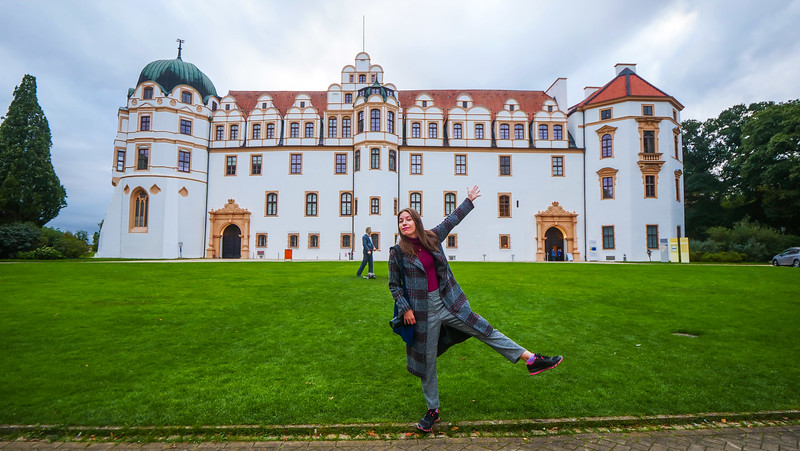
Our first stop of the day was one of the town’s main attractions, Celle Castle. This is a medieval fortress-turned-castle that sits on an island surrounded by a moat.

Now to share a bit of history, an early version of Celle Castle was built around the year 980 in the form of a fortified tower, however, the current castle was first documented in 1315.
Over the centuries Celle Castle grew, evolved, and was redesigned and redecorated into what we see today, which explains the mix of Renaissance architecture and Baroque-style staterooms.
The castle suffered severe damage and fell into disrepair during the Thirty Years’ War, however, Celle Castle has since been restored to its former glory and today visitors can explore the castle’s history through a range of exhibits, including Renaissance and Baroque furniture, artwork, and other artefacts from its past.
I was really amused by the fact that we got to wear slippers as we visited certain rooms in the castle.
We actually ended up joining a tour for part of the castle visit, because it’s the only way to gain access to certain parts of the building like the chapel, which is stunning.


The castle chapel is pretty special because it’s the only religious building north of the Alps with completely preserved Renaissance interiors.
You can only view it from behind a glass barrier in order to preserve it, but it was a real highlight and worth the visit.

Explore Celle’s Half-Timbered Houses
After visiting the castle, we continued towards the old town which is renowned for its medieval timbered houses.
In fact, Celle has the densest concentration of them! Nowhere else in all of Germany or even Europe, can you find so many timbered buildings so close together without any gaps in between.


Walking through Celle’s old town is essentially like stepping into a fairy tale. The Old Town dates back to the Middle Ages, and visitors can explore the town’s history by walking along its cobblestone streets and admiring the beautiful architecture.


The town’s centre is marked by the 14th-century St. Mary’s Church or Stadtkirche St. Marien, which is an excellent example of North German brick Gothic architecture.
Also, many of these houses have narrow passages that lead to tiny courtyards, which makes it feel like you’re stepping into a secret garden.
You could easily spend a few hours in the old town not only admiring the architecture but also wandering into all sorts of cafes and specialty shops.
Find the Hoppener Haus
If there’s one building you need to visit in Celle’s old town it’s Hoppener Haus. This is the most famous half-timbered house located in the heart of Celle’s Old Town.
The house dates back to 1532 and it has six stories, each one protruding slightly more than the one below. It is decorated with all sorts of mythological figures.
We took a guided walking tour and our guide explained that the houses were built smaller on the ground floor because the smaller dimensions resulted in lower taxes. The houses were then made slightly bigger with each additional level as a funny workaround to the law.
Drink at an old pharmacy
One of the stops we made was at Alter Provisor, which is a former 17th-century pharmacy that has been turned into a gift shop.
The building’s beautiful half-timbered façade and historic charm are still visible today, and stepping inside is like taking a trip back in time.
Alter Provisor is well known for an amber-coloured herbal liqueur that has been made for over a hundred years following a highly secret family recipe.

No one really knows what goes into the drink except for a select group of people, however, the spicy herbal schnapps does taste of ginger, honey, cinnamon and probably has other select herbs.

There’s a small courtyard in the back where you can sit down and enjoy a cocktail, hot chocolate, or hot punch. All with a dash of Alter Provisor!
We got to do a fun little tasting; the drink was sweet, but also fiery. This was a really fun experience in Celle, so if you’re in the area it’s definitely worth trying.
Tour a Bauhaus neighbourhood
The Italian Garden is a bit of a misnomer because this place is less a garden and more a residential neighbourhood.
These Bauhaus-style buildings were designed by architect Otto Haesler and built between 1924 and 1926, and the idea was to provide affordable housing for workers and their families.
Haesler’s designs were innovative for their time and incorporated features that were revolutionary in terms of housing design.
For example, his buildings were designed to maximize natural light and ventilation, with large windows and open floor plans that allowed for a more flexible use of space.

The buildings have a very modern look with bright splashes of red and blue that help highlight their cube-like shape. It’s a really interesting place to visit in Celle to see a different side of the city.
One minute you can be walking down a narrow lane surrounded by timber-frame houses, and just a few streets over, you find yourself in a Bauhaus dream.
If you’re interested in Bauhaus architecture, not too far from there you can also visit the Otto Haesler Museum.
Traditional German lunch at Ratskeller
Then for lunch, we went to Ratskeller. This historic restaurant is located in the Altes Rathaus, or Old Town Hall, in the heart of Celle’s old town.
The building itself dates back to the 13th century and has been used for a variety of purposes over the years including as a wine cellar.

The restaurant is accessed via a staircase that leads down to the basement level, and it’s a cosy dining experience where you can enjoy a range of traditional German dishes.
I ordered the venison stew served with cabbage, a puff pastry, a pear and cranberry sauce.
Meanwhile, Sam ordered the Currywurst, which is more of a fast food dish that consists of a steamed and fried sausage seasoned with curry ketchup and served with a side of fries.

For dessert, we enjoyed a delicious panna cotta served with wild berries. It was a good meal and we also enjoyed the dimly-lit and warm ambience.
Stroll through the Französischer Garten
Celle’s French Garden, locally known as Französischer Garten, is a beautiful park located in the heart of the city. The garden’s history dates back to the 17th century when it was first established as a private garden by Duke Georg Wilhelm.
The French Garden features a meticulously manicured landscape inspired by the classic French style with symmetrical paths.

The fountain is surrounded by benches and shaded by trees, making it a great place to relax and take in the beauty of the garden.
Visit the first 24-hour museum
Another thing to do in Celle is to visit the Kunstmuseum, which is the world’s first 24-hour museum!


The idea is that there is something to see here any time of day. The museum’s exterior appearance changes twice a day when the museum’s doors open and close.
The museum features modern and contemporary art from the Robert Simon Collection by day and night.
Eating Raw Roulade
Of course, we couldn’t leave Celle without trying the local dish. That evening, we ate at Thaers, which is technically a sports bar, but they serve one of the town’s specialties: roulade!

Typically, roulade refers to a slice of meat that is rolled with a filling of herbs, spices, and vegetables and then browned in a pan before being braised or roasted.
The difference is that in Celle, this dish is eaten raw!

They take a super think slice of raw beef, it’s stuffed with raw onions, gherkins and mustard, rolled up, and served as is with just a bit of cracked black pepper on top.
The meat was surprisingly tender and it reminded me of the consistency of smoked salmon. I didn’t think I would like it, but it surprised me so I would recommend trying it!
Stay at Althoff Hotel Fürstenhof Celle
You can visit Celle on a day trip or stay overnight to explore a bit more in-depth. During our visit, we stayed at Althoff Hotel Fürstenhof Celle. This is a luxurious five-star hotel located in the heart of Celle, just a short walk from the historic old town.

The hotel is housed in a beautiful neo-Renaissance building that dates back to the late 19th century and has been lovingly restored to its former glory.
Tips and Practical Advice for Visiting Celle

Celle’s Neighbourhoods and What’s Nearby
| Neighbourhood | Why Go | Time from Markt |
|---|---|---|
| Altstadt | Timber-frame maze, boutiques, bars | You’re standing in it |
| Schlossvorstadt | French Garden and Bauhaus loop | 5 min walk |
| Westercelle | Riverscape beer gardens, canoe launch | 8 min by bike |
| Lüneburg Heath | Heather fields, woodland walks, nature park | 15–20 min by car |
| Wienhausen | 13th-century Cistercian convent | 20 min on regional train + 10 min walk |

Getting to Celle and Getting Around
Celle is well connected by rail from the major northern cities. From Hanover it’s a quick hop — direct trains run roughly every 20 minutes and take around 30–35 minutes. Hamburg to Celle is direct and takes about an hour, which makes a day trip genuinely easy in either direction. Berlin is a bit further, with most services taking just over two hours, sometimes with one change. By car, Celle sits right on the A7 motorway, making it a natural stop on any northern Germany road trip.
- By train: Deutsche Bahn runs all the main connections; book ahead on weekends for the best prices
- By car: Celle is right on the A7 motorway, making it a convenient road trip detour through Lower Saxony
- By bike: For slower travel the region has good bike paths and the flat terrain makes it pleasant
Once in town, leave the car behind — the Altstadt is compact and best explored on foot. For the Bauhaus quarter, French Garden, or anything along the river, a bike is ideal. Many hotels provide them for guests and the flat streets make it effortless.

Celle’s Half-Timbered Houses: What to Look For
With more than 400 preserved half-timbered houses, the old town rewards slow wandering. A few things worth paying attention to as you walk:
- Count the storeys: Many houses narrow at the ground floor and widen with each level above — the tax workaround our guide explained at Hoppener Haus played out across the whole street. Look up for carved beams, painted details, and decorative date inscriptions above doors.
- Find the courtyards: The narrow alleyways between houses often lead through to secluded courtyards — some open to the public, some clearly private. It really does feel like stumbling into a hidden world just off the main lane.
- Spot the oldest buildings: Some date from the early 1500s. The dates are carved above the doors if you know to look for them.
The Talking Lampposts of Hoppener Haus
Stand directly across from Hoppener Haus for more than a minute and something odd happens: the streetlamps start talking. Two lampposts positioned opposite the house are wired to speak — reciting local anecdotes, historical fragments, and the odd bit of dry humour to passersby who happen to be standing nearby when they trigger. It’s a small, slightly surreal detail that most visitors walk straight past, since nothing about a lamppost suggests it has anything to say. The idea plays on Celle’s habit of layering the unexpected into its most photographed corners, the same instinct that put Bauhaus cubes a few streets from six-hundred-year-old timber frames.
If you’re photographing Hoppener Haus and the lampposts start up, it’s worth pausing rather than moving on — the commentary rotates, so a second visit later in the day can turn up a different anecdote than the one you caught that morning.
Find the Hoppener Haus
This section intentionally left as originally published — see note.

What to Eat and Drink in Celle
Classic Celle Bites
- Raw roulade: As described above, this one divides people, but if you’re at all curious it’s worth ordering at Thaers. The raw beef is paper-thin and surprisingly tender — the mustard, onions, and gherkins give it a brightness that cuts through the richness in a way I wasn’t expecting. I didn’t think I’d like it either.
- Venison stew: If you’re visiting in autumn, this is peak game season and the slow-cooked stew at Ratskeller is the version to try. It pairs well with a local Dunkelbier or a glass of red wine.
- Welfenspeise: A creamy, eggy pudding associated with Lower Saxony — named after the House of Welf, a noble family connected to the region. If you see it on a menu, it’s worth ordering.
Local Drinks
- Alter Provisor schnapps: The herbal liqueur is a genuine must — sweet, fiery, and the courtyard setting makes the whole thing feel a bit ceremonial. Even if you’re not normally a spirits person, it’s a good story with a small glass.
- Local craft beers: Lower Saxony has a strong brewing tradition and unfiltered local taps appear at Ratskeller and the river beer gardens in summer.
- Kaffee und Kuchen: Germany takes the afternoon coffee-and-cake ritual seriously and Celle’s Old Town cafés deliver on it. Apple cake, Black Forest torte, whatever is freshest — this is not the moment to skip dessert.
Celle’s Two Historic Spirits: Alter Provisor and Ratzeputz
Alter Provisor gets most of the attention, but it isn’t Celle’s only claim to a bottle. Since 1877, a separate family distillery, C.W. Baland & Langebartels, has been producing Ratzeputz just outside the old town — a fiery, ginger-forward spirit with a much higher proof than the amber liqueur served at the pharmacy-turned-shop. Where Alter Provisor leans sweet and herbal, Ratzeputz is sharper and more medicinal, built around fresh ginger root and meant to be drunk ice-cold. Locals sometimes mix the two spirits together into a drink nicknamed the “108er,” a nod to the combined alcohol percentage of the pair.
The two traditions grew up independently and are still sold separately today — Ratzeputz is now produced under licence outside Celle, though its roots and its name stay firmly tied to the town. If you’re bringing a bottle home as a souvenir and want something with more of a kick than Alter Provisor, this is the one to look for; regional heath shops and spirits retailers around the Altstadt tend to stock both side by side.

More Things to Do in Celle
- Visit the Landgestüt Celle (State Stud): Founded in 1735, this working stud farm is one of the oldest in Europe and central to the history of the Hanoverian horse breed. Open year-round for guided visits; the Hengstparade (stallion parade) returned in 2025 after a multi-year hiatus, drawing crowds for the stud’s anniversary celebrations. Dates move around, so check the Landgestüt’s own calendar before planning a trip around it — this is one event worth confirming close to your travel dates rather than assuming it’s on.
- Visit the Bomann Museum: Regional history, folk culture, and rotating exhibits — a good option on a rainy afternoon.
- See the Synagogue: One of the few in Germany to survive the Second World War intact, Celle’s 18th-century synagogue now houses a small museum and memorial. It’s worth the visit for anyone interested in the history of Jewish life in northern Germany.
- The Saturday market on Schlossplatz: Local cheeses, sausages, and honey from nearby heath farms. Worth timing your visit around if you can.
- The Aller River: The meadows and parks along the riverbank are peaceful and good for a long walk or a picnic. Canoes can be hired from the Westercelle bank in summer.
Bergen-Belsen: A Short, Sobering Trip from Celle
It’s easy to spend a whole trip in Celle without realizing how close you are to Bergen-Belsen, one of the most significant Holocaust memorial sites in Germany. The former camp and its documentation centre sit roughly 25 kilometres north of Celle, about a 25 to 30 minute drive, in a quiet stretch of the southern Lüneburg Heath. Entry is free, and the memorial recommends setting aside at least two and a half hours to see the exhibition and walk the grounds properly — this isn’t a stop to squeeze between other plans.
It’s a heavy visit, and a different register entirely from the half-timbered streets and schnapps tastings that fill the rest of a Celle itinerary. But for travellers with a car and a spare afternoon, it’s a meaningful way to round out a trip to this part of Lower Saxony — the region’s postcard charm and its darker twentieth-century history sit only a short drive apart.

A Sample Day in Celle
If you have one full day, here’s roughly how we’d structure it:
Morning:
- Coffee and cake at a café in the Old Town to ease in slowly
- Guided tour of Celle Castle — book the guided option rather than self-guided, since the chapel is only accessible that way. Tours are primarily in German; if you’d prefer English, private tours can be arranged in advance through the castle. The castle is closed on Mondays.
Midday:
- Wander the timber-frame streets at your own pace — save time to peer down the narrow alleys between houses
- Lunch at Ratskeller or a riverside café
Afternoon:
- Alter Provisor schnapps tasting and a browse through the shop
- Stroll through the Bauhaus quarter and the Französischer Garten
Evening:
- Dinner at Thaers for the raw roulade
- Evening walk along the Aller River, or a look at the Kunstmuseum after dark when the façade does its thing
Where to Stay in Celle
We stayed at the Althoff Hotel Fürstenhof Celle and it was a lovely base — beautifully restored neo-Renaissance building right by the old town, indoor pool and spa, and the kind of service that makes you want to take your time over breakfast. It’s a genuine splurge and worth it if the budget allows. Great for honeymooners or couples marking a special occasion.
For those looking at other options:
- Hotel Caroline Mathilde — a well-regarded 4-star property with an indoor pool, sauna, and restaurant, about a 10-minute walk from the old town; a comfortable mid-range alternative to the Fürstenhof, and a good fit for couples who want a bit of spa time built into the trip
- Hampton by Hilton Celle — a modern, dog-friendly 3-star with free hot breakfast and a 24-hour fitness centre, within walking distance of the French Garden; a solid pick for families who want reliable, no-surprises comfort
- IntercityHotel Celle — solid 3-star right by the station with free WiFi and a central location; practical if you’re arriving by train and want to drop bags and walk straight into the old town
- Heidekönig Hotel Celle — a family-run 3-star on the quieter edge of town, well known locally for value and friendly service, with free parking and a restaurant on site; the best fit for budget-conscious travellers or solo backpackers who don’t mind a short walk or bus ride into the centre
Tours & Experiences in Celle
If you’d rather have some of Celle’s history unpacked for you rather than piecing it together from plaques, a few bookable options are worth considering:
- Private Guided Walking Tour — a private guide walks you through the medieval streets and architecture, covering the town’s Guelph history and its half-timbered houses in more depth than a self-guided wander allows; a good fit for history-minded couples or solo travellers who want context without joining a group
- Private Segway Fun Tour — a couple of hours covering the Aller riverside, the Old Town, and the castle grounds by Segway; a fun, faster-paced option for anyone who’d rather cover more ground with a bit of adrenaline mixed in
- Self-Guided Outdoor Escape Game & Adventure — a smartphone-led mystery that sends you around the Old Town solving clues at your own pace; well suited to families or groups of friends who want a playful way to see the sights together

Seasonal Events Calendar
| Month | Event | Why It’s Worth Planning Around |
|---|---|---|
| Apr (Easter weekend) | Frühlingsmarkt (Spring Market) | Flower stalls and local producers set up around the Altstadt — a pleasant time to visit as the town shakes off winter. |
| Jul–Aug | Summer street festivals and open-air concerts | The Old Town squares come alive on warm evenings; check the local events calendar closer to your visit for what’s on. |
| Autumn (dates vary) | Hengstparade (Stallion Parade), Landgestüt Celle | Hanoverian stallions presented at the State Stud in a display built on centuries of breeding tradition. The parade returned in 2025 after a multi-year hiatus, so treat this as a special event to confirm close to your travel dates rather than an annual certainty — check the Landgestüt’s own calendar before planning around it. |
| Late Nov–23 Dec | Celler Weihnachtsmarkt | A repeat winner of the public online “Best Christmas City” vote — mulled wine, roasted almonds, and gingerbread between illuminated half-timbered façades. One of the best Christmas markets in Lower Saxony. |

Practical Tips for First-Timers
- Opening hours: Shops and many restaurants close early on Sundays, so plan any souvenir shopping for Saturday.
- Best photo spots: Hoppener Haus and Poststraße at golden hour. The wet cobblestones after rain are actually better — colours pop and the reflections are worth having a camera out for.
- Souvenirs: Local honey, artisan ceramics, and a bottle of Alter Provisor or Ratzeputz to bring home. The pharmacy-shop has small gift sizes.
- Free things: Walking the old town, the churches, and the Französischer Garten cost nothing. A lot of what makes Celle special is just wandering.
Celle, Germany: Frequently Asked Questions
Why visit Celle — what makes it special?
Celle is one of those places that keeps surprising you. More than 400 half-timbered houses packed into a walkable old town, a Renaissance-Baroque castle with the only fully preserved Renaissance chapel north of the Alps, a colourful Bauhaus neighbourhood just a few streets away, and distinct food and drink (raw roulade and two separate historic spirits, Alter Provisor and Ratzeputz, among them). It’s compact and unpretentious, which is part of the appeal.
How do I get there and get around?
By rail: about 30–35 minutes from Hanover (trains every 20 minutes), roughly an hour direct from Hamburg, and just over two hours from Berlin. By car, it’s a straightforward exit off the A7. Once in town, walk the Altstadt; rent a bike for the Bauhaus quarter, French Garden, or river paths.
Day trip or overnight — how much time do I need?
A day covers the castle and chapel, the timber-frame lanes, a tasting at Alter Provisor, and the French Garden comfortably. An overnight lets you add the Bauhaus loop, museums, a longer river walk, and an unhurried dinner at Thaers. We stayed one night and felt we’d seen it well without rushing.
What should I know about Celle Castle before I visit?
The moated castle blends Renaissance architecture with Baroque staterooms. The chapel — the only fully preserved Renaissance church interior north of the Alps — is accessible on guided tours only. Self-guided museum entry is around €10 for adults (concessions €7); public guided tours are booked separately at the castle counter for a modest supplement and are the only way to see the chapel, the theatre, and the kitchen. Public tours run in German; private English tours can be arranged in advance, typically for an additional fee on top of admission. The castle is closed on Mondays.
Where are the best half-timbered house views?
Start around the Stadtkirche St. Marien and fan out along Poststraße and the market lanes. Hoppener Haus (1532) is the standout: six stories with each level overhanging the one below, carved figures and painted beams — and keep an ear out for the talking lampposts across the street. The narrow passages between houses often lead through to quiet courtyards — don’t skip those.
Alter Provisor and Ratzeputz — what are they and can I taste them?
Alter Provisor is a former 17th-century pharmacy turned shop and café, known for a century-old herbal liqueur with a secret recipe — sweet but fiery, with honey, ginger, and cinnamon somewhere in the mix. Tastings are available, and the small courtyard in the back is a lovely spot to sit with a cocktail or a hot chocolate spiked with the house spirit. Ratzeputz is Celle’s other historic spirit, a much stronger ginger schnapps dating to 1877, best served ice-cold and traditionally mixed with Heidegeist into a local favourite called the 108er.
What is the “Italian Garden” Bauhaus neighbourhood?
Despite the name, it’s a residential quarter designed by Otto Haesler between 1924 and 1926 — modernist cubes in bold red and blue, large windows and open floor plans that were genuinely revolutionary for worker housing at the time. A quick walk from the old town, and a good visual contrast to all the medieval timber-framing. The Otto Haesler Museum nearby gives the full story.
What should I eat — and is raw roulade really raw?
Yes, genuinely raw — a paper-thin slice of beef rolled with mustard, raw onions, and gherkins, served as is with cracked black pepper. Try it at Thaers. It’s surprisingly tender and the flavours are bright; I didn’t expect to like it and I did. Also look for the venison stew in autumn at Ratskeller, and the Welfenspeise dessert if you see it on a menu.
Is Celle family-friendly?
Very. The castle has child-friendly interactive exhibits and the slippered rooms go down well. The self-guided outdoor escape game is a good way to keep older kids engaged around the Old Town. The courtyard cafés, river meadows, and flat bike paths work for all ages. On rainy days, the Bomann Museum and the Kunstmuseum both offer shelter with something worth looking at.
When is the best time to visit?
Celle is worthwhile year-round. Spring is peaceful with the market flowers; summer brings open-air concerts and river beer gardens; autumn is the season for game dishes and, when scheduled, the Hengstparade; winter has the Christmas market, a repeat winner of the public “Best Christmas City” vote — lit half-timbered houses, mulled wine, and roasted almonds.
What’s a realistic budget?
Castle entry runs around €10 per adult (concessions €7); cafés and sit-down meals are good value. Many of the best parts of Celle — walking the old town, the churches, the gardens, the river — cost nothing. Cards are widely accepted but carry a little cash for smaller purchases and public facilities. Shops close early on Sundays.
Photo tips and general etiquette?
Poststraße and the Hoppener Haus frontage at golden hour are the classic shots. After rain is genuinely better — the cobblestones reflect everything. In residential alleyways and courtyards, keep it discreet; some passages lead to private homes. In the castle, certain rooms require slippers (they hand them out) and photography rules vary by section — follow the signage.
That should give you a few ideas of things to do in Celle in Northern Germany during your visit!
If this seems like your kind of destination, then you might also enjoy visiting Lüneburg for its medieval charm, exploring Germany’s northernmost wine region of Saale-Unstrut, or going on a road trip through the Black Forest.
Very nice story and beautiful pictures. Thank you!
Hi Audrey, I am so glad I stumbled upon your post about Celle. It looks like a charming and historic town that I would love to visit. Your photos are gorgeous and your writing is captivating. You made me feel like I was there with you, exploring the cobblestone streets, admiring the half-timbered houses, and sampling the local delicacies. You also gave me some useful tips on how to get there, where to stay, and what to see. You have inspired me to add it to my bucket list!
I think Celle sounds like a fascinating place to visit. There are so many historical and cultural attractions, and I’m sure I would have a great time exploring the town. I’m especially interested in visiting the Old Town, the Celle Castle, and the Wilhelm Busch Museum. I’m also a big fan of museums, so I’m sure I would enjoy visiting the Museum of Prehistory and Early History and the Celle Natural History Museum.
Thank you for providing this resourceful content and it is really insightful. Got to know some amazing insights about the content topic. I am really delighted and appreciate the efforts for putting up this topic to the limelight. The Blog topic was very well explained. Thank you so much. Looking forward to consume more of the informational content.
You made me be hungry for german foood!!! Gonna visit Germany again this September to the Munich festival!