
Hiking the Inca Trail is one of those bucket list items for anyone planning a trip to Machu Picchu, and it’s something that I had been contemplating ever since my previous trip to Peru when I took the easy route and rode the train from Cuzco to Aguas Calientes. I knew I wanted to come back and walk the trail one day, and that opportunity presented itself when Sam’s parents decided they would be travelling to Peru. Just like that, the famed Inca Trail quickly worked its way up our travel itinerary!
There are a lot of different trek options out there for anyone considering the Inca Trail; you have a 2-day Inca Trail, the standard 4-day Inca Trail, and even a 10-day hike if you want to tack on Choquequirao, which is considered to be Machu Picchu’s lesser known and far more isolated sister city.
After much debating over which trek to do, we all settled on the 2-day Inca Trail. Since none of us had done anything longer than a 2-day trek before, we figured this one would be relatively easy (not quite!), plus we were also lured by the thought of having a comfortable hotel bed at the end of the walk rather than camping out in tents (I guess my taste in travel is changing).
We joined Action Peru Treks for our hike based on the recommendation of a friend of a friend, and they were amazing! (Seriously one of the best tours I’ve been on to date.)
Our guide, Roxner, met with us in Cuzco a few days before the trek and he made sure we were prepared and knew what to pack.
It was nice having this time to ask questions and go over the details, plus once we got on the trail we felt completely confident in his abilities.
He was knowledgeable, let us set a pace we were comfortable with, made sure that no one got left behind, and he was also there to assist us through the tricky parts.
For anyone considering doing the 2-day Inca Trail, here’s a look at what to expect:
Day 1: Walking the Inca Trail
The first day of the trek started long before the sun came up. We had a 3 a.m. wake up call at the hotel to finish packing our bags for the hike, and then at 4 a.m. our driver came to pick us up and take us all the way to Ollantaytambo where would catch the train heading towards Aguas Calientes.
It was about a 2 hour drive, and since it was still dark out, I took the opportunity to catch up on some much needed sleep.
When we arrived in Ollantaytambo at 6 a.m. and boarded the Peru Rail train, I was surprised to see how much the train had changed since my first visit some 7+ years ago.
Gone were the hard wooden benches, and instead these had been upgraded to plush and comfortable seats. Not only that, but there were also additional windows on the ceiling so that you could enjoy the looming mountains along the way.
We even got complimentary tea and pastries aboard the train. Peru Rail is getting fancy!
We were on the train for about an hour and a half before we reached our stop: Kilometre 104.
This is technically an unscheduled stop, so the guides have to carry special permits in order for their hikers to be let off.
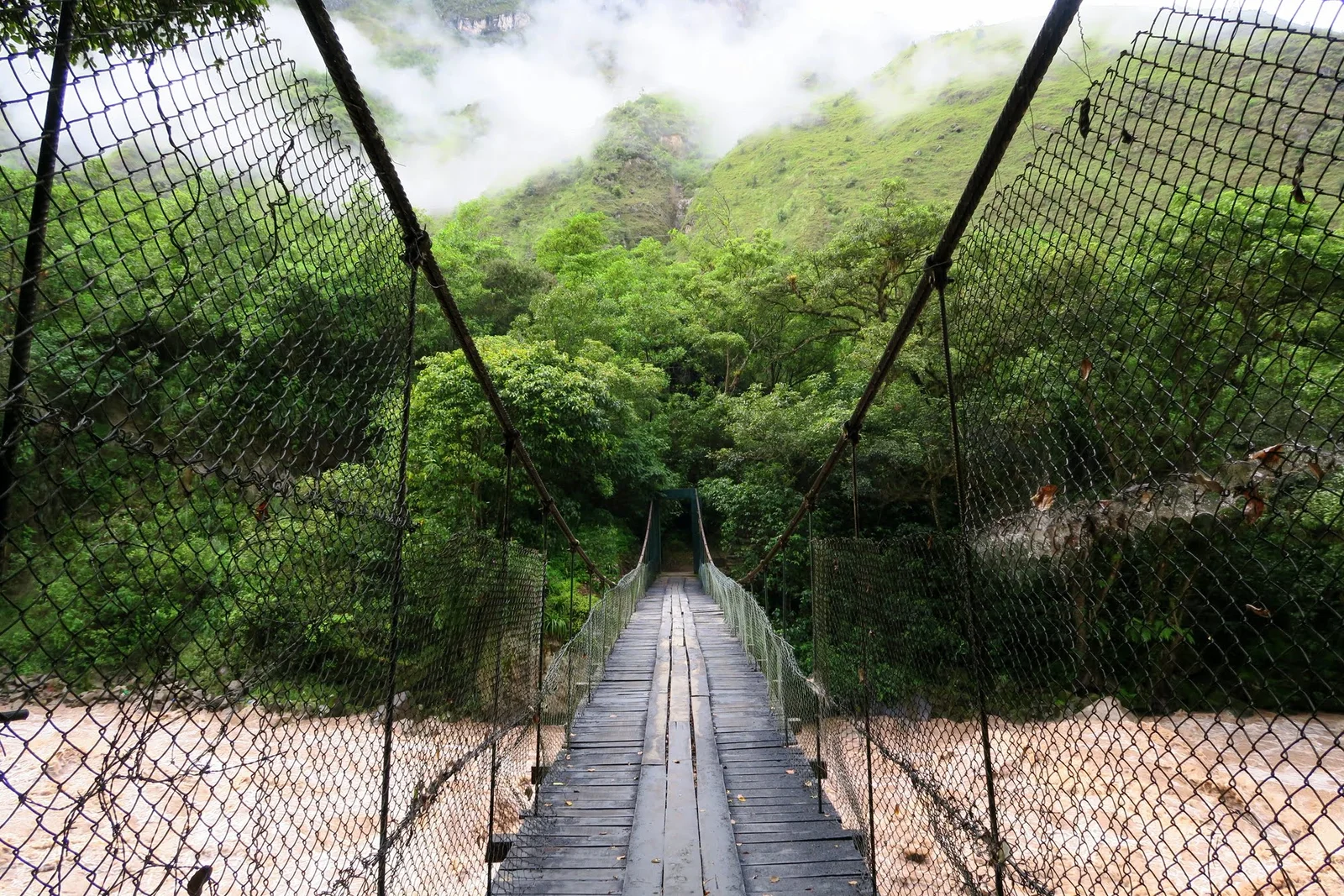
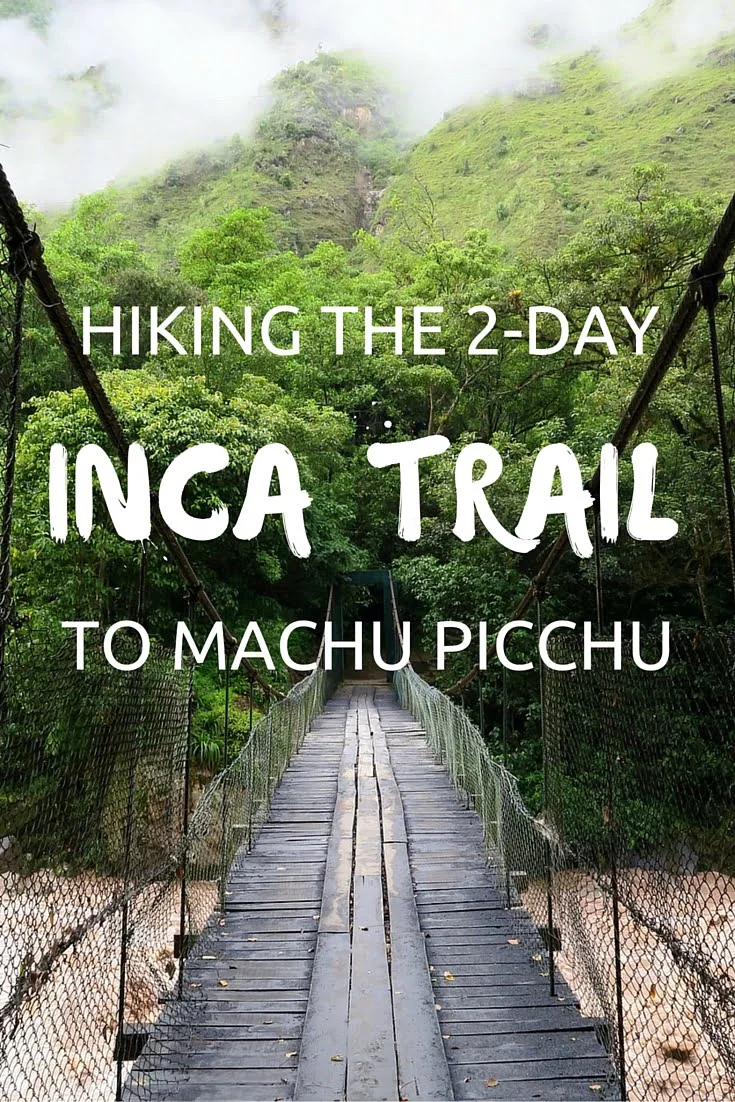
We hopped off the train with our bags in tow and walked down to the shores of the Urubamba River where we were greeted with a wooden bridge leading into the thick jungle and a few clouds hanging in the morning air.
Could you ask for a better welcome to the Inca Trail?
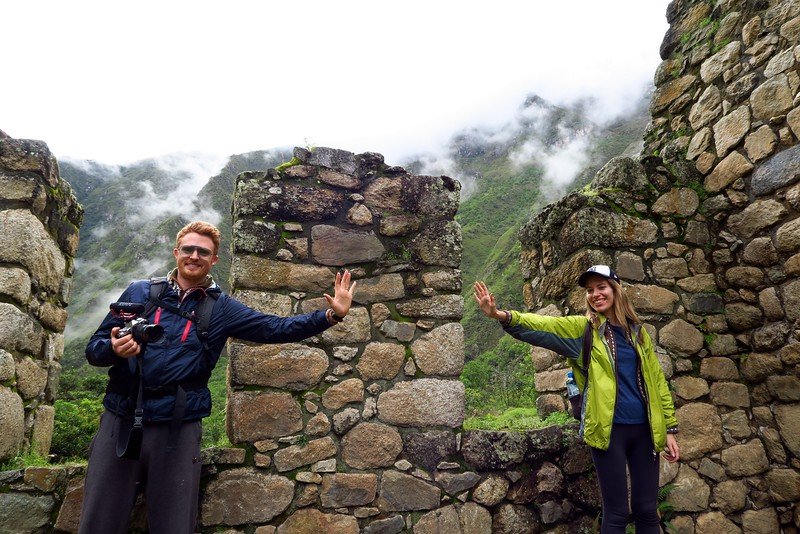
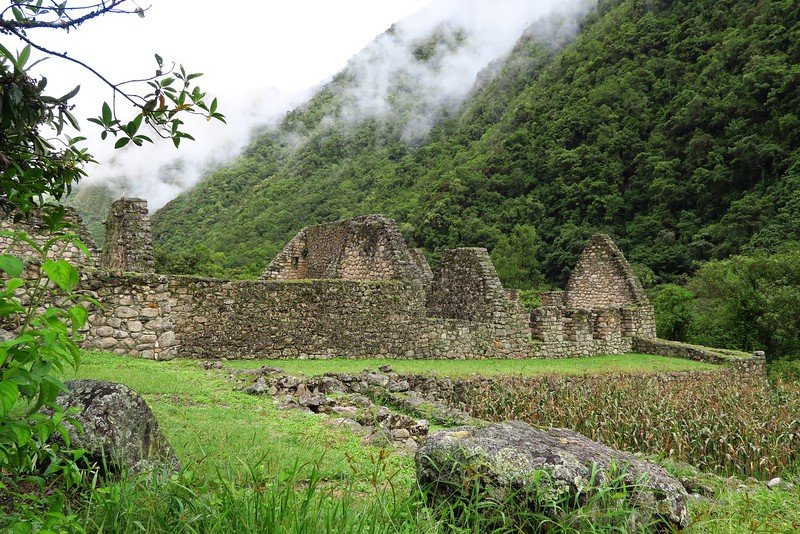
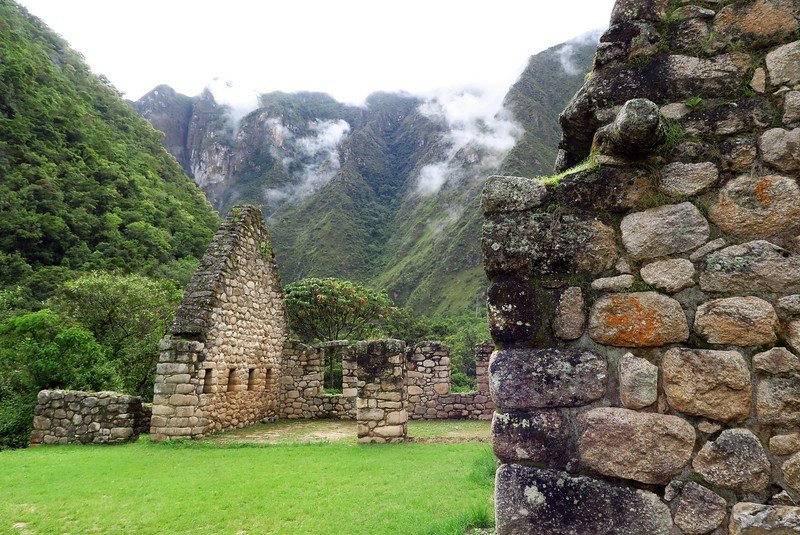
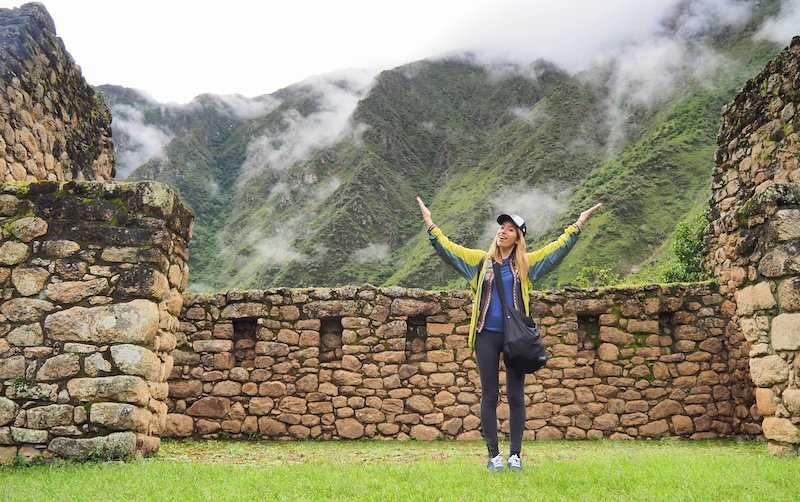
As soon as we checked in to the trail, we came across our first archaeological site of the day: Chachabamba.
This site sits at 2,170 meters and it was one of the last shelters that the Incas used before reaching Machu Picchu. It also operated as a religious and administrative centre.
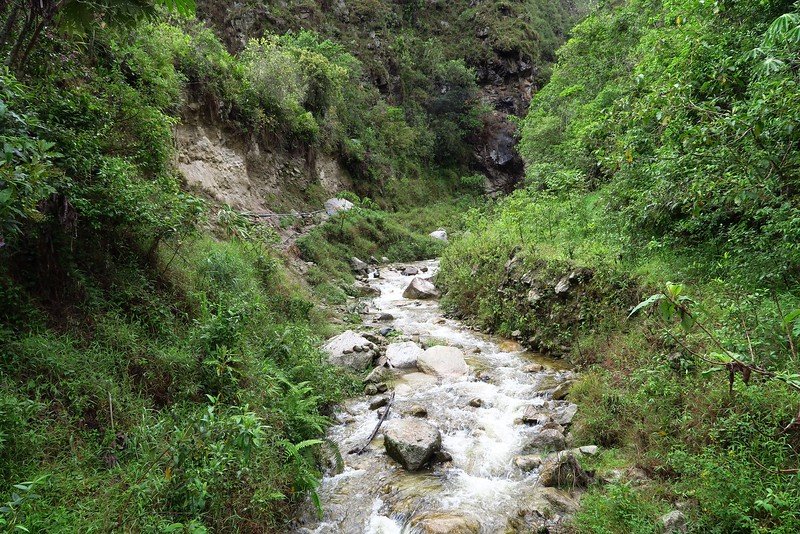
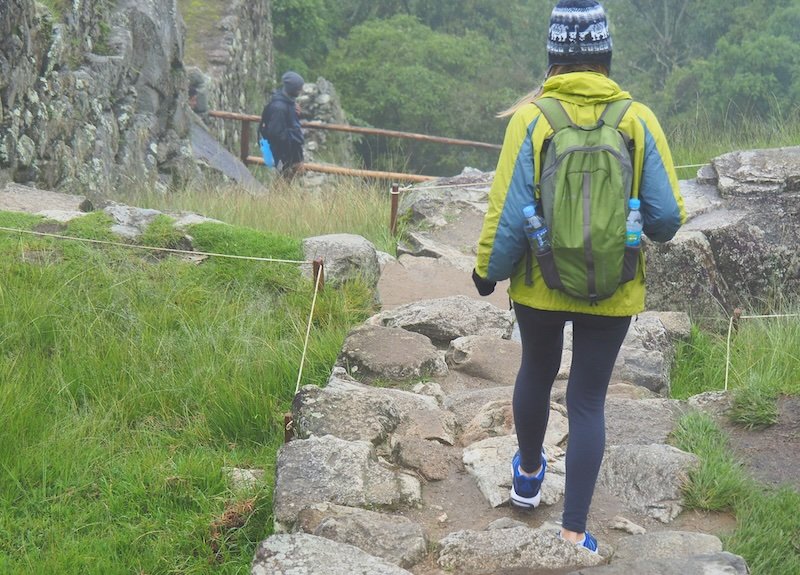
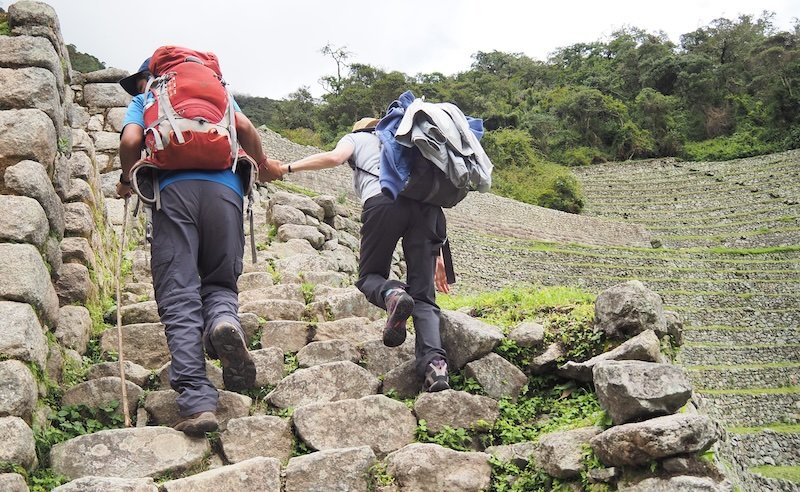
After visiting Chachabamba we began the slow ascent on the Inca Stone steps. The trail was steep for the first 2 hours, but it eventually levelled out (for a few brief stretches, anyway).
During that time we stopped at 2 different shelters where we cooled off in the shade and enjoyed some snacks.
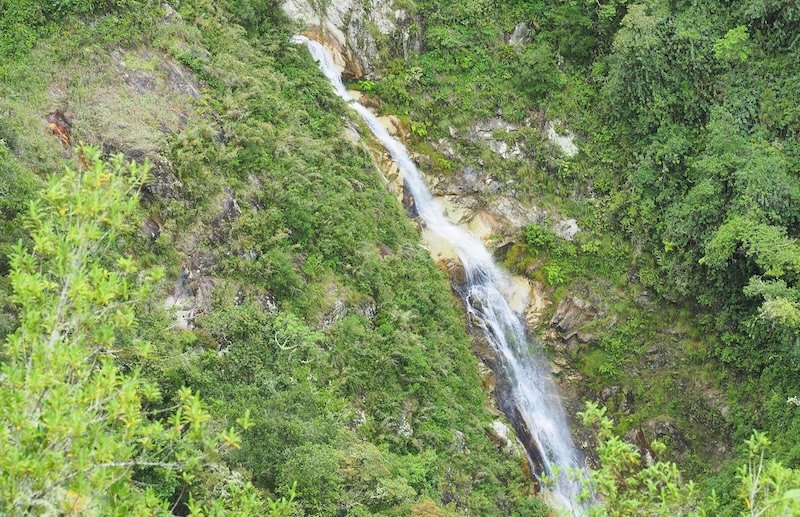
By lunchtime we reached a waterfall and unpacked our boxed lunches which were provided to us by Action Peru Treks.
Inside our lunch boxes we had fried rice with chicken, crackers, bottled water, and lots of fresh fruit. I was so famished at that point in the hike that I could have eaten anything!
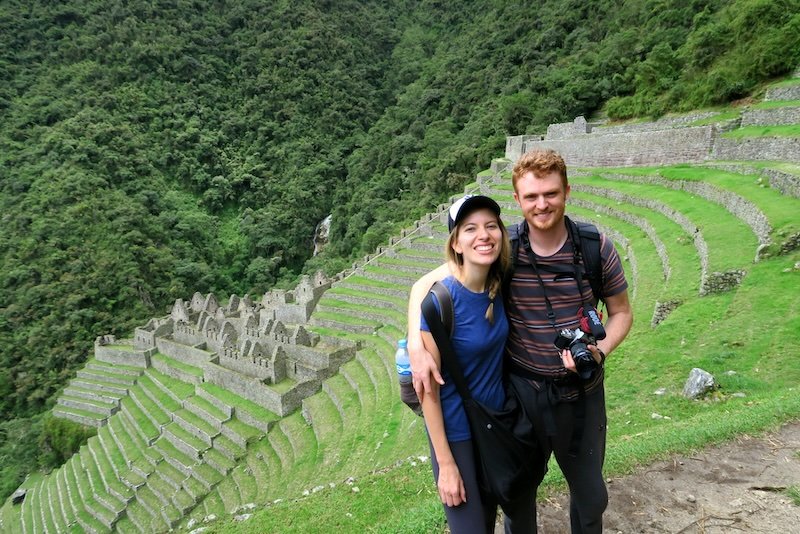
From there we continued on to Wiñay Wayna which sits at 2,650 meters. This was the highlight of the Inca Trail for me!
Wiñay Wayna is one of the most beautiful archeological sites I have ever seen, and I daresay it gives Machu Picchu a good run for its money.
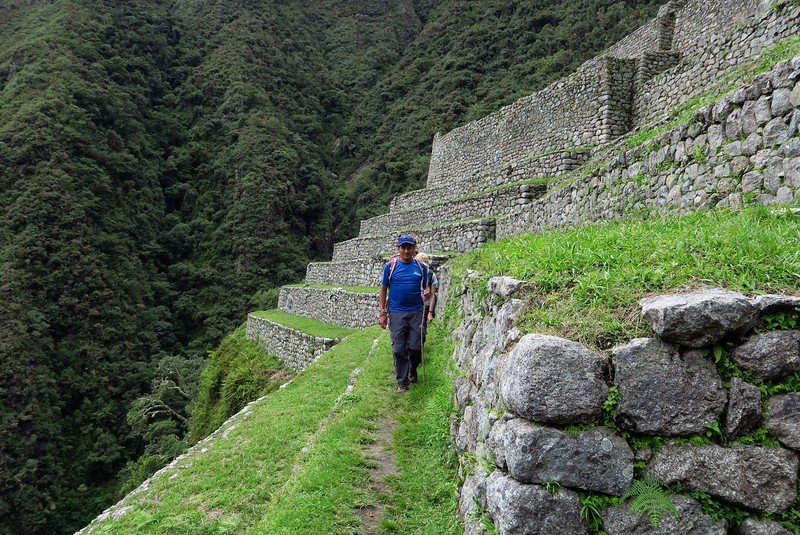
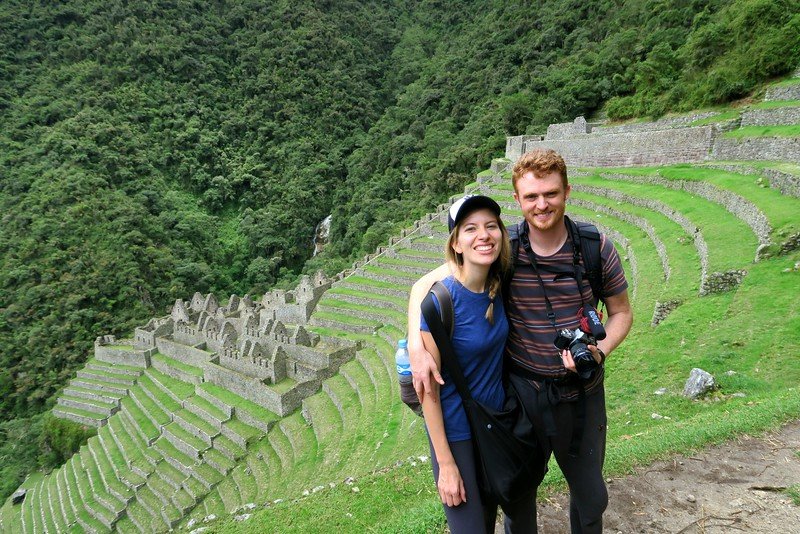
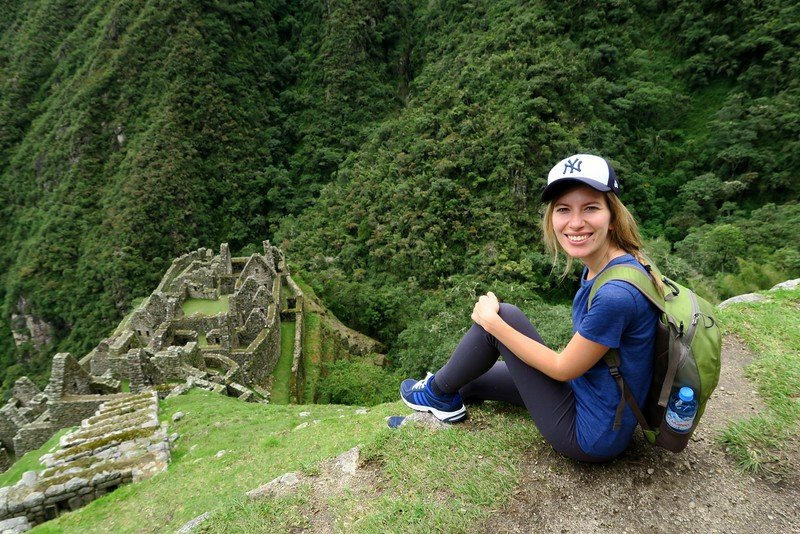
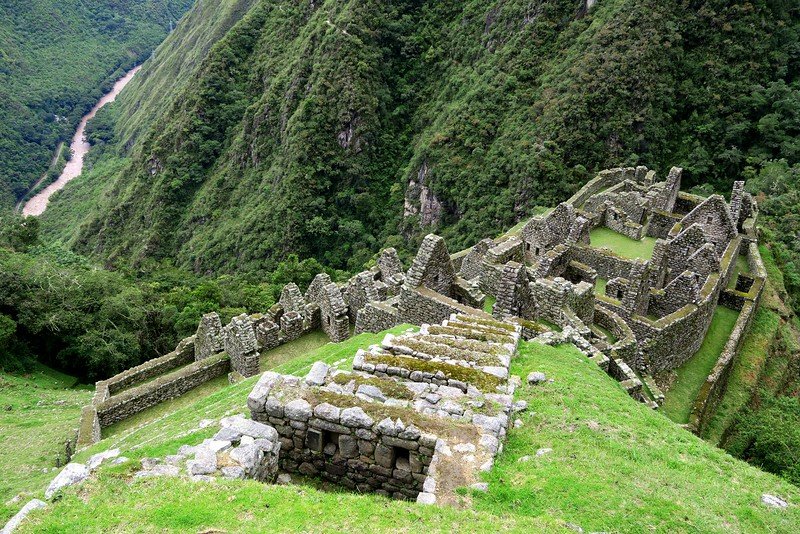
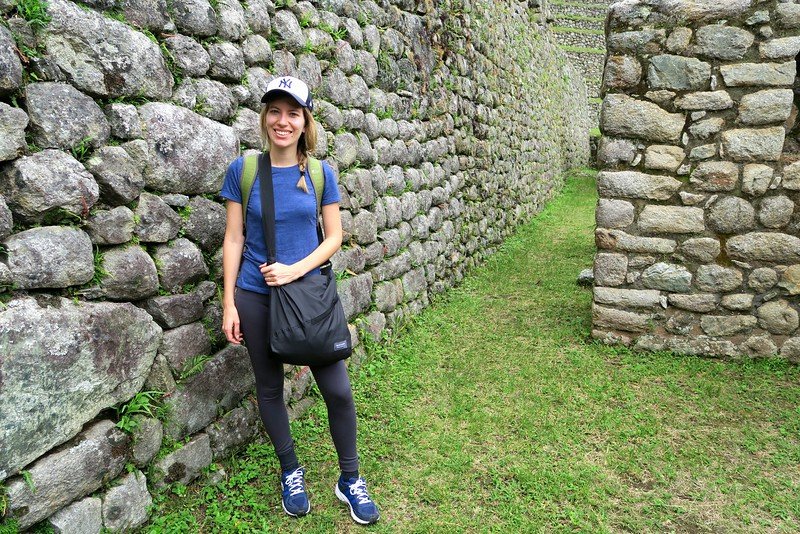
What makes it special is that there is hardly a soul there, plus the terraces are built in a really cool amphitheatre formation that allows you to see the whole area.
These terraces were built to grow different crops and you’ll also find a temple that was dedicated to the rainbow.
We also got to see Intipata in the distance (this is another archaeological site that sits at 2,750 meters), however, we didn’t get to visit since it’s on the other side of the valley and it would have involved a bit of a downhill-uphill detour.
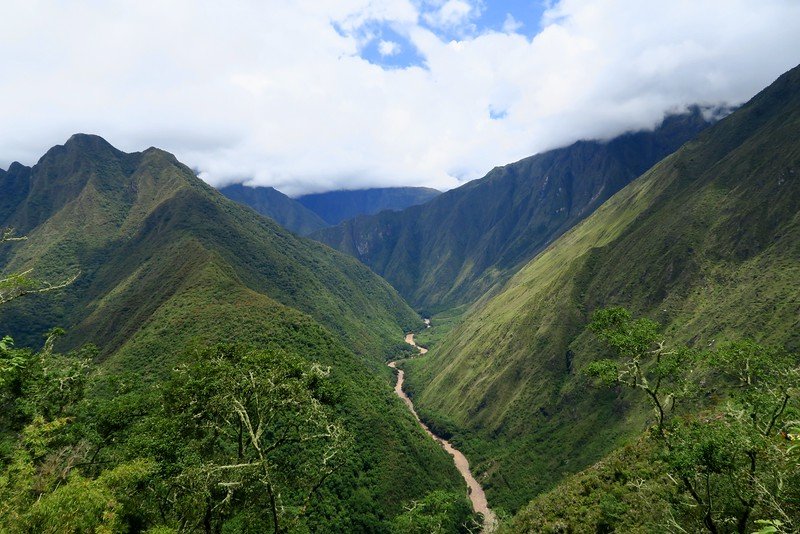
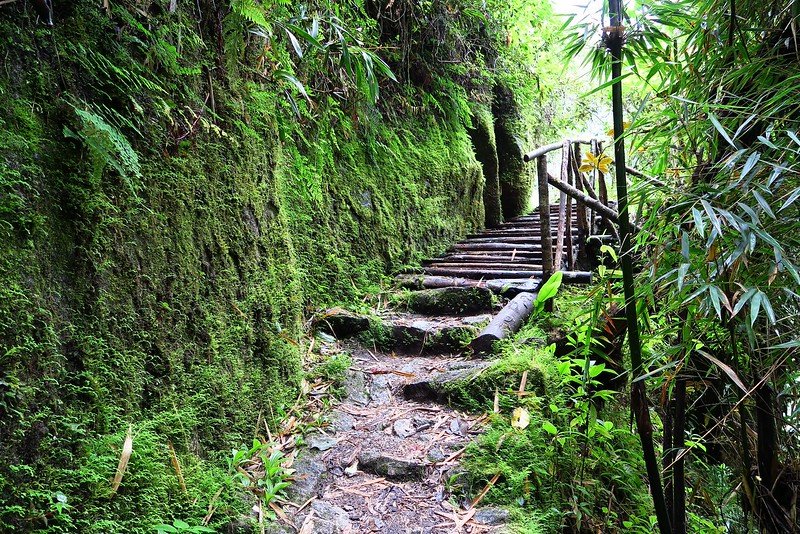
I really enjoyed the section of the trail from the waterfall to Wiñay Wayna because the landscape changed quite drastically.
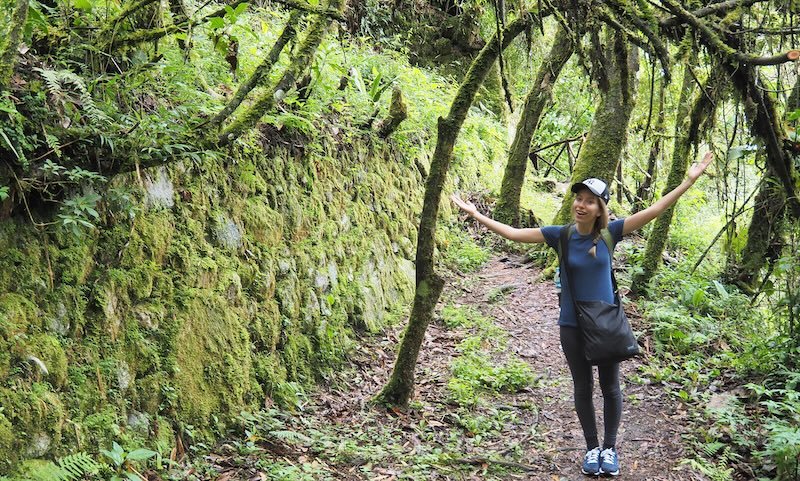
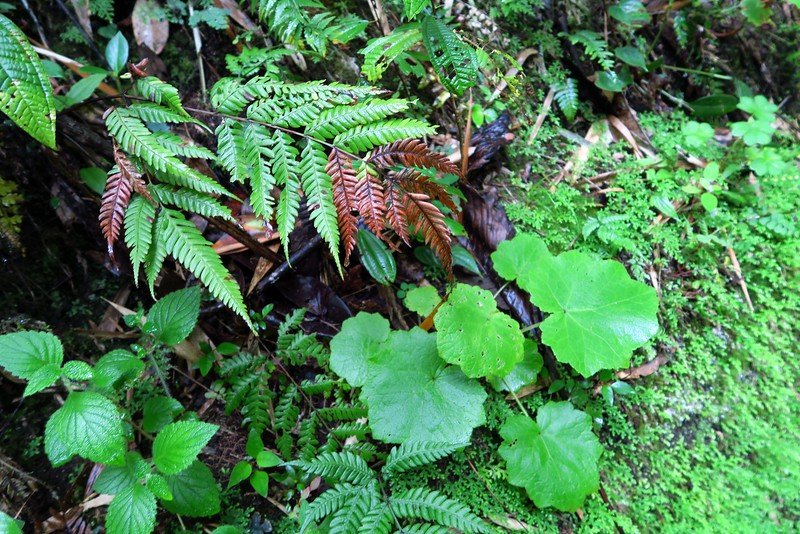
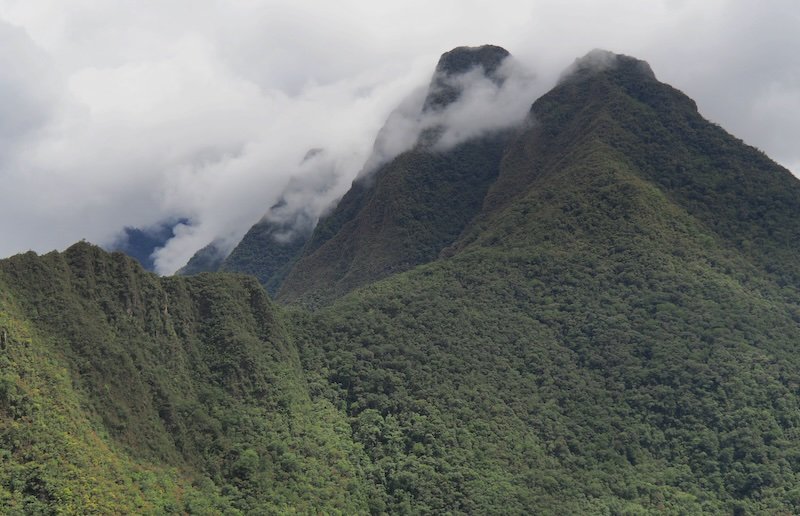
As we trekked closer to the water, the temperatures became cooler, the vegetation became greener, and at times it felt like we were walking through a moss-covered forest.
It was a welcomed change after the hot temperature and dryer landscape we had experienced near the start of our trek.
After visiting Wiñay Wayna we got back on the trail and charged on. Our next landmark on the trail was Intipunku, also known as the Sun Gate, and then after a long day of walking, we were there!
Here our group paused for a few moment to relish the moment: we had our first glimpse of Machu Picchu!
All around us there were fellow hikers high-fiveing, crying, napping on the terraces and taking their first Machu Picchu selfies.
It was a moment none of us will soon forget.
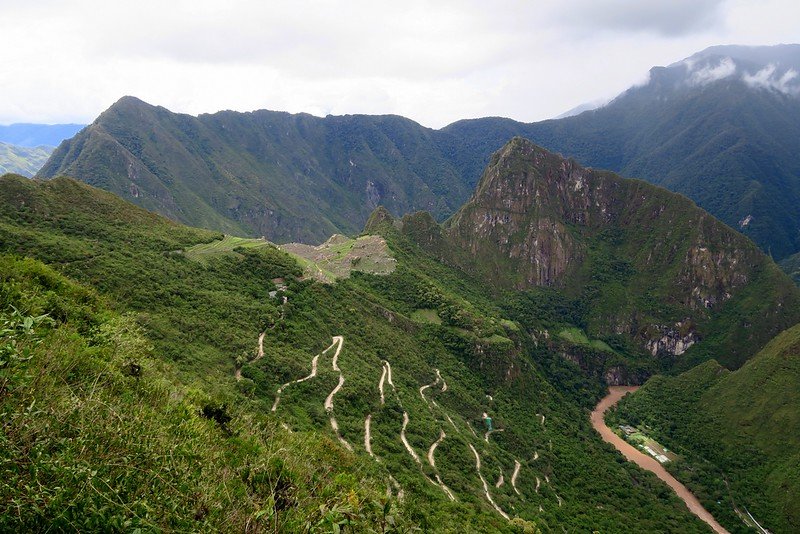
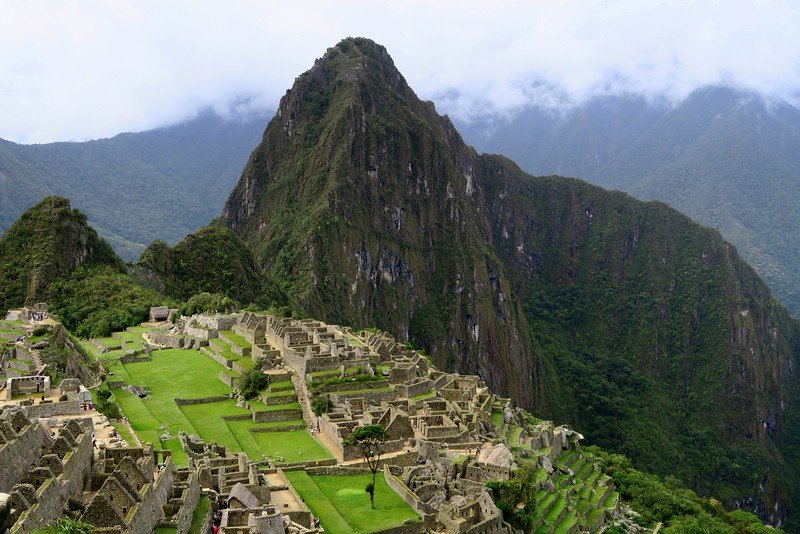
After getting our first glimpse of Machu Picchu, there was still some work left to be done.
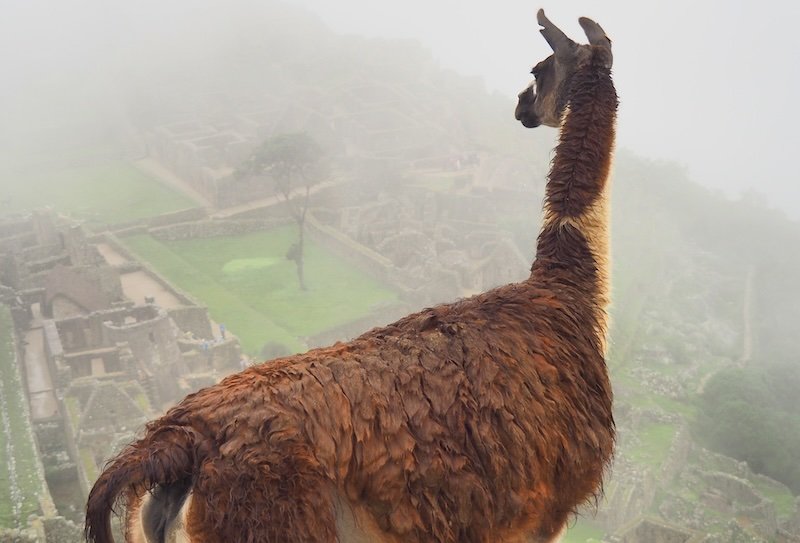
We continued along the same trail and inched closer to the city. I encountered some llamas and had to snap my first #LlamaSelfie, and then once we reached the gate to Machu Picchu, we hopped on the bus and took it down to Aguas Calientes.
That’s right, Machu Picchu would have to wait until the following day.
Day 2: Visiting Machu Picchu
Our second day called for another early wake up call. We were up at 5 a.m., grabbed a quick breakfast at the hotel, and then hightailed it to the bus stop where we caught one of the first buses up the mountain.
The idea had been to watch the sunrise in Machu Picchu, but that was a bit of a bust.
The first few hours were plagued with rolling clouds and light rain, however, by mid-morning things were starting to look up; the rain had stopped and the clouds were slowly starting to lift.
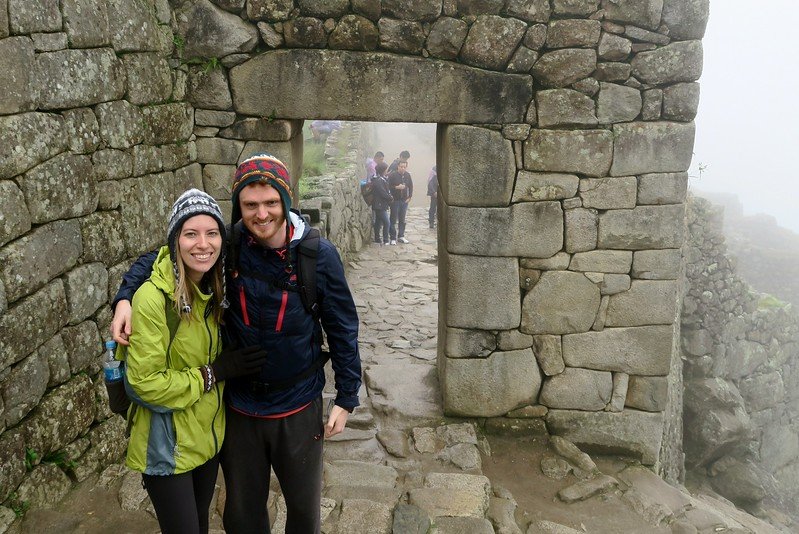
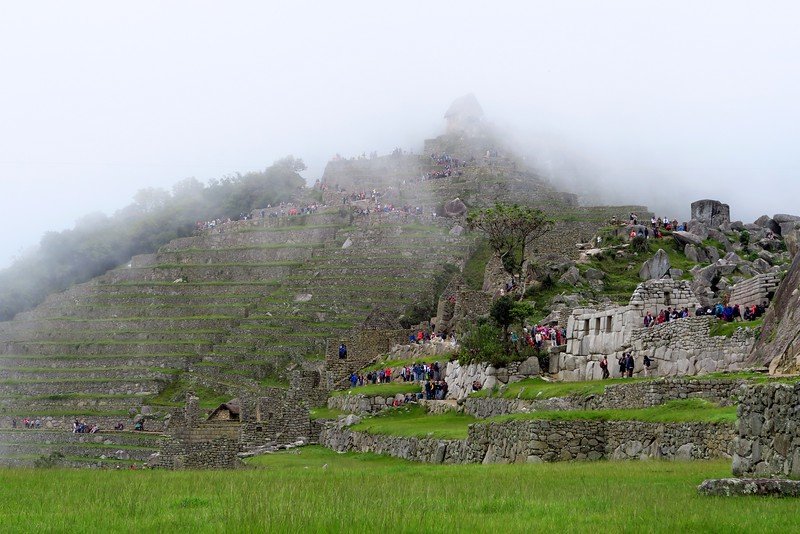

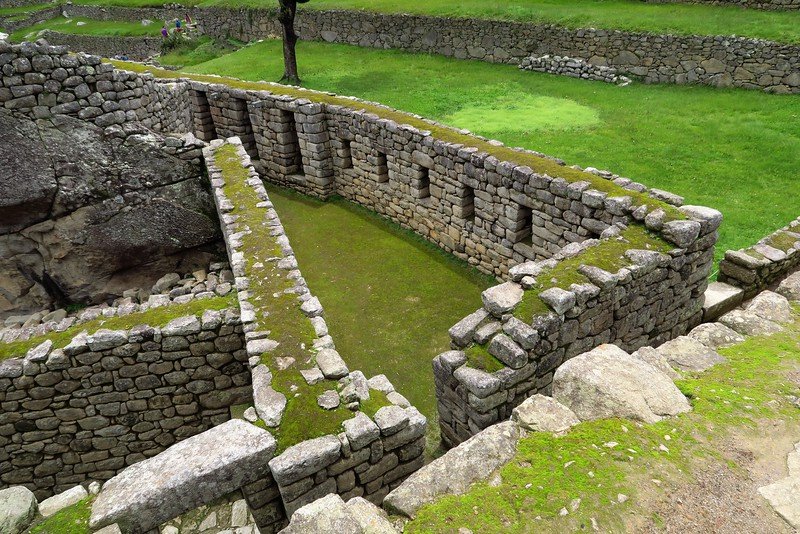
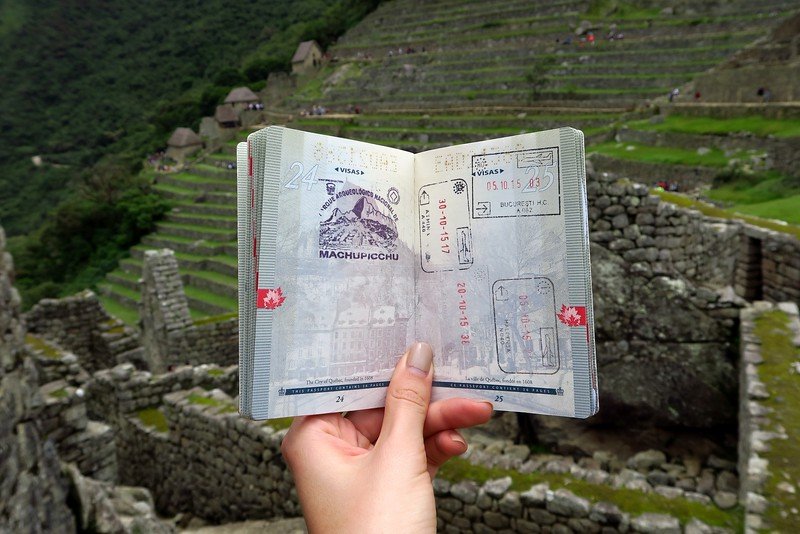
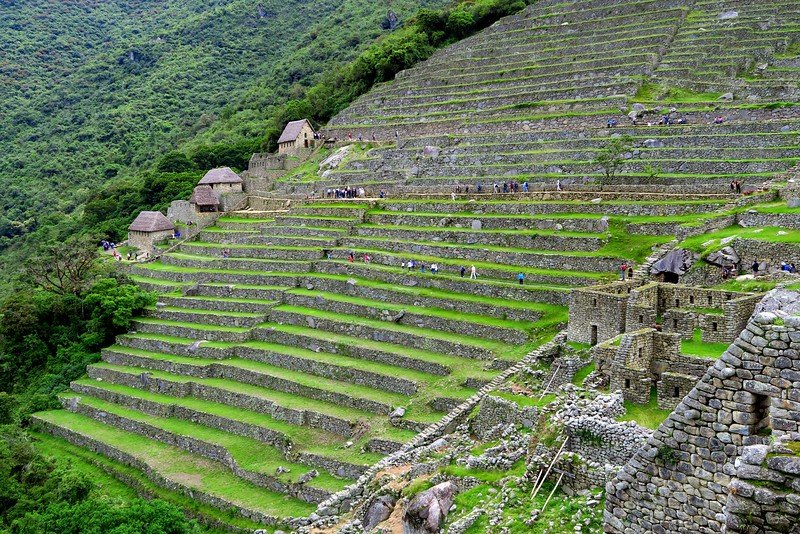
We then got a 3 hour walking tour of the site with our guide. (This is something that I had been too cheap to do the first time I visited, and as a result I hadn’t learned anything that time around.) So if you do decide to visit Machu Picchu, this is something you shouldn’t skimp out on.
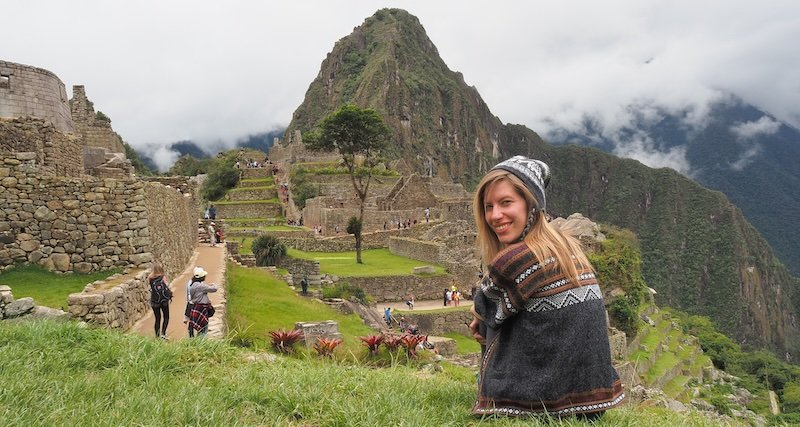
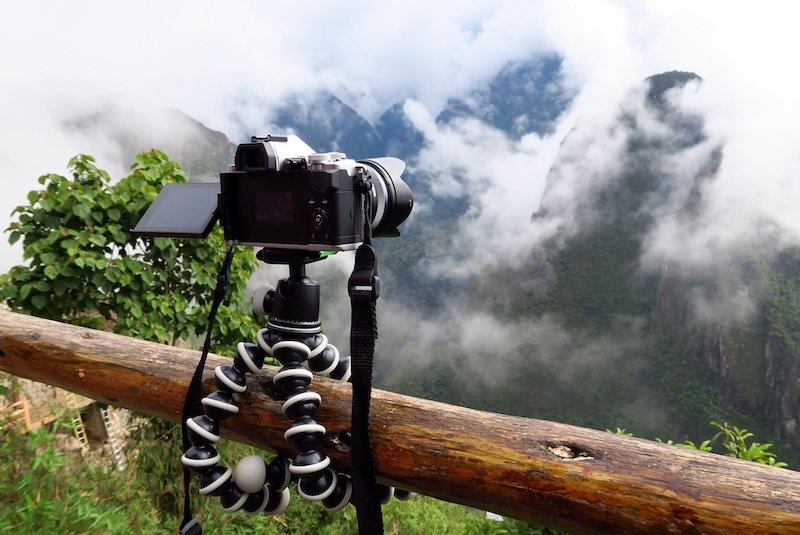
After the tour of the Machu Picchu, we bid our guide farewell and had some free time to roam on our own and visit the places we were interested in. Sam and I ran around doing our silly video antics, and then we took a rest on one of the terraces.
I have to say, Machu Picchu was just as magical the second time around!
So would I recommend hiking the 2-day Inca Trail?
Definitely!
Since the 2-day Inca Trail only requires one full day of walking, I think it’s a good option for people who are relatively fit but don’t want to commit to the longer treks out there.
It’s a beautiful hike with some impressive ruins (I’m looking at you Wiñay Wayna!) and you get to see some cool changes in vegetation along the way.
That being said, it is a full day of physical work, so don’t go into it thinking that it’ll be a walk in the park.
Some sections of the trail have a really steep incline, you’ll be climbing tall stone steps, and there are parts where the ground is quite uneven.
You’ll have to earn your admission to Machu Picchu, but I think it’s worth it.
In retrospect, I do think I could have tackled the longer trail, but maybe that’ll give me a reason to come back a third time one day.
Who knows, maybe next time you’ll find me doing the 10-day trek to Choquequirao!
As one final but very important point, don’t forget to get travel insurance before hitting the Inca Trail!
This should go without saying as you should always be covered when you travel, but even more so when you’re travelling to a place that is quite remote and isolated.
You can see our full 1-month Peru travel itinerary here.
If reading about our experience has you thinking seriously about the 2-day Inca Trail, here’s everything we’d have wanted in one place before we set off — from the booking timeline and permit logistics to what goes in your daypack and how to make Day 2 in Machu Picchu count.
The Road You’re Walking Predates the Trail Itself
What most hikers experience as a single scenic day was, for the Incas, one short stretch of something enormous. The Qhapaq Ñan, or Great Inca Road, once stretched more than 40,000 kilometers across six modern countries, linking the empire’s capital at Cusco to its furthest provinces through desert, jungle, and altitudes that still leave hikers gasping today. There were no pack animals allowed on most of it and no wheels — the network was built and maintained entirely by human labor, with stone paving, drainage canals, and retaining walls engineered to survive centuries of Andean rain. Sections of the road you walk between Chachabamba and the Sun Gate are original Inca stonework, not reconstruction.
The road’s real genius, though, was communication. Relay runners called chasquis were stationed roughly every two to three kilometers at small waystations, sprinting short bursts to hand off messages, knotted-cord quipu records, and small packages to the next runner. A message could reportedly cross hundreds of kilometers in a matter of days — astonishing speed for a mountain empire with no writing system as we’d recognize it. Your porters and guide today are, in a real sense, walking the same profession those runners once did on this exact stretch of road, just at a gentler pace.
Booking Timeline
| When | Do This | Why It Matters | Little Bonus |
|---|---|---|---|
| 6–8 months out | Pick a licensed operator and lock the Short Inca Trail permit (KM 104). Ask about group size, inclusions, and pre-trek briefing. | Permits are capped and sell out — especially May–September. | Ask for a sample day-by-day so you know exactly how they pace KM 104 to the Sun Gate. |
| 4–6 months out | Request Machu Picchu add-ons (Huayna Picchu, Machu Picchu Mountain, Huchuy Picchu) if you want them. | These are separate, time-slotted tickets with limited spots. No tickets sold at the gate — all must be booked in advance at tuboleto.cultura.pe. | Your operator can adjust your Day 2 circuit to reach the add-on gate on time. |
| 6–10 weeks out | Book flights to Cusco, hotels in Cusco and Aguas Calientes (if not included), and airport transfers. | Dry-season availability tightens quickly. | Choose hotels with early breakfast and bag storage. |
| 3–4 weeks out | Start stair training and light hikes with a daypack. Confirm dietary needs and passport details with your operator. | Stairs plus altitude is the short trail’s personality. | Ask for their packing list to compare with this one. |
| 1–2 weeks out | Buy travel insurance with trekking coverage. Gather cash soles for tips, snacks, and bathrooms. | Remote setting and changeable weather; coverage matters. | Screenshot all tickets and train times offline. |
| 3 days out | Acclimatise in Cusco or the Sacred Valley, hydrate, and attend the pre-trek briefing. | A little altitude time makes Day 1 stairs friendlier. | Pick up rubber tips for trekking poles (required if you use them). |

Permits and Tickets: What You Need
| Item | Needed for 2-day? | Who Secures It | Notes |
|---|---|---|---|
| Short Inca Trail permit (KM 104) | Yes | Operator | Name and passport must match exactly — bring the same passport you booked with. |
| Machu Picchu entry (Llaqta) | Yes | Operator | Often bundled with a guided circuit (3 hours). Standard circuits currently run just over 150 soles for foreign adults, with a smaller conservation surcharge added on top — the exact total shifts periodically, so confirm the current figure with your operator or at tuboleto.cultura.pe. No tickets sold at the gate — advance purchase only. |
| Huayna Picchu / Machu Picchu Mountain / Huchuy Picchu | Optional | Operator (on request) | Roughly 200 soles, similarly subject to periodic adjustment. Time-slotted; ask early — these sell out fast. Adjusts Day 2 flow. |
| Train: Ollantaytambo to KM 104 and return | Yes | Operator | KM 104 is an unscheduled stop; only licensed guides can offload passengers. |
| Bus: Aguas Calientes to/from Machu Picchu | Yes | Operator or you | Carry small soles for on-site purchases (bathrooms at the gate, village snacks). |
3-Day Acclimatisation Plan
| Day | Sleep | Easy Wins | Keep It Light |
|---|---|---|---|
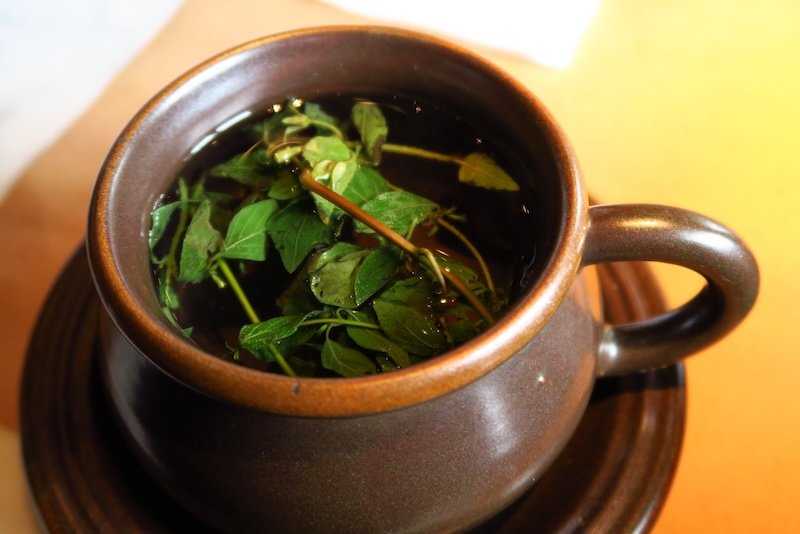
| Day -3 | Cusco (3,400 m) | Stroll San Blas, sip coca tea, early night. | No big hikes yet; let your lungs adjust. |
| Day -2 | Sacred Valley (2,800–2,900 m) | Pisac market and ruins or Ollantaytambo terraces. | Eat carbs and salt, hydrate well. |
| Day -1 | Cusco or Ollantaytambo | Operator briefing, pack daypack, charge batteries. | Avoid late drinks — the 3 a.m. alarm looms. |
Day 1: Hour by Hour
| Time Block | Where | Do This | Elev. and Distance | Little Bonus |
|---|---|---|---|---|
| 04:00–06:00 | Cusco to Ollantaytambo | Van transfer, board PeruRail or Vistadome. | — | Ceiling windows give you a sunrise Andes show. |
| ~07:30 | KM 104 checkpoint | Passport and permit check; quick safety chat. | 2,170 m | Snap the Urubamba and the bridge on arrival. |
| 08:00–09:00 | Chachabamba ruins | Warm-up wander through the riverside site. | +50 m | Early history means a slower heart rate before the stairs start. |
| 09:00–11:00 | Jungle stairs | Steady Inca stone steps; shade breaks every 20–30 mins. | +400–500 m | Micro-sip water and a salty snack at each stop. |
| 11:00–11:30 | Waterfall nook | Boxed lunch and electrolytes. Shoes off, stretch calves. | — | Cold splash on wrists is an instant reset. |
| 11:30–13:00 | Wiñay Wayna terraces | Explore the amphitheatre; climb to the upper terrace for the wide shot. | 2,650 m | Usually few people here — soak it in. This was the highlight of the whole trail for us. |
| 13:00–15:00 | Cloud-forest traverse | Rolling path, orchids, butterflies; one hands-on staircase. | +70 m | Gloves save palms on rough stone. |
| ~15:00–16:00 | Intipunku (Sun Gate) to Guardhouse | First Machu Picchu reveal, then the easy ridge walk for classic angles. | 2,720 m high point | If it’s foggy, give it 10–15 minutes — the clouds often lift. |
| Late afternoon | Exit gate to Aguas Calientes | Bus down, hot shower, early dinner, sleep. | — | Set two alarms for tomorrow. |
Why Wiñay Wayna Looks the Way It Does
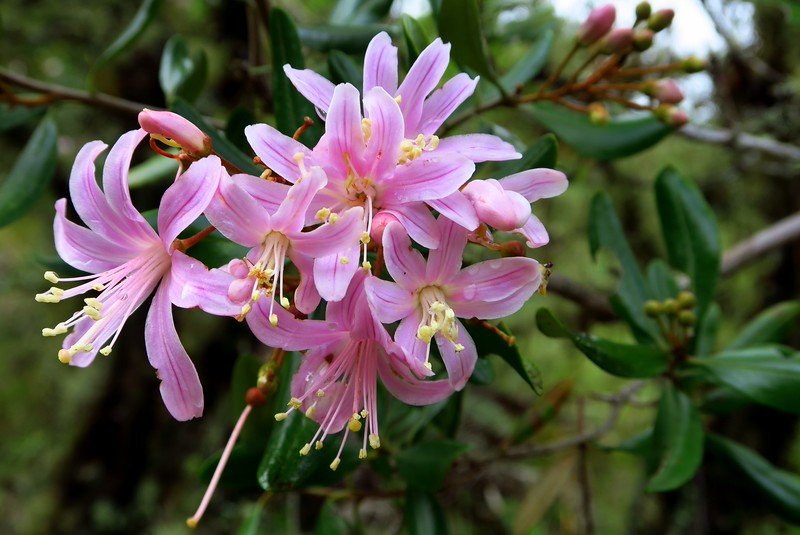
Wiñay Wayna means “forever young” in Quechua, and locals will tell you the name comes from the orchids that bloom there almost year-round rather than from anything about the ruins themselves. But the site earns the name a second way: it’s one of the few Inca settlements on this stretch of trail that was never found and stripped by the Spanish, having stayed hidden under cloud-forest vegetation until the twentieth century. What sets its terraces apart from the more famous ones at Machu Picchu is the curve — where Machu Picchu’s terracing runs in straighter, more geometric lines, Wiñay Wayna’s platforms bend with the contour of the hillside, stacking into the amphitheater shape that makes the site feel so enclosed and quiet when you arrive.
The upper sector still has a working water system: stone channels carry spring water down through a sequence of ceremonial fountains, the same route it’s followed for over 500 years. Archaeologists believe the site combined three functions at once — agricultural terracing for crops that wouldn’t grow at Machu Picchu’s colder elevation, a resting tambo for travelers and porters moving along this section of the Qhapaq Ñan, and a ritual bathing site tied to water worship, since the Incas treated flowing water as sacred rather than simply useful. That layering is part of why it rewards slowing down for the extra half hour, rather than treating it as a photo stop on the way to the Sun Gate.
The Sun Gate Was Never Just a Viewpoint
It’s easy to treat Intipunku as the spot where the trail delivers its payoff photo, but the Incas built it to do a specific job. Every hiker arriving via the classic approach passes through what was once a mandatory checkpoint — the last control point on this section of the Qhapaq Ñan before entering Machu Picchu’s restricted grounds, where guards would have verified who was permitted to continue. Pachacuti, the Inca ruler credited with commissioning much of Machu Picchu, is believed to have ordered its construction in the mid-1400s, and its placement wasn’t arbitrary: on the June solstice, the sunrise aligns precisely with the gate’s opening, an event tied to the Inca agricultural calendar and to ceremonies honoring Inti, the sun god.
None of that history is obvious from the trail itself, which is part of why the moment can feel oddly quiet compared to how much buildup it gets. There’s no plaque, no fanfare — just a stone doorway, a long view down into the citadel, and (often) a crowd of hikers experiencing exactly what pilgrims and messengers on this same road once did: their first sight of the city below, framed by a gate built specifically to frame it.
Day 2: Machu Picchu
| Time Block | Route | Do This | Tips |
|---|---|---|---|
| Pre-dawn | Aguas Calientes to gate | Bus up; bathroom stop outside the entrance. | Bring coins; there are no bathrooms inside the site. |
| 07:00–10:00 | Guided circuit | 3-hour walk through temples, terraces, viewpoints. | One-way circuits; follow your guide’s route. Don’t skip the guide — I skipped it on my first visit and learned almost nothing. |
| 10:00–12:00 | Free time or add-on hike | If you booked Huayna Picchu, Huchuy Picchu or Machu Picchu Mountain, head to the time-slot gate. | Add-ons are steep; sun hat and water are essential. |
| Midday | Exit | Stamp your passport (optional), bus down. | Snacks and food are only allowed outside the main gate. |
| Afternoon to evening | Train and van | Return to Ollantaytambo and Cusco. | Sit left-side for Sacred Valley views on the return. |
Packing: Trail Daypack vs. Overnight Bag
| Item | Daypack (Carry) | Overnight (Train/Hotel) | Notes |
|---|---|---|---|
| Passport and tickets | ✅ | — | Show at KM 104 and Machu Picchu. |
| 2 L water and electrolytes | ✅ | — | Guides sometimes top up; ask at briefing. |
| Rain shell and pack cover | ✅ | — | Showers appear out of nowhere. |
| Sun protection (hat, SPF, sunglasses, lip balm) | ✅ | — | High UV even on cloudy days. |
| Layers (light tee and fleece or puffy) | ✅ | ✅ spare | Warm-cool swings throughout the day. |
| Trail shoes or boots and spare socks | ✅ | ✅ extra pair | Grippy soles beat heavy boots. |
| Snacks (salty and sweet) | ✅ | — | Nuts, bars, gummy chews. |
| Camera or phone and power bank | ✅ | ✅ chargers | Keep electronics in a dry sack if it rains. |
| Poles with rubber tips | Optional | — | Good for knees on stone steps; rubber tips are required. |
| Small first-aid kit (blister kit, ibuprofen) | ✅ | — | Tape hot spots early. |
| Toiletries, flip-flops, clean clothes | — | ✅ | Aguas Calientes creature comforts. |
| Swimwear (hot springs) | — | Optional | Personal preference. |
Food and Water on the Trail
| Moment | Fuel | Hydration |
|---|---|---|
| Breakfast (hotel) | Eggs and carbs (bread, oats, fruit). | 500–750 ml before hitting the trail. |
| Trail (each break) | Handful of nuts, fruit or a bar. | Sip every 10–15 minutes. |
| Lunch (boxed) | Carbs and protein (rice and chicken), fruit. | Add electrolytes post-lunch. |
| Aguas Calientes dinner | Hearty and early; avoid heavy alcohol. | 500–750 ml plus herbal tea. |
| Day 2 morning | Light snack before the bus; bigger meal after the tour. | Carry at least 1 L inside the site. |
Weather and Season
| Season | What You’ll Feel | Pack Emphasis |
|---|---|---|
| May–September (Dry) | Bright sun, cool mornings, dusty steps, most crowded. | Sun protection, light fleece, hydration tablets. |
| April/October (Shoulder) | Mixed clouds and sun, occasional showers, lusher hillsides. | Rain shell, quick-dry layers. |
| November–March (Rainy) | Frequent rain, slippery stone, fewer hikers. February — the Inca Trail closes for maintenance (the citadel remains open). | Full waterproofing, spare socks, trekking poles. |
Safety, Etiquette and Good Habits on the Trail
- Go slowly and consistently. “Despacio, pero sin parar.” Short micro-breaks beat long collapses. It’s a full day and the steps don’t let up.
- Stay on stone. Don’t shortcut switchbacks or climb walls or terraces.
- Pack out everything. Every wrapper, every bottle.
- Poles need rubber tips only — some sections require you to stow them entirely. Listen to your guide.
- Llamas: admire at arm’s length. Llama selfies are fine; llama petting is not (mind the spit).
- Bathrooms are outside the Machu Picchu gate. Plan your circuit accordingly.
- Drones are banned. Tripods and large backpacks may also be restricted at the citadel.
- Tipping: Bring cash soles for your guide and driver. Ask your operator for their customary per-person ranges.
When Plans Change
- Fog at sunrise? We had this on Day 2 — the clouds started to lift by mid-morning. Give it time.
- Light rain? Shell up. Shorter steps and a wider stance on wet stone.
- Gate changes or timing shifts? Follow your guide. Circuits are one-way and the rules evolve.
- Blister starting? Stop and tape it immediately. Don’t push through.

If Permits Are Sold Out: Great Alternatives
| Trek | Vibe | Ends At |
|---|---|---|
| Salkantay (4–5 days) | High-alpine passes to cloud forest; lodges and domes available. | Aguas Calientes (train to Machu Picchu the next day). |
| Lares (3–4 days) | Villages, weaving collectives, hot springs; few crowds. | Often by train to Machu Picchu. |
| Inca Quarry / Cachicata (3 days) | Quarries, lesser-known ruins, Sacred Valley views. | Ollantaytambo, then train. |
| Choquequirao (4–8+ days) | Machu Picchu’s wilder, more isolated sister city. Serious and spectacular. | Separate site — no train link needed. |
Where to Stay: Aguas Calientes and Cusco
Everyone doing the 2-day trail sleeps in Aguas Calientes after Day 1 and needs at least two or three nights in Cusco for acclimatisation beforehand. Here are some good options at both stops, from simple and social to full luxury.
Aguas Calientes (your overnight on the trail):
- Sumaq Machu Picchu Hotel — a 5-star boutique on the banks of the Vilcanota River, regularly named one of South America’s best hotels by Condé Nast Traveler and Travel + Leisure. Spacious rooms, a spa, and a restaurant serving traditional Peruvian cuisine. Worth it for a treat after Day 1. Best for: honeymooners and travelers wanting a splurge finish to the trek.
- Inkaterra Machu Picchu Pueblo Hotel — a luxury eco-retreat with individual casitas tucked into 12 acres of cloud forest just outside town. Orchids, hummingbirds and night-time quiet, plus family-friendly two-suite villas for those traveling with kids. A different experience from a standard hotel.
- El MaPi by Inkaterra — the mid-range option from the Inkaterra family: modern, central, comfortable, and well priced relative to the area. Good for those who want reliability without the full luxury spend. Best for: families and couples wanting a straightforward, well-located base.
Cusco (pre-trek acclimatisation base):
- Aranwa Cusco Boutique Hotel — a 5-star set in a 16th-century mansion declared a National Historic Monument, two blocks from the Plaza de Armas. Particularly notable for the in-room intelligent oxygen system — a practical feature for anyone arriving from lower altitudes and wanting to ease the acclimatisation process. Best for: honeymooners and anyone prioritising comfort during acclimatisation.
- Antigua Casona San Blas — a family-run boutique in the historic San Blas neighbourhood, set in a beautifully preserved historic building. Cosier and more personal than the larger properties. The restaurant is consistently praised and there’s a fireplace courtyard for cool evenings. Best for: couples and solo travelers wanting a quieter, boutique base.
- Pariwana Hostel Cusco — a highly-rated, sociable hostel two minutes from Plaza de Armas, with private rooms as well as dorms, a coworking space, an on-site tour desk, and daily activities like cooking classes. The most budget-friendly of this group and a good pick for solo backpackers wanting to meet other travelers before setting off. Best for: solo travelers and budget-conscious backpackers.
Tours Worth Booking Alongside Your Trek
If you’ve got a few spare days in Cusco before or after the trail, these are worth building into your schedule — all three run as small-group day tours with hotel pickup included.
- Sacred Valley Full-Day Tour — covers Pisac’s ruins and market plus the Ollantaytambo fortress, with most versions adding Chinchero, Moray, and the Maras salt pans. A natural fit for your acclimatisation days, since it’s a lower-altitude, lower-effort day than the trail itself. Best for: history-focused travelers and first-timers wanting Sacred Valley context before the hike.
- Rainbow Mountain (Vinicunca) Day Trip — a demanding early-start hike to the striped mineral slopes at over 5,000 meters, with breakfast and lunch included. Only worth booking once you’re well acclimatised, ideally after the Inca Trail rather than before it. Best for: fit, adventurous travelers with an extra day to spare.
- Cusco Half-Day City Tour (Sacsayhuamán and Q’enqo) — an easier, lower-altitude-effort half day through Sacsayhuamán’s massive stone walls, the Q’enqo ceremonial site, and (often) the Qorikancha temple. A good low-key option to slot into an acclimatisation day without tiring yourself out before the trail. Best for: families and travelers wanting culture without a full-day commitment.
Small Things That Make a Big Difference
- Two alarms — phone and watch.
- Spare socks in your daypack = instant morale at the waterfall break.
- Coins for the bathroom at the citadel gate — there are no card readers there.
- Do Not Disturb on your phone overnight (alarms allowed).
- Share something with your group at the waterfall break. Chocolate, nuts, whatever — it’s good trail magic.
- Pause at the Sun Gate. Breathe. You walked here.

2-Day Inca Trail FAQ
How far and how hard is the 2-day Inca Trail?
Day 1 is roughly 11 km (6.8 miles) from KM 104 to the Sun Gate and on to the Machu Picchu gate, with around 600–700 m (2,000–2,300 ft) of elevation gain — mostly on Inca stone stairs. Day 2 is a guided tour inside Machu Picchu with no major ascent unless you’ve added a mountain. Expect 6–8 hours of moving time on Day 1 at a steady, manageable pace. Don’t go in expecting it to be a gentle walk, but it’s absolutely achievable without prior trekking experience.
Do I need a permit and when should I book?
Yes. The Short Inca Trail uses limited, name-specific permits. Book 4–8 months ahead for dry season (May–September), somewhat less for shoulder months. Your licensed operator secures the permit — your passport details must match exactly on trek day.
What’s the altitude and will I get altitude sickness?
KM 104 is about 2,170 m (7,120 ft); the Sun Gate tops out around 2,720 m (8,924 ft); Machu Picchu sits at about 2,430 m (7,972 ft). Most hikers manage well with 2–3 nights of acclimatisation in Cusco or the Sacred Valley first. Hydrate, take it slow, and drink coca tea.
What’s included in a typical 2-day package?
Usually: permits, licensed guide, KM 104 train, transfers, Machu Picchu entry, Day 1 packed lunch, hotel in Aguas Calientes, and the return train and van. Not typically included: tips, some meals, personal snacks, bathrooms at the gate, and optional mountain add-ons.
What should I carry in my daypack vs. leave for the overnight bag?
Daypack (with you all day): passport, 2 L water, rain shell and pack cover, hat and SPF and sunglasses, light fleece, snacks, first-aid and blister kit, camera or phone and power bank, optional poles with rubber tips, spare socks.
Overnight bag: clean clothes, toiletries, flip-flops, chargers, swimwear if you plan to use the hot springs.
When is the best time to go?
Dry season (May–September) is the sunniest, coolest in the mornings, and the busiest. April and October are shoulder months with greener hillsides and fewer hikers. November to March is the rainy season — slippery stone, fewer people, and spectacular vegetation. The Inca Trail closes for maintenance every February, though the citadel itself remains open.
Are there bathrooms on the trail and inside Machu Picchu?
On Day 1, basic facilities exist at KM 104 and near Wiñay Wayna; otherwise it’s Leave No Trace for nature calls. Inside Machu Picchu, bathrooms are only available outside the main gate — plan your circuit with that in mind.
Can I bring trekking poles and a drone?
Poles are allowed only with rubber tips (metal scratches the stone). Some sections may require you to stow them — follow your guide. Drones are prohibited on the trail and at the citadel. Large tripods and bulky bags may also be restricted at the main gate.
What about food and water — do I need a filter?
Your operator provides a boxed lunch on Day 1 and usually a hotel breakfast on Day 2. Bring your own snacks (salty and sweet) and at least 2 L of water for Day 1. Most groups can refill from operator supplies at breaks; if unsure, pack electrolyte tablets and ask at your pre-trek briefing.
How do the trains and buses work on the 2-day trail?
You take a PeruRail or Vistadome train from Ollantaytambo to the unscheduled KM 104 stop — your guide carries special permits to offload your group. After reaching the Machu Picchu gate on Day 1, you bus down to Aguas Calientes to sleep. On Day 2, you bus up pre-dawn, tour the citadel, then train back to Ollantaytambo and van to Cusco.
Can I add Huayna Picchu or Machu Picchu Mountain?
Yes, but both require separate, time-slotted tickets booked well in advance. Standard Machu Picchu circuits currently run just over 150 soles for foreign adults (plus a smaller conservation surcharge that was added in 2026), and mountain add-ons run roughly 200 soles — these figures shift periodically, so confirm the current total with your operator or at tuboleto.cultura.pe before you pay. Your guide adjusts your Day 2 circuit to reach the gate on time. Both are steep — Huchuy Picchu is the shorter, friendlier option.
How much should I tip and what else do I need to know about safety?
Tip your guide and driver in soles on the return day; ask your operator for their customary per-person ranges. Safety basics: set two alarms, carry an offline passport copy, keep Do Not Disturb on overnight, and tell your guide early if you feel off. Pacing is everything on this trail — steady and slow beats fast and collapsed every time.
Have you hiked the Inca Trail?
Have you done any other hikes around the world that you’d recommend?
This was such a great post. I don’t hear very much about the 2-day option so it is always nice to get another perspective. I have to admit, the hotel must have felt pretty dang nice, huh? The Inca Trail is kinda one of those treks that is always in the back of my mind. Maybe one day I’ll get to do it!
Oh yes! Having a comfortable hotel bed and a hot shower waiting for me at the end of that trek was pretty nice! 😉
Incredible story and kudos for doing that trek! We’ve been to Machu Picchu – the lazy way via the train and bus. We missed all the little adventures along the way but Machu Picchu itself is worth everything. So while I can’t commensurate with you, I can live through your story so thank you for sharing!
The train can be a scenic journey too, especially if you’re in the train carriages that have windows on the ceiling. I hope you enjoyed your visit! 🙂
My husband has always told me that when we go to visit Machu Picchu, we are not allowed to take the train to the top, he wants to HIKE! Luckily we are both in decent shape but I love that you have given me a sneak peek into what the 2-day hike looks like and involves. Good read and I can’t wait to see if you do the 10-day hike someday!
It was so nice looking at your pictures, and this post brought me back to my own 4-day trip down the trail a few years ago. I’m glad you got to experience it!!
Thank you! I bet the 4-day trek was great. I’m sure you guys saw some fascinating ruins along the way.
The Inca Trail trek is something I’ve always wanted to do, and like you said, top of my bucket list! The photos are stunning and make me even more eager to go!
Shona x
I hope you get to do it someday, Shona! It’s a really scenic trek and it’s worth all the panting and sweating. 😉
The terraces in Machu Pichu are quite similar to those rice terraces in the Philippines. Have you been to the Philippines yet? I heard it’s such a paradise for adventurers!
I haven’t been to the Philippines yet, but I have heard of the famed Banaue Rice Terraces. They look spectacular in photos and I’d love to see them one day!
Thanks for sharing. This seems like a good option for me as well as I’ve never done multiple day hikes.
‘Love this post Audrey and the photos are great!
I’ve never done the Inca Trail. In fact, I haven’t really “done” South America and I haven’t a clue really as to why lol!
I have hiked in the Brecon Beacons in Wales. It’s really lovely there. In the Yorkshire Dales, the Peak District & in the Lake District in England. And in the Black Forest in Germany. I’ve also done some hiking in Brittany (France), on the Isle of Skye (Scotland) and on the Isle of Wight (Channel Islands – UK).
So, I’m going to admit my ignorance here – I had no idea you could do shorter Inca Trail hikes!! That is awesome, because the 4-day camping treks do not interest me AT ALL. But a 2-day trip, staying at a hotel overnight? That sounds just about perfect! I will add this to my list.
I had no idea either until we started doing the research! It’s pretty cool, the train stops at Kilometre 104 (which looks like the middle of nowhere!), and then you hop off the train and get right to it. 😉
Hi Audrey,
Great post I always wanted to visit Peru.
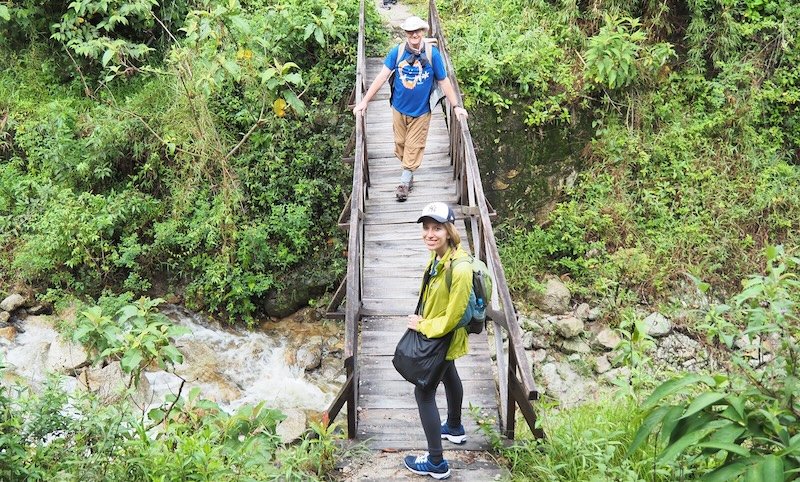
Suspension bridge looks really scary!
Marina
Goosebumps the whole time reading this. The two day trek looks like it would be perfect for me, but let me know if you decide to go back a third time for the longer one — I’ll train! 😉
I absolutely HAVE to go there. Hiking, ruins, llamas? All the best things are there!
I’ll be tackling the 4-day trail in April. I’m super psyched, even moreso after seeing your gorgeous photos. Thanks for sharing!
What a huge achievement! And to make time to do videos too, respect! Beautiful photography!
I did the 4-day trek with Quest Overseas. It was really enjoyable but there is a HORRIBLE uphill bit where you climb these enormous steps for about 2 hours! Also because we were trekking all around South America we had to carry all of our stuff – tents, food, pots and pans…while all of the other hikers were skipping past us with their day bags! I’ve never been so happy to see Machu Picchu (and to get on that fancy train back to Cuzco!) I’d definitely do it again, though. Your post made me miss it!
Lovely, easy read, thanks so much, the 2 day hike sounds very accessible.
I think these are the coolest pictures I’ve seen all day! Awesome share. I’m going to pin it to my oldest daughter, she’s a world traveler but has yet to visit Peru.
Did you feel safe on the 2 day trail and in the towns? I really want to this exact tour but I’ve read things about kidnapping and robbing in Cuzco.
Hi Kristy, I felt very safe both on the Inca Trail and in Cuzco (I have now visited twice). To be honest, I have never heard of kidnappings in either of those places, and I feel the chances of that ever happening would be very very unlikely. If you decide to walk the trail, know that you won’t be alone; you’ll be with a guide and a group of travellers the whole time. As for Cuzco, I can tell you that I have never been hassled there, not even walking around on my own, and if it makes you feel any better there is plenty of police presence on the streets. I hope you’ll still consider visiting Peru! I
Thanks for the informative post! I am going to Peru for 8 days in August and am considering a 2 day Machu Picchu hike. My question for you is how much time did you get to spend at Machu Picchu after the guided tour before you had to head back down to catch the train? What time did you have to leave?
I am looking at different tours and am worried that we will not have enough time to explore the ruins at our own pace before heading back to Cusco after the guided tour portion. Your input is much appreciated!!
Those are some amazing pictures, I would say! I have it on my bucket list of things to do before I die.
Loved reading about your experience. Peru my first international trip 13 years ago, and I loved it. Did you experience any issues with the altitude? I had issues adjusting to the high altitude.
Hey Audrey, it seems you had a great experience trekking the Inca Trail. The 2 days definitely a good option, especially if you do not have much time.
@Rachel Machu Picchu officially closes at 6:00 pm and you will be asked to make for the exit by 5:30 pm
Wow, wonderful place. This trail connects Machu Picchu with the rainforest of Vilcabamba, which was the last capital city of the Incas. This trail has also been used as one of the most important commercial trade trails between the Incas and the rainforest people. This vacation I am planning to go for a tour to Peru with Green Peru Adventures. Hope it will be a great trip. Thanks for sharing your experience.
So glad to see this post! Did you find it necessary to wear hiking boots for the 2 day trail? I don’t have any and wasn’t sure if that was investment I should worry about for a 2 day thing.
Since I was doing the short trek, I just went with a sturdy pair of running shoes with arch support. If this is the only trek you’re doing in South America, then I wouldn’t bother investing in hiking boots – I know they can be quite heavy to lug around. Keep in mind that if you do get a pair, you’ll want to break them in before the trek.
Awesome pictures! My coworker and I are going to Peru in September and she is afraid of heights. She is mostly concerned about the width of the trail and drop offs. Do you think the 2 day hike would be bad for her?
Great post! I am interested in doing the 2 day hike in March. I was wondering if you had to keep your hotel in Cusco during the time you went on your hike? If not, did you just take all of your belongings with you on the hike? Also, did you have to stay in Cusco for a day or two to acclimate to the altitude? I heard the 2 day hike does not hit as high altitudes as the other hikes and does not require the two day stay in Cusco ahead of time. Thank you ahead of time for any input!
What month did you do this in? I see you posted this in February but it looks like the Inca Trail is closed the month of February. I’m trying to figure out what I should expect weather-wise for a trip in May. I’m so glad I found your blogpost, it’s great hearing a review and seeing pictures from someone who did the trail rather than a representative of a company that sells tours. The 2 day hike sounds just my speed 🙂
Hi Riley, I did this trek in January. You’re right, the trail is closed every February for repairs! You can have a look at what to expect weather wise here.
Hi Audrey! My family and I just love you and Sam’s travel videos! We are going to Peru in June for 5 weeks.We are going to visit some missionaries in Lima and to study Spanish. We can’t wait! I am glad to hear y’all are home for some rest. Our senior class is heading to Toronto in a week for their senior trip. I just wanted to say hi. Lord Bless,
Maria ☺️
This is very helpful for planning our trip to Machu Picchu this April! We just climbed camelback mountain in Scottsdale and that was pretty rough. Not sure if you are familiar with it…but would you say this hike is very difficult with the altitude change? We are in pretty good shape, work out regularly but after I struggled on camelback I am hesitant about this hike.
If you’re short on time or short on stamina, the two-day Inca Trail trek might be a good option for you. It gives you a taste of the classic Inca Trail hike but takes half the time and requires less than half the physical exertion — but don’t expect the price to be half that of the classic four-day/three-night hike.
Hi Audrey! Love everything about your work and hope you love doing it. We (6 of us) are slated to do the 2-day short Inca Trail in 2 weeks. We are 50-55 years old and in varying levels of fitness. We’ve been training (although not at elevation) with an expectation that the hike is about 6 miles long with an elevation change of about 2000′. We recently saw something that said the climb was more like 4000′ feet and are getting nervous. Did Sam’s parents trek with you? Did you see other people in our age group on this trek. I’ve seen assessments from easy to moderate to challenging, but a 4000′ climb even in 6 miles is a lot. Most of the write ups and videos by people make it look very doable. Just looking to appropriately set expectations. Thanks and happy travels.
Hi Mark,
It’s nice to hear you’re planning to walk part of the Inca Trail! Yes, we did the trek with Sam’s parents who are both in their early 60s. To be honest, I was a bit worried about it too, but they ended up doing fine. It was just the 4 of us with a guide, so we went at a steady pace but stopped for breaks every chance we could. We even completed the hike ahead of schedule, which surprised me, because I felt we were taking our time. I would say the hardest part of the trek was at the very start of the day when we were going uphill, and then at the very end once we had to climb the steps to the Sun Gate. I think the important part is that you have some time to acclimate in Cuzco, and that you pack super light because otherwise, your pack can wear you down.
Best,
Audrey
Hi Audrey, I am off with some friends to do the 2 day MP trek (very excited)! My concern, which may come across as a girlie question – what did you pack / hike in? I am currently looking into Osprey backpacks (as we will also be doing Humantay lake 1-day hike) and would love to know what you used. We are going in mid-july, but heard the mornings + nights are cold. Love any suggestions!
Hi Sheeta, we each just brought a day pack with the essentials – 2 bottles of water, a packed lunch, sunscreen and 2 warm layers. I wore a t-shirt, leggings, running shoes (with good grip), and a baseball cap for the sun. Aside from that I also had an alpaca sweater and a windbreaker, but those came off pretty early in the day since it warmed up – it’s still nice to have those in case the weather isn’t ideal.
Very good experience in Machu Picchu Katie and Ben and thank you very much for sharing it with us. It is important to remind everyone who is interested in doing this walk that there are two basic tours, 4 days (classic) and 2 days (short). The classic one has to book at least 6 months in advance and the short one 2 months in advance. Of course there are more alternatives to get to Machu Picchu as the beautiful Salkantay Trek that I hope you can do soon.
Greetings from Peru!
Elvis
Machu Picchu has always been on my list of places to go and get lost, but I think it will have to wait for another year as I;m still in Asia and I think June next year looks good. Let’s see; I’ll come back to you when I need tips then.
El viaje fue increíble al Camino Inca . La comida increíble con Vamos Machupicchu, porteros muy amable y trabaja duro, todo el transporte, etc. fue fácil y cómoda. Por no mencionar, nuestro guía Edwin era increíble!!!! Él hizo por encima y más allá de su papel como guía, y sin duda, hizo que la experiencia tan divertido e interesante, y todo perfecto.
http://www.vamosmachupicchu.com/
Hi there, thank you for the great info. Do you recommend a specific tour company?
Thanks!
We went with Action Peru Treks.
Hey Audrey: Can you tell me what time/dates of year this trip to Machu Picchu was? Heading there at the end of next May & trying to gauge weather! Thank you so much for such amazing photos & videos!
Hi Jennifer, we hiked the Inca Trail at the end of January, just before they closed for the month of February.
So is there option to hike Huayna Picchu after the tour of Machu Picchu? And then is the bus down/train back included in this tour and bus to Cusco?
Incredible story! The entry of Machu Picchu tours is very different from March 16 2020. The Machu Picchu new 2021 rules, in addition to the introduction of 3-time slots (shifts) of visiting hours, have added other measures to be taken into account when visiting the Inca city.
I am thinking to go here, but not sure if my daughter who is 10 can handle this hike. Debating if I should wait until she is 12plus. Did you see any kids on the 2 day hike ?
Hi Mai, I did not see any children when I did the hike. You may want to chat with some of the tour operators and see about the minimum age requirements.
Great post! The tips for preparing for the hike were super helpful. I can’t wait to experience the Inca Trail and see Machu Picchu for myself!
This guide is incredibly detailed! I’ve always wanted to hike the Inca Trail, and your tips on what to pack and the best time to go are so helpful. Can you share more about your experience on the trail? Would love to hear about any memorable moments!
I tried checking out the “Hiking the 2-Day Inca Trail to Machu Picchu” piece at ThatBackpacker, but got an internal error when accessing the post—I couldn’t load the full content. Still, even the concept is deeply appealing: two days of trekking that balance challenge and reward, leading to the triumphant Machu Picchu sunrise. For people with limited time but big wander-lust, it looks like a perfect fit—enough adventure to feel you’ve earned the views, but short enough to not be overwhelming.
This guide is incredibly helpful! I’ve always wanted to hike the Inca Trail, and your tips on preparation and what to expect are just what I needed. The packing list is especially useful. Can’t wait to hit the trail and experience the beauty of Machu Picchu!
Great post! The tips for preparing for the hike were super helpful. I can’t wait to experience the Inca Trail and see Machu Picchu for myself!
Amazing post! The information and recommendations for the trek were very useful. Visiting Machu Picchu through the Inca Trail has always been a dream of mine, and this made me even more excited for the adventure!